0

Finals Week 3- Adelaide v Geelong: River Dancing in the Riverbank Stand

river dance

With spring’s warmth kissing our little city on this exquisite Friday evening, where else to meet for this Crows and Cats preliminary final clash, but at the Malcolm Blight statue?

Yes, the man who fostered enduring belief in Corio Bay by taking Geelong to three grand finals, and then with a magical swiftness, scurried in and out of Adelaide, but gifted them successive flags.

I shake Citrus Bob’s hand. We chat, and I ask after his dogs, “How’s Freddie Flintoff and Chloe on Flinders?” I wonder if the real Mr Flintoff has ever ascended the stairs at Young and Jackson to admire the eponymous bar’s nude portrait. No, I decide. That’d distract Fred from his singular, ferocious work on the ground floor.

Standing by Blighty with Bob must be like flopping down on a Trafalgar Square bench with Mick Jagger. Celebrities, past presidents, parents of players, media identities: Bob knows them all. As Patrick Dangerfield’s grandfather, this is no surprise, but Bob’s a star himself. Olympians, octogenarians, off-spinners: all say howdy to Citrus. And we’re not inside the ground yet.

Our seats are in Bay 130 of the Riverbank Stand, next to the Geelong players’ race. Finishing his warm-up Paddy runs down the tunnel. His grandfather waves a hot chip at him. “No thanks,” Paddy nods. He was always respectful.

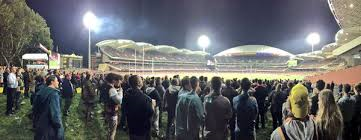
After the curious theatre of the national anthem and the Crows’ warrior stance we’re away. Torrents of sound drown us, like a mallet banging the inside of a 44-gallon drum. Betts and Cameron establish their key theme early with a pair of conjured scores inside two minutes.

It’s hot at Adelaide Oval and the giant ceiling fans are twirling in the Riverbank Stand like the helicopter rotors of Captain Willard’s nightmares, but the Crows fashion a dream start. Cricket Australia would welcome a balmy (barmy) evening such as this for the inaugural Day/Night Ashes Test.

Paddy begins forward and completes a contested grab, to the roaring delight of the Cats who surround me, like a TS Eliot creation. But he pushes the drop-punt to the right, as if he, too, is puzzled by the haunting, inexcusable absence of the Chicken Salt hoarding.

It’s Flemington fast footy. However, the locals are quick by hand and foot, and run to space in ominous formation, while the Cats seem hesitant and lack precision when travelling goalward. Betts registers his second and I ask Citrus, “Has there been a more fun footballer to watch?” Bob has witnessed many decades of this game, and smiles an instant no.

Adelaide dominates the stanza and a message blinks through, not from my man in Amsterdam, but a lad in Largs. It’s raining. What might this mean? There’s not much in it, and I think of my wife’s late grandfather, who would’ve described it as, “three squirts of nanny-goat piss.”

Despite its habitual, incurable dropping, Joel Selwood’s neck continues to play well, and enjoys gushing admiration from the umpires, who offer Secret-Service-murmuring-into-their-lapels levels of protection to the Cats captain’s décolletage.

The third quarter sees the Cats produce some fleeting patches in which they look poised to snatch a canary or two, but the Crows respond and counterattack, if not accurately, at least with psychological potency. The Crouch industrial/ military complex again dominates and as we steadily build a lead, the record crowd begins to sense something special, two decades in the making.

When big Cat Hawkins is caught juggling the ball, like it’s the opening hour of Circus School, I ease into the moment. Then, a mostly subdued Tex Walker curls one through from just inside the boundary immediately in front of our bay, and our collective ecstasy finally commences. The Cats fans are gracious, if resigned. A Mexican wave does a few rippling circuits and once the demons of 1993 have vaporised, throaty baritones belt though the Crows song.

With the siren, I feel a couple of hot tears, and wonder at the berserk week ahead. My phone pings a message from Louisville, Kentucky, and then one from Harrow in London. I thank Citrus Bob for a great night. He’s going down to the Geelong rooms to see his grandson.

The world’s a shadowy, sometimes unknowable place, but right now Adelaide’s golden.

AO

0

Friday’s for funerals, Saturday’s for brides: Tex, Don and Charlie

tex

As an unreconstructed country boy, I love a stubby holder. So, last night at Adelaide’s premier live music pub, the Gov, my pace accelerated as I approached the merchandise table.

T-shirts. CDs. Vinyl. Yes, yes. What’s this? Coffee mugs. Fair enough, but where’s the stubby holders? Then I saw it. A linen rectangle. A Tex, Don and Charlie tea towel. Ah, my first ironic tea towel. I considered. I could, I guess, use it to dry my Wagga Wagga souvenir spoon (ironically purchased too).

Tex Perkins has a massive voice, an instrument of booming sonics and attack. Doubtless, others could tell me if it’s a baritone or bass, but I do know the timbre is entrancing. If human voices can possess a narrative then this one plots panther danger, underworld trickery and tropical heat. It reminds me of Captain Beefheart, and those monochrome images of Bikini Atoll or Maralinga nuclear blasts. When singing, he doesn’t adopt the central personas so much as become possessed by them.

Fittingly, we’re in a pub for these are pub tales, and my only regret is we’re not suspended on stools, in a wobbly circle, and nodding over beers at our sage raconteurs. The songs of Tex, Don and Charlie have incontestable gravity and lonely geographies. The music slinks through inner-city grime, but mostly slouches in the dust and dusk north of the Tropic of Capricorn, and owes a debt to the 1950’s and our cheerful beginnings of despair.

Don Walker sits at his keyboard, his silver mane flopping in time, while his voice is a diverse instrument. At its most intimate it absorbs and pacifies, but in the upper register, it can fall into Willie Nelson parody. His gifts are his words and his stories, and in these rests an unrushed economy, and a vernacular deep with hot tears, smiles and snug hearts. Beyond “Flame Trees” he wrote “Harry Was A Bad Bugger.” Don’s an icon.

Phantasms drift about the Gov, and I think of Tom Waits and his tunes, all swarthy menace and ragged swagger. I think of Bruce Dawe and his depictions of rural lives, wrecked. Spinifex and scrub. Lyrical and parched places; ferocious light, sky. There’s landscapes in the soundscape. I think of romping observation, but also agedness and its introspection, prowling upon me.

Into this evening, I imagined Charlie Owen’s guitars. Plaintive acoustic, spiralling lap steel, his elegiac electric. Barely speaking, but with boyish enthusiasm, he paints our stage. With splashes of surf, we move along his removed beach. As if to counter these sparse yarns, and our collective flouting down at the dread, his strings urge the joy of the quiet minutes.

I come away into the windy midnight troubled and exhilarated by cold grey Saturdays; brokenness; Tex’s denim jacket bouncing like a St Kilda uniform; the black and white tableau of a double bassist; mosquito nets; sharks at funerals; Elvis; deliciously tired and unfussy drumming; eulogies; paychecks and gratitude.

spinifex


3

Crows v Giants- Row G’s phalanx of tepid thermoses

thermos

I cross Victor Richardson Road; bow at the Barrie Robran statue; undergo a cheerfully non-invasive security check, beep my ticket and click through the turnstile; sniff a whiff from the Neil Kerley Bar whose patrons are plainly devouring some Walker Flat yabbies doubtless netted (legally) by Knuckles himself; amble past the Chappell Stand that’s next to the Bradman Pavilion so Ian and the Don can symbolically continue their fiscal disagreements in perpetuity; glance sideways at the Favell/Dansie Indoor Training Centre; consider a swift beer at the David Hookes Terrace Bar, or possibly the Phil Ridings Bar; catch some uncharacteristic clatter coming from the Ian McLachan Room, and finally climb the stairs to the Sir Edwin Smith grandstand, where I breathe in the elegant sweep of the Clarrie Grimmett Gate, the Bob Quinn Gate, and the heritage-listed, yet soothingly nameless scoreboard. 

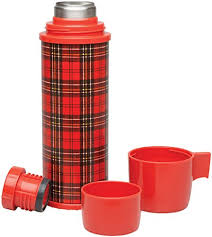
Misty rain is falling as the match begins, and bobbing about us are crocheted tri-colour beanies and tartan thermoses by the bagpipe-full. Somehow, I don’t think we’ll get invited into a shout of bundies with the strangers in Row G.

The GWS-ers start brightly and move the ball forward frequently, but without any significant threat until the man-bunned Harrison Himmelberg opens the affair.

There’s certain footballers who execute specific skills with rare exquisiteness. Brodie Smith is a glorious kick, and invests the ball with joyous flight and astonishing physics. I pay to see him launch a scorching drop punt. He does, and goals at the Riverbank end. Minutes later he slips when tackling, and appears to wreck his ACL. This is cruel. Knees are the most robust of our moving parts, but also the most delicate.

Ex-Collingwood racer Paul Seedsman is in our best side, but again takes the field attired with Andrew Newton Jarman-style three-quarter length sleeves. I’m unsure of the function, and speculate if the inaugural Crow himself knocks these up in the shed on his Singer, as a tribute to himself. It’s not impossible. Still, Seed provides telling run and carry, and is a penetrating kick. He goals to give the home side a small, but ultimately permanent lead.

With appendectomy Wikipedia entrant Rory Sloane spectating, giant Giant Rory Lobb jumps up one place to claim the title of this game’s third best Rory, behind Laird and Atkins. His point is the last score of the first term. Pleasingly, the Crows have not made their customary slow start.

Tonight, it’s not the third quarter that defines the contest, but the second, and on a soggy evening Eddie Betts again shows why he is among our code’s most effervescent players. He generates joy where none should exist. He goals from spatial situations beyond human contemplation. Like McCartney singing over a lonely guitar, or Black Caviar lengthening her stride and lowering her back, his contributions are rare and breathtaking. I’m privileged.

Mercifully, our tidy lead means we’ve heard little from the supporter in Row A who provides coaching and umpiring recommendations from her seat. Her vocal stylings seem to echo mid-career Tom Waits, Bobcat Goldthwait and a distressed, if not deceasing, dugong. For many reasons, we’re all relieved the footy’s not close.

The GWS mob get three speedy majors after the long break, and there’s some momentary tension. Waits/ Goldthwait/ dugong screeches. With a single first-half goal, the visitors have registered the lowest score in VFL/AFL finals footy since 1960.

However, a Richard Douglas intercept mark and conversion ensures that we relax, and not kick over any checkered soldiers in Row G’s phalanx of tepid thermoses. He then collects another in what has been an emblematic season, and at the siren the opposition has crept forward but a single point.

During the huddle, a nearby couple gathers up their goods and squeezes past us saying, “If we go now we can get home to watch the last quarter.” This is bewildering and I wonder why they bother coming at all, and how these Port supporters stole a pair of tickets. Curious.

At the ten-minute juncture of a fizz-less final stanza Coniglio achieves the game’s concluding goal, and at 10pm the Crows have advanced to their second only home preliminary final.

As we cross the Torrens foot bridge, even the mediocre busker warbling an Oasis cover is thrilling.

It’s getting exciting.

eddie

0

Cricket, tennis and Father’s Day brunch


FD

The chorizo is ferociously tasty, and just short of generating physical pain. It’s as hot as the Henley Beach weather is not. Outside, Alex and Max are leaping over some wooden benches. Storm surges roll past the jetty in thunderous grey and white. Even the seagulls shelter under the eaves. We’re starting Father’s Day at a café.

*

Alex went to his first cricket training last Sunday. Worried he wouldn’t be good enough, he had told me repeatedly that, “Ty can bowl at 55 kilometres an hour, Dad.” Indeed, his mum confirmed that he had bowled at a Jason Gillespie cricket centre with a speed gun measuring the pace of his looping delivery. Statistics can haunt us early in sport, and life.

Max batted first, and as the family expert, then showed Alex how to insert the box or protector as it’s now disappointingly known. What a curious sight, to see the boys bonding over a triangular plastic prism. Still brotherhood is a surprising beast and this shared skill is a most Australian thing. Not for the first time I considered a cricket box, and wiped a tear from my eye, although this was a parental observation, and not the wincing experience of an inadequate lower-order batsman on a dusty West Coast pitch.

Alex galloped in to bowl from an excessive run-up, all limbs and heart-breaking innocence. Max was back a pitch length as well, and reminded me of the Yorkshire fellow who once commented that a bowler ran too much before delivering the ball. “I don’t go that far for me holiday,” he noted.

He nodded as the coach advised on his action, listening well and taking it in. He’s made an investment in this sport, and already values his emerging place in this most Australian of pursuits. Too soon, his summers appear to be stretching out, in their endless, languid joy. He’s on his way.

*

Max and I went on his first school camp Monday, down to Narnu Farm on Hindmarsh Island. As a former teacher who gorged himself on camps early in his career, I reckon everyone has a lifetime quota. Although I reached mine years ago, I was excited. I was a volunteer.

I had some benevolent community-mindedness in jumping on that bus, but like many, a major motivation was to watch and learn, to see Max in action. Of course, I was going to spy on him.

As leader of Group 3 and its eight kids, we cycled through a set of activities including horseriding- the old gelding Pudding a class favourite; animal feeding- an escapee goat providing a highlight, as goats generally do, and finally; half-court tennis.

I played with Max and two of his friends. Between fetching balls from the neigh-bouring (sorry!) horse paddocks I discovered much. Dispensing with the medieval French scoring system we played first to twenty points. It was close throughout. If Max and his partner lost a point, there was no disappointment, just the fizzing joy of a close contest; an opportunity to go again, to share the action with his friends.

Self-appointed scorer, he’d jump up and down, proclaiming, 16- 15, and so on. He preferred it tight, to enhance the social connection. He had no wish to surge ahead, and claim an easy victory.

Great or errant shots with balls lurching about in exotic trigonometry offered little for Max. He simply wanted us: his mates, his Dad, himself, to zip about together on a tiny court in communal enterprise. He was entirely in the moment. That was his universe. I loved it. I’ve rarely been happier.

*

Later, in the bunkhouse, Max took himself off to bed around ten. Of the fifty kids, he was the first asleep, and I suspect, the first awake. One of his friends told me that in the morning, “Max told them funny stories” as they squirmed in their bunk beds with the sun struggling through.

The deputy principal was unsurprised that Max was done in moments. “He runs pretty hard.” I nodded, “He’s just the same at home.” Over his coffee the deputy continued, “He gives every minute a flogging, does our Max.”

I considered. Giving every minute a flogging. Beyond report cards, or NAPLAN results, this, I reflected, is exactly how I want them to tackle life.

Henry


2

Weirdness and Tom Waits

TW

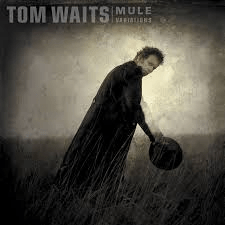
I love Tom Waits. His music is a dark world and explores life at, and beyond, the margins. It’s rich and frightening and funny. I wrote a short story based upon his classic from the album Mule Variations called, “What’s He Building?”

*

Well, the house is nearly prepared. The windows are fixed, and the leak in the cellar is patched. I pulled up the grimy carpets, and treated the ironbark boards, and now during clear mornings, with the sun rushing through the skylight, their flaxen warmth reminds me of the timber floor in our old house.

Our old house.

The street is quiet and pretty. As they’re keeping a respectful distance I’ve not met any of the neighbours. Their properties are modest with immaculate lawns, hedges and solemn, reassuring facades.

Up on the corner, by the reserve, a car’s parked in a driveway. It is the identical colour and model as Jane’s old car, remember that horrible burnt orange? Can you believe this? I wonder what happened to that Datsun. It defined her in so many ways. For many people, a car is just a way of conducting life’s business, an economic necessity in which no personal investment is made, or creative expression is given. But even the dents on the doors echoed Jane’s cheerfully chaotic outlook on life. I’ve never seen someone abuse a gearbox like that! Long before you’d see her you could hear her coming down the road.

I’ve enjoyed working on the house. It’s been calming. Rejuvenating. Dare I suggest remedial? Some heaven-sent physical exertion, during which I’ve used muscles ignored for years. It’s been a transformation from living primarily in the spiritual. I’m finally beginning to understand what Bill meant when he’d say, “People shouldn’t live too long in a single house.”

peering

The front yard might one day become a garden. The shrubs had been pruned towards an irritable death, and they’d been left a crazed mess like a bad Picasso. All jarring angles and stunted, agonised shapes that surely have no place in front of a humble bungalow. A faithful priest, every evening in the fading warmth I’ve been watering them, and some tiny green shoots are emerging; emerald stars in a scorched galaxy.

A man from the telephone company came by just after lunch, and said that the line should be operating by the end of the week. That’ll be good. Another little victory. Isn’t this all we can hope for in life: a succession of little triumphs? Do you think I could call over the weekend? I think I’ve got your number in one of my notebooks. If not, I’ll phone Bill to get your number. He’s sure to have it. He is so very reliable, he’s mechanically sound.

Hidden beneath a sheet in the garage I found an old barbeque. It must belong to the former owners, so given what happened there, I guess it’s now mine. Feeling thrilled with this slight surprise, I took it out the back by the rainwater tank, and hosed it off. Some spiders scuttled off across my lawn while the muddy water cascaded off the metal like toxic rain. Later, the barbeque hissed and spat like a gruff football coach, and cooking my meal, I heard a dog barking in the middle distance, from down near the creek. Its yapping seemed to protest a catalogue of sharp disappointments.

As the dark fell upon me I ate the meat. I thought about how quickly life can change, like an earthquake rumbling up from a previously undetected fault line. The cruel seismology reminding us, as if this was its only function, of how suddenly jolted people can be. Just like spiders sent from a private space, into an unexpected world. I had the radio on and that new song by the Beach Boys came on. God Only Knows. Such symphonic melodies, and handsome singing, as it extends its love, like a heart attack.

I wheeled the ticking barbeque back into the garage, and like a ghost made corporeal, put the white sheet back over its exoskeleton, and went into the house. Washing the dishes, I looked out my kitchen window. Above my fence the neighbour’s back light was on, and it shone warmly, stupidly into the velvet.

I was ready.

Boo


0

Freud eggs and the condom-vending machine

uni students

I dislike graffiti, but often admire the wit that inspires the funniest examples, and I share some with you today.

Each was spotted about the Salisbury campus of the modest teachers’ college I attended back in the outrageous 1980’s. It’s now the University of South Australia, although having visited several of its sites over the years, I’ve seen nothing as worthy.

In my degree there were a number of compulsory units, and frequently these were forgettable, horrid affairs. Like caged zoo creatures, we had no choice about our environment nor our diet. We did a term of educational psychology in one of the scattered theatrettes and had a stream of prominent thinkers to consider such as Piaget, Dewey and Bloom. I enjoyed learning about these.

Flipping down my personal desk one March afternoon I knew instantly Paul had written it. He was hilarious, and sometimes cruel.

Every Friday at 1pm we’d finish English in one of the large auditoriums and make our way home or to the library or to the bar and as we bounced off, laughing and chatting, Paul would yell out to one of our geeky, socially desperate classmates who so wanted to join us, “Hey Xavier!” Xavier’s eyes would widen with hope. Perhaps today would finally be the day they’d ask me to the bar! Paul would then enthusiastically kill his dream with a single dismissive sentence: “Have a zany weekend!”

But back on that autumnal afternoon in the psychology theatrette I spotted his unique handiwork on the aging laminate-

When I was Jung I used to eat Freud eggs

*

In another pointless educational moment I signed up for an introductory computing course, thinking it’d equip me for my thrilling future. The lecturer was a ferocious Welshman. He never smiled. I was a bit scared of him, and learnt nothing that helped me beyond that semester.

During this forbidding episode I saw in thick black texta the following character assessment of my computing lecturer, fittingly, on a cubicle door. Please, enjoy with me, the sharp juxtaposition of Biblical language with a, let’s say, rather frank Australian tongue. The fact that I found myself nodding in agreement also helped me to commit this to eternal memory-

And the Lord spake to the shepherd saying, “Fuck that Jim Davies is a wanker.”

*

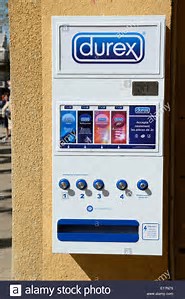
It was in my third year at college that I first saw a condom-vending machine. A simple white metal box, it was mounted, as it were, on the wall of the men’s toilet across from the bar. Given the Friday night cover bands hosted in that bar, this made sense. All that youth, all that disposable freedom, all those 50 cent beers during happy hour! It was tremendous fun.

Yes, it was a plain vending machine- not one of those lurid truck-stop equivalents with their hot promises of good vibrations and pleasuremax©. It hung there innocently, quietly performing its role, but within minutes of it being erected, as it were, this appeared on the front, right where Xavier’s trembling fingers weekly inserted hopeful dollar coins-

This is the worst chewing gum I’ve ever tasted.

machine

0

Servo Wars/Bin Ninja: So you wanna be a Reality TV star?

bins

I still can’t believe it. It was a sure thing. The public would’ve loved it, but it wasn’t to be. Of course, I speak of my reality TV show, Servo Wars.

At the end of our Singaporean street were two busy service stations (petrol stations/ gas stations). Yes, two, right across the road from each other. I almost want to type “literally across the road from each other,” but my fingers, in grammatical obedience, won’t allow this.

Anyhow, can you imagine a more perfect setting for a gripping reality TV series? Each station a microcosm of bustling human activity within a teeming island state, but- and here’s the kicker- there’s a broader narrative arc in which our two servo’s are in constant, artificially-constructed competition with each other. Genius, I hear you breathlessly whisper.

Servo Wars.

The thrilling drama would’ve included-

The ancient, stumbling driveway attendants- yes, folks who fill your tank, check the oil and wash your windscreen- dodging inattentive drivers- who once or twice a week are necessarily skiddled in the name of televisual art, and are stains on the driveway, their bloodied limbs a-thrashing. Soon followed by the engaging theatre of wailing ambulances and Ray-banned police, not chewing gum, but interrogating the trembling car owners before they’re hauled off to Changi prison.

cop

And

The duelling managers of both affixed convenience shops shouting at the store assistants, sometimes simultaneously, “I asked for more condoms in the counter display! Together is this curiously asexual nation’s most popular, albeit furtively purchased brand of birth control, and I can only see dozens of Alone packages!”

Or-

“Look across the road at our competitor, our life-long enemy! Esso! They’re offering two-for-one croissants. Somebody. Do something!”

I know, I know.

While Servo Wars remains unproduced, our planet is a little poorer. But’s here’s hope. Casting will soon begin for my latest project, one that will capture our hearts like the charming Bachelorette bogans.

Ladies and gentlemen, Bin Ninja.

A character-driven vehicle focussing upon the endless struggles of a middle-aged suburbanite as he tries desperately to manage his bins: the red (general refuse), the green (organic materials only) and the yellow (recycling), this is everyman drama, but infused with the conventions of Greek theatre.

Bin Ninja’s work is manual and repetitive as he selflessly takes stuff to his nest of driveway bins, five, six, sometimes ten times a day, every day! But, watch as the meditative power of these acts instantaneously transcends the mundanity. Bin Ninja!

Look! The boys have just finished some muesli bars- wrappers to the bins! Plastic milk container empty again? That’s the second today. They’ll pee the bed! Never fear, Bin Ninja silently walks it outside, before momentarily dashing through the hail and wind, stomping the plastic flat and dropping it into the yellow (recycling) bin. The man’s a hero!

Then there’s the Sunday Bin Ninja’s wife lopped the 97-year-old neighbour’s overhanging tree, scattering limbs and leafy debris all over the precious and universally-admired lawn, and left him to chop up the branches with a cheap hand saw and inadequate pruning shears and, somehow, fit them all into the green (organic) bin while the wife promptly trotted off to the local footy club with her girlfriends and drank Adelaide Hills sparkling wine!

BH

Oh, Bin Ninja, I think the nation’s falling in love with you already!

And just when Bin Ninja merchandise is sold out across the entire country- t-shirts, stubby holders, novelty BBQ aprons- the eagerly awaited Christmas special screens. On Boxing Day!

apron

The plot is simple: the boys again get too many presents, and all the plastic and cardboard packaging for the infinite games and the Lego and the car racing tracks and the cricket-sets and the bike accessories and the bed-sheet like wrapping paper has to all fit into the yellow (recycling) bin already exploding with pre-Christmas boxes and clunking bottles and beer cartons, and abandoned greeting cards and envelopes from already-forgotten former work colleagues.

What will Bin Ninja do? How will this very real, very residential conflict find resolution? The bin is spilling all over the sorry driveway, and what’s that sinister noise? It’s the council bin-truck making its menacing, diesel-fumed way along their very street! Go Bin Ninja, go! Will he wheel the bins out in time? Will he dodge being run over by this mechanical beast? Will he save his family from a recycling crisis?

Coming in 2018.

Bin Ninja.


Esso

0

The Shortest Song in the World

ND

As a kid I loved playing Mum and Dad’s records on the stereogram. There was always a little zap of frisson as I dropped the needle onto the vinyl, spinning at 33 1/3 RPM, and the speakers would spit and sizzle, and provided the stylus didn’t bounce off, we’d soon hear some music. Not the cold digital tunes of today with their obedient binary code, but some warm, enveloping sounds.

A favourite record was Creedence Gold.  Its track listing is-

Side 1

1.”Proud Mary” – 3:07

2.”Down on the Corner” – 2:43

3.”Bad Moon Rising” – 2:19

4.”I Heard it Through the Grapevine” (Norman Whitfield, Barrett Strong) – 11:03

Side 2

1.”The Midnight Special” (Traditional) – 4:11

2.”Have You Ever Seen the Rain?” – 2:39

3.”Born on the Bayou” – 5:14

4.”Susie Q” (Dale Hawkins, Stan Lewis, Eleanor Broadwater) – 8:34

The last track on Side 1, “I Heard it Through the Grapevine” mesmerised me. It featured not one but two great guitar solos. The second of these stretched on forever and to my eight year old self was impossibly cool. It was always disappointing when the song faded out.

There was so much happening within it, it was a snaking southern boogie like the Mississippi itself, and I wondered how this huge instrumental break enlarged upon the lyrics, how it connected to the story, and of course, it didn’t. It had no textual meaning.

It just was.

It was beyond narrative, but nonetheless epic. It told me that there was much in the world about which to get excited. There was possibility and opportunities for wild, unhinged self-indulgence. And Creedence Clearwater Revival was from San Francisco, a city that fascinated me.

Long, meandering songs such as this open themselves up to connotation and interpretation; like a novel or a film, and many argue that these marathon songs often possess a cinematic quality.

But how do we locate meaning in the world’s shortest song?

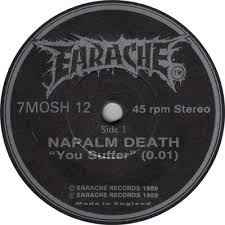
“You Suffer” is a track by the British grindcore band Napalm Death, from their debut album, Scum.  It’s precisely 1.316 seconds long. It’s now over thirty years old. Its lyrics are officially listed as-

You suffer

But why?

However, I must confess, I was unable to detect these unaided. I only heard the lyrics “Raaaah.” I had to find them on the web, probably because rightly or wrongly, my ears have enjoyed limited grindcore listening experience. Like arc welding, I think lyric decipherment, when it comes to micro grindcore, is actually quite a specialised skill. There’s possibly a TAFE, or adult education course in it.

I first came across the song when teaching in Singapore (don’t tell the authorities- they might come after me) when babysitting covering a Maths class one humid, bothersome afternoon. I played the song on my MacBook at random points during the lesson when the pupils- all compliant and sweet, were silently immersed in matters algebraic and entirely unsuspecting. I made a few of them jump. It was the most fun I’ve ever had in Maths. It was decidedly un-Singaporean.

Among other places it’s located on an album called Earache: The World’s Shortest Album which has thirteen songs and clocks in at a total of ninety-two seconds. You can listen to the entire album when watching the evening news, in the advertisement break between, say, the sport and the weather. For our British friends iTunes lists the album for sale at 29 pence. There’s a walk-the-dog and put-out-the-bins pocket money incentive for the kiddies of Birmingham.

So, micro grindcore fans, it’s nice to have visited your world, but I don’t think I’ll stay long, despite it being the funniest song about human suffering I’ve ever heard.

Give it a listen or two. 1.316 seconds isn’t much out of your day.

2

Round 20- Adelaide v Port: Barney 43

hill

I blame the shameless brewers of that most horrific muck West End Draught. Where were the dissenting voices at that fateful marketing meeting? Here we are, into the third decade of the state’s biggest football event and it’s still, somehow, called the Showdown, as determined by the fifteenth best beer manufacturer in Adelaide.

However, it’s also another example of American linguistic imperialism. If we were talking about Ole Miss and Arkansas in the Cotton Bowl then the word would work, but here in South Australia we should’ve gone with Dust Up, Yike, Blue, or my preference, Barney.

“We’re underway in Barney 17.” Or-

“There’s the siren. Adelaide has won a thriller in Barney 31!”

For the first time this millennium I’m on the Hill, just down from the world’s best scoreboard. We’re in a tidy quintet of chaps. There’s ferocious rain and wind and the sky is like an aubergine. The mud and slushy grass is tundra. Old mate behind us has on a Power scarf and is in shorts. My phone says it’s eight degrees. Jason pulls out his sunglasses, “Reckon I’ll need these soon.” We laugh, and Chris asks, “Did anyone bring the 50+?”

With a significant wind-assistance Adelaide traps the ball within their arc, and like an over-zealous debater, makes point after point after point before The Hoff collects his own kick and soccers cleverly. This, I’m delighted to report, would be the Power’s sole major until about ten minutes into the third quarter.

The Crows dominate across the ground and despite the conditions are clean and sure in disposing by hand and foot, which is a happy contrast to their dismal first half at the MCG last Sunday. Tex Walker appears impatient with his side’s inability to punish the Power so, both as captain and big forward, monsters his teal competitors in taking strong grabs and slotting telling goals.

Paddy Ryder has been in colossal form and various denizens of the Hill voice their anxieties about how Sam Jacobs might handle the Power star. They needn’t have worried for while their aerial and ruck duels are spirited, the boy from Ardrossan is also outrageous at ground level and kicks a great pack snap for a rooster who’d bang his red-combed head on the hen-house rafters.

Despite now missing his appendix Eddie Betts kicks some amazing goals, including one from his pocket just down in front of us. As the ball bent through, the heaving crowd about me leapt and there were ponchos and scarfs bouncing and flapping like a Latino dance party. The only deviation from the Happy Days script is when yet another goal-of-the-year contender is deemed by the evil umpire to have been touched by an evil Power player.

And what of Port? They’d appeared to be entirely unlike Port such is their pedestrian spectating. They seem disinterested, and must be waiting for The Choir Boys to reform. In the sheds at half-time only Robbie Gray has earnt his hot cup of Milo.

September looms and pleasingly Sloan finds plenty of it, and creates well. On the Hill, I spy a gent wearing a bespoke shirt featuring a picture of Rory’s blonde bonce with this accompanying prose-

Men want to tag him

Women want to shag him

The crowd is boisterous and enjoyable. I see lots of Crows fans standing with Power faithful, and the banter is lively. Not Disney channel, but not Tarantino either.

Suddenly, Charlie Cameron has it and he accelerates through the middle. It’s among our game’s most exhilarating sights, but while his pace is Lamborghini, his kicking is still often Holden Gemini.

Then Brad Ebert gets one, but unlike last Saturday against the Saints, it really is too late, and the Port supporters are shuffling towards the gates like an Alabama chain-gang. The Nissan Urvan will soon be pointed towards the Lefevre Peninsula, and I just hope that Uncle Ernie managed to fix the heater when he popped round yesterday.

Adelaide records its biggest winning margin against the INXS wailers, and after two decades now lead 22-21 in these most magnificent of contests, the Barney.

I must get back to the Hill again.

nissan


0

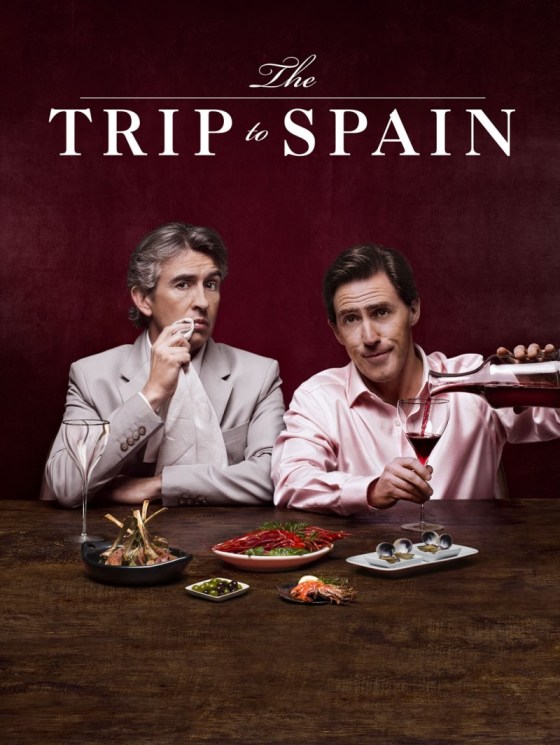
Film Review: The Trip to Spain

The-Trip-to-Spain-poster

Enticing Spanish food, gorgeous cinematography and two actors playing fictionalised versions of themselves perpetually engaged in battles over career, family and who does the best Michael Caine impression.

Yes, Steve Coogan and Rob Brydon have returned with the third in director Michael Winterbottom’s now much-anticipated film series.

With a typically thin premise- Coogan insists he’s writing a book inspired by Laurie Lee’s As I Walked Out One Midsummer Morning- along with the usual contract to write a set of restaurant reviews for the Observer, our team departs from Plymouth by overnight ferry for the north of Spain.

The comic energy of the film comes from the endless cockfight between the characters over their impersonations of actors and celebrities. Their stable includes Michael Caine, Robert De Niro and celebrated BBC Radio announcers Terry Wogan and Ken Bruce. Brydon’s impersonation is so uncanny- “Up next: The Doobie Brothers! – that he once took over Bruce’s Radio 2 morning show and most listeners only knew what had happened when the real host appeared at the end!

Mick Jagger is a welcome addition to their repertoire, having snuck in following Coogan and Brydon’s early discussion of older men having kids. He stunningly captures the Stones’ front man and his nasal, public schoolboy tones, along with the hysterical clapping trope associated with Jagger’s onstage performances. It’s funny, and early on we have Coogan 1, Brydon 0.

Beyond the aural fun it’s also an essay on middle-aged masculinity. The ebb and flow of careers; Coogan now sees himself primarily as a writer, and the scenes with him sitting morosely at his laptop indicate how dismally this is travelling, through to meditations on death and the struggles with family and love. Coogan’s sad Dad-joke attempts to flirt with an attractive ferry attendant establishes this middle-aged loss early. Happily, Steve later announces that “Fifty is a sweet spot” but of course there’s underscored doubt about his optimism.

With Emma, Steve’s assistant and Yolanda, the photographer, joining them late in their journey a shared lunch gives the leads the attractive female audience they need for a final showdown in which Coogan and Brydon duel over who can do the best Roger Moore with the Welsh star taking this to maddening yet terrific excess. It’s magnificent.

In the previous films we had literary assistance in Keats, Shelley and Bryon, and here in Spain it’s Don Quixote and his assistant Sancho Panza which somehow reaches its ridiculous zenith in them duetting on “Windmills of Your Mind” as their Range Rover speeds towards Malaga.

The film is part travelogue too with the countryside as well as the restaurants in luscious prominence. The Alhambra is used to highlight Coogan’s latest existential crisis as he wanders through this stunning palace, his haunted, hunched self in contrast to the natural and Moorish architectural wonder.

“She was only nineteen years old!” is the overdue vocal joust- I thought Michael Caine might be unforgivably absent- at their final restaurant in which their shouting match somehow remains unheard by those at the surrounding tables. This impossibility adds to the film’s absurdity.

The Trip to Spain is huge fun and already I’m guessing where they’ll next venture. I suspect a French tour.

Regardless, I’m sure that Caine, Moore, De Niro and co will be along too.

The Trip to Spain is in Australian cinemas now.

0

To old mate Chris Hayward, on his 50th


About a month back six former Kapunda High scholars- Rocket Ellis, Nick Lienert, Trevor Lucas, Andrew and Chris Hayward and I were at the MCG taking in Port versus Collingwood: a truly post-apocalyptic and dentally-challenged fixture. Ours was a tidy collective.

During the second quarter Chris returned with his round, and this is instructive for he had not six, but two Bundies. One for his brother, and yes, one for himself. Now some of you are possibly thinking, that’s a bit selfish. Indeed, some of our ensemble in Row G may have thought this too- despite none of us liking Bundy. What do we make of this purchase? The meaning is, of course, that Chris values family deeply, and for this how can we but admire him?

And those in our group at the MCG not called Hayward were pampered by Chris with refreshments. Yes, light beer. No, one each. As the insipid lagers made their sorry way to the downcast recipients there was anger and a fight threatened, and partly because it was Port and Collingwood and we wanted to blend in, a fight threatened.

But this is to misunderstand the situation. Ever a visionary, Chris had foretold that we’d end up in an Irish bar at 3am, and plainly, he was looking after his mates. Our safety, and our health were, as always, his priorities. So, thanks for your human concern Chris. Indeed, leadership can be lonely.

Chris is a tremendous enthusiast, and as all of us know, this great gift is contagious. To spend time in his company is one of life’s joys for Chris finds happiness and fun everywhere. He loves laughter and people, and lives in robust and generous ways. And for this, we thank him.

So happy 50th Chris. To Chris!

0

Brewery Review: Greenock Brewers

brewery.png

In one of his more reflective and tender moments Australian poet-balladeer Kevin “Bloody” Wilson offered the following as a courtship inquiry

            Does your Dad own a brewery?

I’m unsure what reply Kev received- probably one in the negative, but I do know that a bloke from my hometown of Kapunda runs Greenock Brewers Barossa Valley in this gorgeous hamlet about an hour from Adelaide.

If you ask the average punter their favourite law what do you get? Thou shalt not kill? The deliberate out of bounds law? Unlikely.

I nominate the German Beer Purity Law of 1516, and happily the owners, Chris and Lisa Higgins are fans of this one too, and it guides their craft. And, of course, it’s especially relevant here in the Prussian-settled Barossa with its tradition and strict codes and nodding respect.

I ducked in last week, and while Chris was down in town, Lisa let me in and after a couple snifters, I strolled out with some tremendous cargo in the form of two six-packs. I drove back to Glenelg with matronly care.

stout

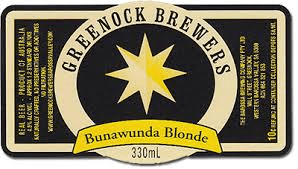
Bunawunda Blonde is dangerously easy to drink. But unlike many commercial beers (read muck) this lager rewards with complexity and maturity that doesn’t scream, “Messy Millennials on a hot Sunday.” There’s delicate spice infused with a smiling approachability. I like it. It’d find a cheery spot around a BBQ, or at five bells on a Friday (or earlier in the week).

The brewery is set just off the town’s main drag on Mill Street. Coming from Nuriootpa (where a young HG Nelson once kicked a footy) if you get to the pub, once run by iconic mine hosts, Norton and Mick Schluter, then you need to turn the EH Holden around. But if you slip into the Greenock Tavern’s front bar, never fear, for the brewery’s excellent product is available there too.

Having spent not a few winters up at spoggy’s on a Saturday and playing footy in various Barossa towns I can assure you it gets decidedly crisp, and in these times of personal need the application of dark ale becomes vital.

beers

Greenock Brewers Dark Ale is like the Bunawunda Blonde, in that it’s a beer of subtlety and elegance. It doesn’t get in your face like a Tanunda Magpies fullback or an Angaston opening bowler, but moves with seduction. This, as many will tell you, always works better and jags the win. There’s some lingering Mocha and wafts of smokiness too that seems perfect for an evening around a cracking fire, after the Kapunda Bombers have had a top day in the lead-up to finals.

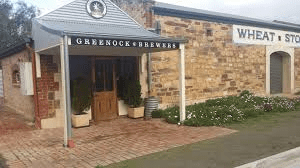
When I poked my head in the other day I spotted a cosy outdoor area with tables and chairs and a fire. The brewery itself is housed within a fetching old stone wheat store that immediately makes a wonderful impression. It sets a tone, and turns up the thirst a few Fahrenheit notches.

Couple this with occasional live music- probably no Kevin B Wilson, although I can’t be certain- and it makes the Greenock Brewers Barossa Valley an attractive location, in an attractive town, in an attractive valley.

I’m there.

greenock blonde.png

https://www.greenockbrewersbarossavalley.com.au/


0

Pardon me, Pastor, pass the pasta

DD

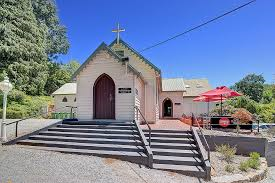
The torchlight beams hop about the dirt path in front and then above, and occasionally, behind us, as our boys, Alex and Max, guide the way into Sassafras. The mountain dark and colossal cold presses down. Fern trees are all about, like extras in Avatar, for we’re in the Dandenongs. To our north a wooden building appears. It’s a church.

At least it was. Now, it’s a restaurant called Dine Divine. On the phone, a week ago, Janine was insistent.

“We must go to the old church Sunday for they have a brilliant pasta night.”

Mine host and restaurateur Trev punches our order into his iPad with one finger. He’s had a successful career, and splits his time between Southbank, his farm and this converted place of worship. He could be retired, but I know there’s nowhere he’d rather be. He likes a yarn.

Janine, Garry and I have the carbonara. It’s magnificent. Creamy and luscious, but possessing subtle flavours, while the pasta is bouncily solid, as it should be. The ham is salty and necessarily complementary, and the dish is equivalent to the food I had at Jamie’s Italian in January. Anyway, we know his restaurant juggernaut is a genealogical lie, for Mr Oliver was born in Essex.

Garry and I each have a Crown Lager, and I remember a time, back in the simpler, pre-globalised 1990’s when these represented a beery extravagance, and were something to be enjoyed at a Christmas function, when the boss was shouting- Quick! Davo! Get a couple more Crownies. We’ve still got ten minutes to go! Or you were on the lunchtime lash, at somewhere precariously bohemian, like Café Junction in the Adelaide Casino. Now, a Crownie’s unreconstructed flavour and nose seems as sophisticated as a night at the Dapto dogs.

When in Ireland on their honeymoon some dear friends ventured into a pub for lunch. Brett considered the blackboard menu above the bar, and asked the waiter, “What’s in the Guinness and steak pie?”

With unblinking eyes, the young local looked through and past Brett, and replied in an unironic monotone, “Guinness.” There was a pause. “And steak.”

So, my wife had the Guinness and steak potpie, and declared it the best she’s ever feckin’ had. A couple bowls of chips are inhaled. Folks sometimes forget that it’s easy to butcher a chip, to mix food industry metaphors. These are an ornament to the spud. We eat them as if we’ve been wandering the desert for over a month, except we’re in a temperate rainforest.

Is there a better soft drink than a Lemon, Lime and Bitters (LLB)? Of course not. I just read that it’s customary for Antipodean golfers to take it after their round, but I must rebut this as bald-faced nonsense. But Alex has one, and for a few minutes it’s the best event of his brief life.

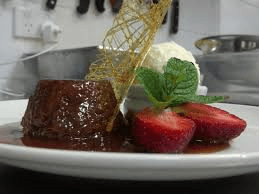
The LLB is superseded by the arrival of his sticky date pudding. He is nine, and eating chocolate dessert inescapably descends into an unholy hybrid of unwatchable reality TV, horror schlock, and Animal House food fight scene. It becomes difficult to tell if he’s gobbling the pudding, or vice versa.

Again, I wonder at what age he’ll possess a fully-functioning mouth, and we’ll be able to throw out the drop-sheet. It seems a while off. Inserted between the almost medieval-black castle of pudding, and the elegant bathtub of ice cream, is a golden lattice of toffee. He makes a suitable mess of this too.

On the flight home, Alex announces it as a Victorian highlight. For me, it is too.

Dine Divine is warm and wonderful, and sits geographically and gastronomically at the centre of Sassafras.

We’ll be back.

Dine Divine is at 345 Mount Dandenong Tourist Road, Sassafras, and

https://www.dinedivine.net.au/

SDP


2

Battery Point Boozers: Brave Journeys into Hobart’s Hotels

SA

Striding up Runnymede Street into the heart of Battery Point and the beginning of Friday night with the dark and the cold pressing down upon me, I take in my surroundings. I dichotomize Arthur Circus, Australia’s only circus, with its cottages built close to each other as if they’re all huddling together around a scrub campfire.

These are streets with houses and restaurants and stores all pushing for attention, right up on the footpath. There’s no sweeping front lawns and yawning gum trees, but cobblestones, and a distinctly London-like topography.

I’m in Hobart for a conference and tonight the Crows are hosting the Bulldogs back at Adelaide Oval. As there’s also a pub back in my hometown of Kapunda called the Prince of Wales I involuntarily step inside the Tassie version, and find my place at the side bar.

It’s a snug corner populated with eccentric locals and bohemians and ordinary folks and tourists who seem to possess some organic ownership over this space. One of the staff, Aaron, is the brother of Nathan with whom I worked in Singapore. Between his pouring and my emptying, we chat in a necessarily staccato way.

I then have a yarn with a raspberry farmer, Phil and his partner Mary, about Turkey. How do these conversations commence? Together, we roam through Kusadasi and its heady lanes of Irish bars, and on to Istanbul and the Bosphorus and the Grand Bazaar and the Blue Mosque, and then, finally, to Gallipoli.

Phil offers me half of his burger. I buy his wife a Bacardi and Coke. Just like the Crows, we’re all winning. Later, they move to the front bar, to dance to a jazzy blues band.

After the siren, I again cut across Arthur Circus, and head down the hill.

*

Saturday, late afternoon and the dark is rising as I amble past the chippy and the curry house towards the Shipwrights Arms, all white and majestic like a billowing sail. Safely inside and perched like a parrot on a stool, I examine her stained-glass windows and nautical photos.

There’s Sydney to Hobart memorabilia including pictures of my favourite yacht, Brindabella, while across the wall is a black and white depiction of HMAS Vampire. By the door is a rack. Black coats hang as if deflated ghouls. The footy’s on a tele and Sydney’s again galloping towards the finals.

Suddenly, I realise the aural beauty. The commentary is muted, and there’s no music pounding down from ceiling speakers, and no jiggly death clatter from hidden pokies. There’s only the lowing conversations from happy knots of folks. No TAB and Sky racing insistence, just human voices like a heartbeat line, traced on an ECG, with laughter providing the graph’s healthy spikes.

It’s a pub in which chat is treasured. The business plan could be: encourage them to talk and relax, just like they would at home. I could be in Cornwell or Yorkshire.

The Shipwrights Arms has but five beers on tap, and around its lavish bar are scattered some older blokes who each buy a stubby, and pour it into a small glass. Although I wasn’t born, it seems very 1955. I recognise one fellow from last night at the Prince of Wales. He’s just retired, and is heading to Sicily next week for a few months. He’s pretty excited. I’m happy for him.

In another nook, by the fire, I see another television screen. The darts is on and Barney is in strife against Chisnel in the Shanghai Masters. By the bar, just next to me, Ted and Ron and Bruce are ribbing each other with the gentle affection of old mates. They drink pots, and talk of absent friends and golf and the daily driftwood of a quiet island life.

*

I know I should pop into a most marvellously named pub, Doctor Syntax, over in Sandy Bay, but time is against me. It’s branded after a famous nineteenth century British racehorse, and as I’m in town for a literacy convention the name should also be personally symbolic or hyperbolic, but maybe instead it’s a name for an editing franchise. Having trouble with apostrophes? Call Doctor Syntax on 1-800-COMMA.

When I walk into a pub I try to look at the floor for I reckon this can be informative. Polished concrete? Run for your life! The Whaler, in the heart of Salamanca Place, has old worn tiles that echo with Moby Dick and Ishmael and the swish of harpoons.

Inside is deep like an old friend’s hug and chocolate dark and above the bar timbers there’s stained glass that’s austere and haunted and vaguely Eastern European. In front of me a circle of young women, possibly tertiary students, are all in black coats. One, clearly the alpha, is setting a fierce Chardonnay pace, and she’s lapped her peers. I’ve seen this movie before. It could be lights out at eleven, for her.

Given it’s a uni pub there’s music. There’s 60’s soul and then songs featured on hip alternative films from the nineties. It makes me smile. A girl from the circle shuffles a few steps across the prehistoric tiles to Morphine’s “Buena” and its saxophone, all sultry and snaking and menacing, but when no one joins her, she flops onto her stool.

There’s an early evening ease, but then an agitated young guy and two barely clad girls burst in, and the spell is broken. There’s now a ménage a trois edge. Time to bolt. I tip down my ale and head home to the footy and Rockwiz.

whaler


.


4

MONA moments

ferry

I’ve been accused, obviously in the past, by both strangers and friends, of ridiculous and unknowable underdressing.

It’s dark as a pint of stout and only just past five bells here in Hobart. As luck would have it, I’ve located a stool in the front bar of The Telegraph, and let me assure you, I’m suitably clad for the climate.

It’s July, but the side door is wedged open, tempting a decidedly crisp draught to gush into the pub, and phantom about us, like an anonymous, yet Arctic ghoul from the Harry Potter series.

Ordering a Cascade Pale Ale and a pizza, I note that Old Mate behind the bar is wearing shorts and a t-shirt. A quick scan of the dark, convict interior tells me that he’s not the only one. If my Mum were here, she may well now be in an involuntary foetal position, wailing for a Bundy and a blanket.

Scrutiny of the pub’s décor also tells me that stripping away the uptartedness, this is an old world, maritime boozer. I can almost hear The Pogues, playing Rum Sodomy & the Lash.

Already, I’m happy in Hobart.

*

With the MONA ROMA ferry hurtling up the Derwent there was music thumping across the deck. I was instantly smitten hearing Joe Tex and his 1977 classic “Ain’t Gonna Bump No More (With No Big Fat Woman).” I mean, who wouldn’t be?

Australia is wobbling on the edge of drought and, even here in Tasmania, the hills are brown and thirsty. It’s a massive harbour, and is more Port Lincoln than Sydney with its expansive stretches and rustic, inviting appearance.

*

How tremendous to invest an afternoon in this most modern and confronting of museums?

The architecture is instructive for we are sent, mole-like, to the depths, and in exploring the exhibits, are to ascend, towards the light. This establishes a central theme of the vast collection, for it is about decay and marginalisation. MONA is more Nick Cave than One Direction. I’m eager.

It’s also surely a first-world indulgence that we have the luxury of introspection and probing questioning. Each room has a theme and the first two I visit are declared as opposites: faith and satire. I take an inner breath. Here’s two ideas I hold important. Are these so incompatible? Do I have to surrender one? I fear satire may be just in the lead.

I pause at an ancient TV which is looping endlessly through the clip of a band unsuccessfully trying to master the Sex Pistols’ “God Save The Queen.” The singer holds a sheet of lyrics in front of her agonised face, while the drummer and guitarist are bravely attempting the same song, but in violently clashing tempos.

Each musician is an octogenarian.

It’s funny and probably cruel and I wonder what I’m supposed to think.

*

There’s a large cement cavern, vaguely reminiscent of London’s Tate Modern and its turbine hall, with its evocations of empire and space and dark. Along its length is Sidney Nolan’s installation, “Snake” comprising over 1,600 individual paintings across 46 winding metres. When it was conceived and assembled Nolan was already elderly, and I gasp at the colossal nature of his singular, ambitious vision.

A major departure, as near as my innocent eye can tell, from European galleries, is how this collection celebrates unheralded, everyday artists. Many of the works are Art Brut and Outsider Art, often by commoners and folks suffering mental illness, especially in the London-based Museum of Everything. There’s an insolent rejection of high culture, and a preference given to solitude, and the voices of the disturbed.

My audio companion instructs me in the work of a Prussian butcher who was fascinated by the cosmos and space travel, and created accordingly. Until recently he received no acknowledgement. How great, how vast, how rich is this planet?

I like that, at least in these very minor ways, there’s an arc towards democratisation.

I swing back through the galleries, past the dinosaurs assembled from found objects such as cable ties and one, a large asaurus of some note, built from both blank and pre-recorded cassette tapes, including incurably hideous disco tapes, but none by Joe Tex. By hang tight folks, if vinyl can make a comeback so can dinosaurs and tapes, like Ripper ’77.

I also take in a smiling hermaphrodite illumination and other happy collisions of ideas and amateur execution, including an entire darkened wall of vaginal casts, and its accompanying eight-minute audio commentary. I wonder if it has been commissioned by my favourite conceptual artist, Maude, of The Big Lebowski. I hope so.

Suddenly, the bright, southern day is rushing to the east. I’m back on the ferry and the Tasmanian velvet is pushing in, all over Salamanca Place.

maude