0

Servo Wars/Bin Ninja: So you wanna be a Reality TV star?

bins

I still can’t believe it. It was a sure thing. The public would’ve loved it, but it wasn’t to be. Of course, I speak of my reality TV show, Servo Wars.

At the end of our Singaporean street were two busy service stations (petrol stations/ gas stations). Yes, two, right across the road from each other. I almost want to type “literally across the road from each other,” but my fingers, in grammatical obedience, won’t allow this.

Anyhow, can you imagine a more perfect setting for a gripping reality TV series? Each station a microcosm of bustling human activity within a teeming island state, but- and here’s the kicker- there’s a broader narrative arc in which our two servo’s are in constant, artificially-constructed competition with each other. Genius, I hear you breathlessly whisper.

Servo Wars.

The thrilling drama would’ve included-

The ancient, stumbling driveway attendants- yes, folks who fill your tank, check the oil and wash your windscreen- dodging inattentive drivers- who once or twice a week are necessarily skiddled in the name of televisual art, and are stains on the driveway, their bloodied limbs a-thrashing. Soon followed by the engaging theatre of wailing ambulances and Ray-banned police, not chewing gum, but interrogating the trembling car owners before they’re hauled off to Changi prison.

cop

And

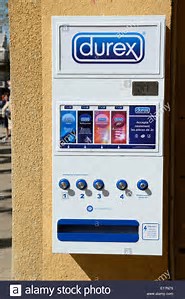
The duelling managers of both affixed convenience shops shouting at the store assistants, sometimes simultaneously, “I asked for more condoms in the counter display! Together is this curiously asexual nation’s most popular, albeit furtively purchased brand of birth control, and I can only see dozens of Alone packages!”

Or-

“Look across the road at our competitor, our life-long enemy! Esso! They’re offering two-for-one croissants. Somebody. Do something!”

I know, I know.

While Servo Wars remains unproduced, our planet is a little poorer. But’s here’s hope. Casting will soon begin for my latest project, one that will capture our hearts like the charming Bachelorette bogans.

Ladies and gentlemen, Bin Ninja.

A character-driven vehicle focussing upon the endless struggles of a middle-aged suburbanite as he tries desperately to manage his bins: the red (general refuse), the green (organic materials only) and the yellow (recycling), this is everyman drama, but infused with the conventions of Greek theatre.

Bin Ninja’s work is manual and repetitive as he selflessly takes stuff to his nest of driveway bins, five, six, sometimes ten times a day, every day! But, watch as the meditative power of these acts instantaneously transcends the mundanity. Bin Ninja!

Look! The boys have just finished some muesli bars- wrappers to the bins! Plastic milk container empty again? That’s the second today. They’ll pee the bed! Never fear, Bin Ninja silently walks it outside, before momentarily dashing through the hail and wind, stomping the plastic flat and dropping it into the yellow (recycling) bin. The man’s a hero!

Then there’s the Sunday Bin Ninja’s wife lopped the 97-year-old neighbour’s overhanging tree, scattering limbs and leafy debris all over the precious and universally-admired lawn, and left him to chop up the branches with a cheap hand saw and inadequate pruning shears and, somehow, fit them all into the green (organic) bin while the wife promptly trotted off to the local footy club with her girlfriends and drank Adelaide Hills sparkling wine!

BH

Oh, Bin Ninja, I think the nation’s falling in love with you already!

And just when Bin Ninja merchandise is sold out across the entire country- t-shirts, stubby holders, novelty BBQ aprons- the eagerly awaited Christmas special screens. On Boxing Day!

apron

The plot is simple: the boys again get too many presents, and all the plastic and cardboard packaging for the infinite games and the Lego and the car racing tracks and the cricket-sets and the bike accessories and the bed-sheet like wrapping paper has to all fit into the yellow (recycling) bin already exploding with pre-Christmas boxes and clunking bottles and beer cartons, and abandoned greeting cards and envelopes from already-forgotten former work colleagues.

What will Bin Ninja do? How will this very real, very residential conflict find resolution? The bin is spilling all over the sorry driveway, and what’s that sinister noise? It’s the council bin-truck making its menacing, diesel-fumed way along their very street! Go Bin Ninja, go! Will he wheel the bins out in time? Will he dodge being run over by this mechanical beast? Will he save his family from a recycling crisis?

Coming in 2018.

Bin Ninja.


Esso

0

The Shortest Song in the World

ND

As a kid I loved playing Mum and Dad’s records on the stereogram. There was always a little zap of frisson as I dropped the needle onto the vinyl, spinning at 33 1/3 RPM, and the speakers would spit and sizzle, and provided the stylus didn’t bounce off, we’d soon hear some music. Not the cold digital tunes of today with their obedient binary code, but some warm, enveloping sounds.

A favourite record was Creedence Gold.  Its track listing is-

Side 1

1.”Proud Mary” – 3:07

2.”Down on the Corner” – 2:43

3.”Bad Moon Rising” – 2:19

4.”I Heard it Through the Grapevine” (Norman Whitfield, Barrett Strong) – 11:03

Side 2

1.”The Midnight Special” (Traditional) – 4:11

2.”Have You Ever Seen the Rain?” – 2:39

3.”Born on the Bayou” – 5:14

4.”Susie Q” (Dale Hawkins, Stan Lewis, Eleanor Broadwater) – 8:34

The last track on Side 1, “I Heard it Through the Grapevine” mesmerised me. It featured not one but two great guitar solos. The second of these stretched on forever and to my eight year old self was impossibly cool. It was always disappointing when the song faded out.

There was so much happening within it, it was a snaking southern boogie like the Mississippi itself, and I wondered how this huge instrumental break enlarged upon the lyrics, how it connected to the story, and of course, it didn’t. It had no textual meaning.

It just was.

It was beyond narrative, but nonetheless epic. It told me that there was much in the world about which to get excited. There was possibility and opportunities for wild, unhinged self-indulgence. And Creedence Clearwater Revival was from San Francisco, a city that fascinated me.

Long, meandering songs such as this open themselves up to connotation and interpretation; like a novel or a film, and many argue that these marathon songs often possess a cinematic quality.

But how do we locate meaning in the world’s shortest song?

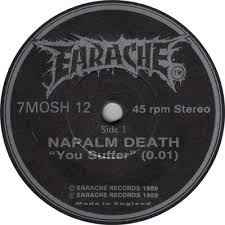
“You Suffer” is a track by the British grindcore band Napalm Death, from their debut album, Scum.  It’s precisely 1.316 seconds long. It’s now over thirty years old. Its lyrics are officially listed as-

You suffer

But why?

However, I must confess, I was unable to detect these unaided. I only heard the lyrics “Raaaah.” I had to find them on the web, probably because rightly or wrongly, my ears have enjoyed limited grindcore listening experience. Like arc welding, I think lyric decipherment, when it comes to micro grindcore, is actually quite a specialised skill. There’s possibly a TAFE, or adult education course in it.

I first came across the song when teaching in Singapore (don’t tell the authorities- they might come after me) when babysitting covering a Maths class one humid, bothersome afternoon. I played the song on my MacBook at random points during the lesson when the pupils- all compliant and sweet, were silently immersed in matters algebraic and entirely unsuspecting. I made a few of them jump. It was the most fun I’ve ever had in Maths. It was decidedly un-Singaporean.
Among other places it’s located on an album called Earache: The World’s Shortest Album which has thirteen songs and clocks in at a total of ninety-two seconds. You can listen to the entire album when watching the evening news, in the advertisement break between, say, the sport and the weather. For our British friends iTunes lists the album for sale at 29 pence. There’s a walk-the-dog and put-out-the-bins pocket money incentive for the kiddies of Birmingham.

So, micro grindcore fans, it’s nice to have visited your world, but I don’t think I’ll stay long, despite it being the funniest song about human suffering I’ve ever heard.

Give it a listen or two. 1.316 seconds isn’t much out of your day.

2

Round 20- Adelaide v Port: Barney 43

hill

I blame the shameless brewers of that most horrific muck West End Draught. Where were the dissenting voices at that fateful marketing meeting? Here we are, into the third decade of the state’s biggest football event and it’s still, somehow, called the Showdown, as determined by the fifteenth best beer manufacturer in Adelaide.

However, it’s also another example of American linguistic imperialism. If we were talking about Ole Miss and Arkansas in the Cotton Bowl then the word would work, but here in South Australia we should’ve gone with Dust Up, Yike, Blue, or my preference, Barney.

“We’re underway in Barney 17.” Or-

“There’s the siren. Adelaide has won a thriller in Barney 31!”

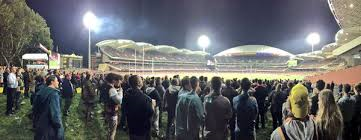
For the first time this millennium I’m on the Hill, just down from the world’s best scoreboard. We’re in a tidy quintet of chaps. There’s ferocious rain and wind and the sky is like an aubergine. The mud and slushy grass is tundra. Old mate behind us has on a Power scarf and is in shorts. My phone says it’s eight degrees. Jason pulls out his sunglasses, “Reckon I’ll need these soon.” We laugh, and Chris asks, “Did anyone bring the 50+?”

With a significant wind-assistance Adelaide traps the ball within their arc, and like an over-zealous debater, makes point after point after point before The Hoff collects his own kick and soccers cleverly. This, I’m delighted to report, would be the Power’s sole major until about ten minutes into the third quarter.

The Crows dominate across the ground and despite the conditions are clean and sure in disposing by hand and foot, which is a happy contrast to their dismal first half at the MCG last Sunday. Tex Walker appears impatient with his side’s inability to punish the Power so, both as captain and big forward, monsters his teal competitors in taking strong grabs and slotting telling goals.

Paddy Ryder has been in colossal form and various denizens of the Hill voice their anxieties about how Sam Jacobs might handle the Power star. They needn’t have worried for while their aerial and ruck duels are spirited, the boy from Ardrossan is also outrageous at ground level and kicks a great pack snap for a rooster who’d bang his red-combed head on the hen-house rafters.

Despite now missing his appendix Eddie Betts kicks some amazing goals, including one from his pocket just down in front of us. As the ball bent through, the heaving crowd about me leapt and there were ponchos and scarfs bouncing and flapping like a Latino dance party. The only deviation from the Happy Days script is when yet another goal-of-the-year contender is deemed by the evil umpire to have been touched by an evil Power player.

And what of Port? They’d appeared to be entirely unlike Port such is their pedestrian spectating. They seem disinterested, and must be waiting for The Choir Boys to reform. In the sheds at half-time only Robbie Gray has earnt his hot cup of Milo.

September looms and pleasingly Sloan finds plenty of it, and creates well. On the Hill, I spy a gent wearing a bespoke shirt featuring a picture of Rory’s blonde bonce with this accompanying prose-

Men want to tag him

Women want to shag him

The crowd is boisterous and enjoyable. I see lots of Crows fans standing with Power faithful, and the banter is lively. Not Disney channel, but not Tarantino either.

Suddenly, Charlie Cameron has it and he accelerates through the middle. It’s among our game’s most exhilarating sights, but while his pace is Lamborghini, his kicking is still often Holden Gemini.

Then Brad Ebert gets one, but unlike last Saturday against the Saints, it really is too late, and the Port supporters are shuffling towards the gates like an Alabama chain-gang. The Nissan Urvan will soon be pointed towards the Lefevre Peninsula, and I just hope that Uncle Ernie managed to fix the heater when he popped round yesterday.

Adelaide records its biggest winning margin against the INXS wailers, and after two decades now lead 22-21 in these most magnificent of contests, the Barney.

I must get back to the Hill again.

nissan


0

Film Review: The Trip to Spain

The-Trip-to-Spain-poster

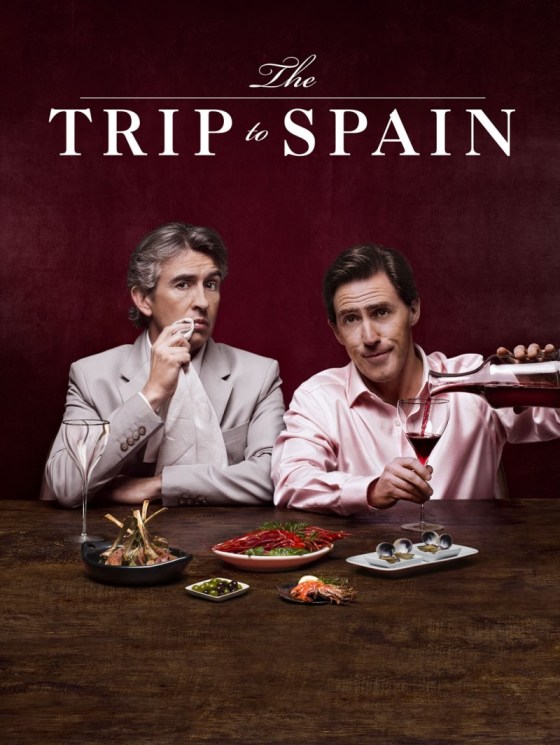
Enticing Spanish food, gorgeous cinematography and two actors playing fictionalised versions of themselves perpetually engaged in battles over career, family and who does the best Michael Caine impression.

Yes, Steve Coogan and Rob Brydon have returned with the third in director Michael Winterbottom’s now much-anticipated film series.

With a typically thin premise- Coogan insists he’s writing a book inspired by Laurie Lee’s As I Walked Out One Midsummer Morning- along with the usual contract to write a set of restaurant reviews for the Observer, our team departs from Plymouth by overnight ferry for the north of Spain.

The comic energy of the film comes from the endless cockfight between the characters over their impersonations of actors and celebrities. Their stable includes Michael Caine, Robert De Niro and celebrated BBC Radio announcers Terry Wogan and Ken Bruce. Brydon’s impersonation is so uncanny- “Up next: The Doobie Brothers! – that he once took over Bruce’s Radio 2 morning show and most listeners only knew what had happened when the real host appeared at the end!

Mick Jagger is a welcome addition to their repertoire, having snuck in following Coogan and Brydon’s early discussion of older men having kids. He stunningly captures the Stones’ front man and his nasal, public schoolboy tones, along with the hysterical clapping trope associated with Jagger’s onstage performances. It’s funny, and early on we have Coogan 1, Brydon 0.

Beyond the aural fun it’s also an essay on middle-aged masculinity. The ebb and flow of careers; Coogan now sees himself primarily as a writer, and the scenes with him sitting morosely at his laptop indicate how dismally this is travelling, through to meditations on death and the struggles with family and love. Coogan’s sad Dad-joke attempts to flirt with an attractive ferry attendant establishes this middle-aged loss early. Happily, Steve later announces that “Fifty is a sweet spot” but of course there’s underscored doubt about his optimism.

With Emma, Steve’s assistant and Yolanda, the photographer, joining them late in their journey a shared lunch gives the leads the attractive female audience they need for a final showdown in which Coogan and Brydon duel over who can do the best Roger Moore with the Welsh star taking this to maddening yet terrific excess. It’s magnificent.

In the previous films we had literary assistance in Keats, Shelley and Bryon, and here in Spain it’s Don Quixote and his assistant Sancho Panza which somehow reaches its ridiculous zenith in them duetting on “Windmills of Your Mind” as their Range Rover speeds towards Malaga.

The film is part travelogue too with the countryside as well as the restaurants in luscious prominence. The Alhambra is used to highlight Coogan’s latest existential crisis as he wanders through this stunning palace, his haunted, hunched self in contrast to the natural and Moorish architectural wonder.

“She was only nineteen years old!” is the overdue vocal joust- I thought Michael Caine might be unforgivably absent- at their final restaurant in which their shouting match somehow remains unheard by those at the surrounding tables. This impossibility adds to the film’s absurdity.

The Trip to Spain is huge fun and already I’m guessing where they’ll next venture. I suspect a French tour.

Regardless, I’m sure that Caine, Moore, De Niro and co will be along too.

The Trip to Spain is in Australian cinemas now.

0

To old mate Chris Hayward, on his 50th


About a month back six former Kapunda High scholars- Rocket Ellis, Nick Lienert, Trevor Lucas, Andrew and Chris Hayward and I were at the MCG taking in Port versus Collingwood: a truly post-apocalyptic and dentally-challenged fixture. Ours was a tidy collective.

During the second quarter Chris returned with his round, and this is instructive for he had not six, but two Bundies. One for his brother, and yes, one for himself. Now some of you are possibly thinking, that’s a bit selfish. Indeed, some of our ensemble in Row G may have thought this too- despite none of us liking Bundy. What do we make of this purchase? The meaning is, of course, that Chris values family deeply, and for this how can we but admire him?

And those in our group at the MCG not called Hayward were pampered by Chris with refreshments. Yes, light beer. No, one each. As the insipid lagers made their sorry way to the downcast recipients there was anger and a fight threatened, and partly because it was Port and Collingwood and we wanted to blend in, a fight threatened.

But this is to misunderstand the situation. Ever a visionary, Chris had foretold that we’d end up in an Irish bar at 3am, and plainly, he was looking after his mates. Our safety, and our health were, as always, his priorities. So, thanks for your human concern Chris. Indeed, leadership can be lonely.

Chris is a tremendous enthusiast, and as all of us know, this great gift is contagious. To spend time in his company is one of life’s joys for Chris finds happiness and fun everywhere. He loves laughter and people, and lives in robust and generous ways. And for this, we thank him.

So happy 50th Chris. To Chris!

0

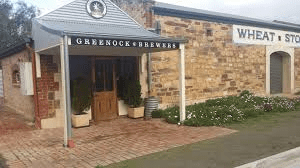
Brewery Review: Greenock Brewers

brewery.png

In one of his more reflective and tender moments Australian poet-balladeer Kevin “Bloody” Wilson offered the following as a courtship inquiry

            Does your Dad own a brewery?

I’m unsure what reply Kev received- probably one in the negative, but I do know that a bloke from my hometown of Kapunda runs Greenock Brewers Barossa Valley in this gorgeous hamlet about an hour from Adelaide.

If you ask the average punter their favourite law what do you get? Thou shalt not kill? The deliberate out of bounds law? Unlikely.

I nominate the German Beer Purity Law of 1516, and happily the owners, Chris and Lisa Higgins are fans of this one too, and it guides their craft. And, of course, it’s especially relevant here in the Prussian-settled Barossa with its tradition and strict codes and nodding respect.

I ducked in last week, and while Chris was down in town, Lisa let me in and after a couple snifters, I strolled out with some tremendous cargo in the form of two six-packs. I drove back to Glenelg with matronly care.

stout

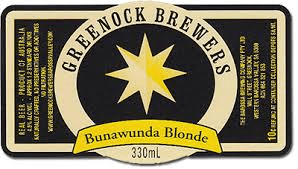
Bunawunda Blonde is dangerously easy to drink. But unlike many commercial beers (read muck) this lager rewards with complexity and maturity that doesn’t scream, “Messy Millennials on a hot Sunday.” There’s delicate spice infused with a smiling approachability. I like it. It’d find a cheery spot around a BBQ, or at five bells on a Friday (or earlier in the week).

The brewery is set just off the town’s main drag on Mill Street. Coming from Nuriootpa (where a young HG Nelson once kicked a footy) if you get to the pub, once run by iconic mine hosts, Norton and Mick Schluter, then you need to turn the EH Holden around. But if you slip into the Greenock Tavern’s front bar, never fear, for the brewery’s excellent product is available there too.

Having spent not a few winters up at spoggy’s on a Saturday and playing footy in various Barossa towns I can assure you it gets decidedly crisp, and in these times of personal need the application of dark ale becomes vital.

beers

Greenock Brewers Dark Ale is like the Bunawunda Blonde, in that it’s a beer of subtlety and elegance. It doesn’t get in your face like a Tanunda Magpies fullback or an Angaston opening bowler, but moves with seduction. This, as many will tell you, always works better and jags the win. There’s some lingering Mocha and wafts of smokiness too that seems perfect for an evening around a cracking fire, after the Kapunda Bombers have had a top day in the lead-up to finals.

When I poked my head in the other day I spotted a cosy outdoor area with tables and chairs and a fire. The brewery itself is housed within a fetching old stone wheat store that immediately makes a wonderful impression. It sets a tone, and turns up the thirst a few Fahrenheit notches.

Couple this with occasional live music- probably no Kevin B Wilson, although I can’t be certain- and it makes the Greenock Brewers Barossa Valley an attractive location, in an attractive town, in an attractive valley.

I’m there.

greenock blonde.png

https://www.greenockbrewersbarossavalley.com.au/


0

Pardon me, Pastor, pass the pasta

DD

The torchlight beams hop about the dirt path in front and then above, and occasionally, behind us, as our boys, Alex and Max, guide the way into Sassafras. The mountain dark and colossal cold presses down. Fern trees are all about, like extras in Avatar, for we’re in the Dandenongs. To our north a wooden building appears. It’s a church.

At least it was. Now, it’s a restaurant called Dine Divine. On the phone, a week ago, Janine was insistent.

“We must go to the old church Sunday for they have a brilliant pasta night.”

Mine host and restaurateur Trev punches our order into his iPad with one finger. He’s had a successful career, and splits his time between Southbank, his farm and this converted place of worship. He could be retired, but I know there’s nowhere he’d rather be. He likes a yarn.

Janine, Garry and I have the carbonara. It’s magnificent. Creamy and luscious, but possessing subtle flavours, while the pasta is bouncily solid, as it should be. The ham is salty and necessarily complementary, and the dish is equivalent to the food I had at Jamie’s Italian in January. Anyway, we know his restaurant juggernaut is a genealogical lie, for Mr Oliver was born in Essex.

Garry and I each have a Crown Lager, and I remember a time, back in the simpler, pre-globalised 1990’s when these represented a beery extravagance, and were something to be enjoyed at a Christmas function, when the boss was shouting- Quick! Davo! Get a couple more Crownies. We’ve still got ten minutes to go! Or you were on the lunchtime lash, at somewhere precariously bohemian, like Café Junction in the Adelaide Casino. Now, a Crownie’s unreconstructed flavour and nose seems as sophisticated as a night at the Dapto dogs.

When in Ireland on their honeymoon some dear friends ventured into a pub for lunch. Brett considered the blackboard menu above the bar, and asked the waiter, “What’s in the Guinness and steak pie?”

With unblinking eyes, the young local looked through and past Brett, and replied in an unironic monotone, “Guinness.” There was a pause. “And steak.”

So, my wife had the Guinness and steak potpie, and declared it the best she’s ever feckin’ had. A couple bowls of chips are inhaled. Folks sometimes forget that it’s easy to butcher a chip, to mix food industry metaphors. These are an ornament to the spud. We eat them as if we’ve been wandering the desert for over a month, except we’re in a temperate rainforest.

Is there a better soft drink than a Lemon, Lime and Bitters (LLB)? Of course not. I just read that it’s customary for Antipodean golfers to take it after their round, but I must rebut this as bald-faced nonsense. But Alex has one, and for a few minutes it’s the best event of his brief life.

The LLB is superseded by the arrival of his sticky date pudding. He is nine, and eating chocolate dessert inescapably descends into an unholy hybrid of unwatchable reality TV, horror schlock, and Animal House food fight scene. It becomes difficult to tell if he’s gobbling the pudding, or vice versa.

Again, I wonder at what age he’ll possess a fully-functioning mouth, and we’ll be able to throw out the drop-sheet. It seems a while off. Inserted between the almost medieval-black castle of pudding, and the elegant bathtub of ice cream, is a golden lattice of toffee. He makes a suitable mess of this too.

On the flight home, Alex announces it as a Victorian highlight. For me, it is too.

Dine Divine is warm and wonderful, and sits geographically and gastronomically at the centre of Sassafras.

We’ll be back.

Dine Divine is at 345 Mount Dandenong Tourist Road, Sassafras, and

https://www.dinedivine.net.au/

SDP


2

Battery Point Boozers: Brave Journeys into Hobart’s Hotels

SA

Striding up Runnymede Street into the heart of Battery Point and the beginning of Friday night with the dark and the cold pressing down upon me, I take in my surroundings. I dichotomize Arthur Circus, Australia’s only circus, with its cottages built close to each other as if they’re all huddling together around a scrub campfire.

These are streets with houses and restaurants and stores all pushing for attention, right up on the footpath. There’s no sweeping front lawns and yawning gum trees, but cobblestones, and a distinctly London-like topography.

I’m in Hobart for a conference and tonight the Crows are hosting the Bulldogs back at Adelaide Oval. As there’s also a pub back in my hometown of Kapunda called the Prince of Wales I involuntarily step inside the Tassie version, and find my place at the side bar.

It’s a snug corner populated with eccentric locals and bohemians and ordinary folks and tourists who seem to possess some organic ownership over this space. One of the staff, Aaron, is the brother of Nathan with whom I worked in Singapore. Between his pouring and my emptying, we chat in a necessarily staccato way.

I then have a yarn with a raspberry farmer, Phil and his partner Mary, about Turkey. How do these conversations commence? Together, we roam through Kusadasi and its heady lanes of Irish bars, and on to Istanbul and the Bosphorus and the Grand Bazaar and the Blue Mosque, and then, finally, to Gallipoli.

Phil offers me half of his burger. I buy his wife a Bacardi and Coke. Just like the Crows, we’re all winning. Later, they move to the front bar, to dance to a jazzy blues band.

After the siren, I again cut across Arthur Circus, and head down the hill.

*

Saturday, late afternoon and the dark is rising as I amble past the chippy and the curry house towards the Shipwrights Arms, all white and majestic like a billowing sail. Safely inside and perched like a parrot on a stool, I examine her stained-glass windows and nautical photos.

There’s Sydney to Hobart memorabilia including pictures of my favourite yacht, Brindabella, while across the wall is a black and white depiction of HMAS Vampire. By the door is a rack. Black coats hang as if deflated ghouls. The footy’s on a tele and Sydney’s again galloping towards the finals.

Suddenly, I realise the aural beauty. The commentary is muted, and there’s no music pounding down from ceiling speakers, and no jiggly death clatter from hidden pokies. There’s only the lowing conversations from happy knots of folks. No TAB and Sky racing insistence, just human voices like a heartbeat line, traced on an ECG, with laughter providing the graph’s healthy spikes.

It’s a pub in which chat is treasured. The business plan could be: encourage them to talk and relax, just like they would at home. I could be in Cornwell or Yorkshire.

The Shipwrights Arms has but five beers on tap, and around its lavish bar are scattered some older blokes who each buy a stubby, and pour it into a small glass. Although I wasn’t born, it seems very 1955. I recognise one fellow from last night at the Prince of Wales. He’s just retired, and is heading to Sicily next week for a few months. He’s pretty excited. I’m happy for him.

In another nook, by the fire, I see another television screen. The darts is on and Barney is in strife against Chisnel in the Shanghai Masters. By the bar, just next to me, Ted and Ron and Bruce are ribbing each other with the gentle affection of old mates. They drink pots, and talk of absent friends and golf and the daily driftwood of a quiet island life.

*

I know I should pop into a most marvellously named pub, Doctor Syntax, over in Sandy Bay, but time is against me. It’s branded after a famous nineteenth century British racehorse, and as I’m in town for a literacy convention the name should also be personally symbolic or hyperbolic, but maybe instead it’s a name for an editing franchise. Having trouble with apostrophes? Call Doctor Syntax on 1-800-COMMA.

When I walk into a pub I try to look at the floor for I reckon this can be informative. Polished concrete? Run for your life! The Whaler, in the heart of Salamanca Place, has old worn tiles that echo with Moby Dick and Ishmael and the swish of harpoons.

Inside is deep like an old friend’s hug and chocolate dark and above the bar timbers there’s stained glass that’s austere and haunted and vaguely Eastern European. In front of me a circle of young women, possibly tertiary students, are all in black coats. One, clearly the alpha, is setting a fierce Chardonnay pace, and she’s lapped her peers. I’ve seen this movie before. It could be lights out at eleven, for her.

Given it’s a uni pub there’s music. There’s 60’s soul and then songs featured on hip alternative films from the nineties. It makes me smile. A girl from the circle shuffles a few steps across the prehistoric tiles to Morphine’s “Buena” and its saxophone, all sultry and snaking and menacing, but when no one joins her, she flops onto her stool.

There’s an early evening ease, but then an agitated young guy and two barely clad girls burst in, and the spell is broken. There’s now a ménage a trois edge. Time to bolt. I tip down my ale and head home to the footy and Rockwiz.

whaler


.


4

MONA moments

ferry

I’ve been accused, obviously in the past, by both strangers and friends, of ridiculous and unknowable underdressing.

It’s dark as a pint of stout and only just past five bells here in Hobart. As luck would have it, I’ve located a stool in the front bar of The Telegraph, and let me assure you, I’m suitably clad for the climate.

It’s July, but the side door is wedged open, tempting a decidedly crisp draught to gush into the pub, and phantom about us, like an anonymous, yet Arctic ghoul from the Harry Potter series.

Ordering a Cascade Pale Ale and a pizza, I note that Old Mate behind the bar is wearing shorts and a t-shirt. A quick scan of the dark, convict interior tells me that he’s not the only one. If my Mum were here, she may well now be in an involuntary foetal position, wailing for a Bundy and a blanket.

Scrutiny of the pub’s décor also tells me that stripping away the uptartedness, this is an old world, maritime boozer. I can almost hear The Pogues, playing Rum Sodomy & the Lash.

Already, I’m happy in Hobart.

*

With the MONA ROMA ferry hurtling up the Derwent there was music thumping across the deck. I was instantly smitten hearing Joe Tex and his 1977 classic “Ain’t Gonna Bump No More (With No Big Fat Woman).” I mean, who wouldn’t be?

Australia is wobbling on the edge of drought and, even here in Tasmania, the hills are brown and thirsty. It’s a massive harbour, and is more Port Lincoln than Sydney with its expansive stretches and rustic, inviting appearance.

*

How tremendous to invest an afternoon in this most modern and confronting of museums?

The architecture is instructive for we are sent, mole-like, to the depths, and in exploring the exhibits, are to ascend, towards the light. This establishes a central theme of the vast collection, for it is about decay and marginalisation. MONA is more Nick Cave than One Direction. I’m eager.

It’s also surely a first-world indulgence that we have the luxury of introspection and probing questioning. Each room has a theme and the first two I visit are declared as opposites: faith and satire. I take an inner breath. Here’s two ideas I hold important. Are these so incompatible? Do I have to surrender one? I fear satire may be just in the lead.

I pause at an ancient TV which is looping endlessly through the clip of a band unsuccessfully trying to master the Sex Pistols’ “God Save The Queen.” The singer holds a sheet of lyrics in front of her agonised face, while the drummer and guitarist are bravely attempting the same song, but in violently clashing tempos.

Each musician is an octogenarian.

It’s funny and probably cruel and I wonder what I’m supposed to think.

*

There’s a large cement cavern, vaguely reminiscent of London’s Tate Modern and its turbine hall, with its evocations of empire and space and dark. Along its length is Sidney Nolan’s installation, “Snake” comprising over 1,600 individual paintings across 46 winding metres. When it was conceived and assembled Nolan was already elderly, and I gasp at the colossal nature of his singular, ambitious vision.

A major departure, as near as my innocent eye can tell, from European galleries, is how this collection celebrates unheralded, everyday artists. Many of the works are Art Brut and Outsider Art, often by commoners and folks suffering mental illness, especially in the London-based Museum of Everything. There’s an insolent rejection of high culture, and a preference given to solitude, and the voices of the disturbed.

My audio companion instructs me in the work of a Prussian butcher who was fascinated by the cosmos and space travel, and created accordingly. Until recently he received no acknowledgement. How great, how vast, how rich is this planet?

I like that, at least in these very minor ways, there’s an arc towards democratisation.

I swing back through the galleries, past the dinosaurs assembled from found objects such as cable ties and one, a large asaurus of some note, built from both blank and pre-recorded cassette tapes, including incurably hideous disco tapes, but none by Joe Tex. By hang tight folks, if vinyl can make a comeback so can dinosaurs and tapes, like Ripper ’77.

I also take in a smiling hermaphrodite illumination and other happy collisions of ideas and amateur execution, including an entire darkened wall of vaginal casts, and its accompanying eight-minute audio commentary. I wonder if it has been commissioned by my favourite conceptual artist, Maude, of The Big Lebowski. I hope so.

Suddenly, the bright, southern day is rushing to the east. I’m back on the ferry and the Tasmanian velvet is pushing in, all over Salamanca Place.

maude

0

Port Adelaide v Collingwood: a Messerschmitt up your arse or free bird seed

free bird seed
During the second quarter, on the fifty-metre arc, at the Punt Road end was, to paraphrase Hunter S Thompson, when the stories and the beer began to take hold.

Six of us are in Row S, connected by the time we spent together at Kapunda High School, and variously on the Barossa’s cricket and footy ovals.

Much of our conversation is our old cars and coaches and mates and publicans and parents and maverick teachers who shaped us.

It’d been a ripping trip so far: early flights, the North Fitzroy Arms for the Footy Almanac lunch which concluded with the final siren at the SCG, the obligatory Young and Jackson nightcaps, and a Saturday laneway breakfast.

With the Uber app showing cars descending like black Pacmen three of us ride in a Caprice, and I’m reminded of the great Dave Graney and his song “Feelin’ Kinda Sporty” which opens with the magnificent

A black Statesman “73

Caprice.

Leaded.

At high noon, and accompanied with ample yarns, we entered the All Nations Hotel to confer with the ghost of Bill Hunter, and then white pub-vanned to the MCG as the match commenced. Each of us is merrily apathetic about the result.

I love footy, but occasionally its lone function is to provide a panoramic context across which we can splash our stories. Rocket would love to be watching his beloved Sturt while Nick, the Hayward boys (not Kapunda’s Gatlin boys) and Lukey are Norwood men, but as neither is scheduled at the MCG today we get along to Collingwood and Port.

With the match chugging along Nick and I discuss contemporary AFL footballers and old players from home, in particular one Mail Medallist and local publican who loved scrapping at the bottom of a pack, like a nuggetty 1970’s Selwood.

“You know what he used to do in the sheds before a game?”
“No. Tell me.”
“He’d smear heaps of Vaseline on his eyebrows so the elbows would slide off.”
I giggle.

Needing to refresh their refreshments the Haywards return with their shouts: Bundy for them, and mid-strength beers for us. For a moment, I fear we’ll need petroleum jelly too, but happily there’s no fight in the forward pocket.

We move onto that most vital of topics: Which Test Cricketer would you most like to have a beer with? (until very recently in pre-production at Network Ten)

“Warney?”
“There’s nothing to discover. Nothing.”
“Yeah, and I can’t have a beer with someone who calls their book, ‘My Autobiography.’”
“That’d have been a funny meeting at the publishers.”
I take a difficult sip of my mid-strength. “Waugh twins?”
“No. Steve’d bore you to death.”
“The worst kind of mental disintegration.”

Ultimately our choice is clear. One of the most stylish middle-order bats we’ve seen, and still a bloke about whom little is really known. An anti-Warney. The one who quit the night of the famous 2006 Ashes victory in Adelaide. Damien Martyn.

On the ground, Port is doing well with Robbie Gray slotting a few while Unley Jets alumnus Brodie Grundy is holding his own for the Magpies.

We wonder if the Chappell brothers still own the Leg Trap Hotel, and if David Warner is less likeable than a curved television and if it’s possible to make Boonie more Australian. It isn’t.

This brings us to the best quotation ever, the one which places sport and our little, self-tortured world into perfect context. Nick remembers his Dad giving him Australian allrounder and WWII pilot Keith Miller’s book. “Pressure,” Keith said. “I’ll tell you what pressure is. Pressure is a Messerschmitt up your arse. Playing cricket is not.”

Still laughing at the magnificence of this, Rocket heads off to a cavern and emerges with some appropriate beers. Normal transmission is resumed. Pendlebury is smooth and constructive, as usual. We note that Ollie Wines has thighs like Californian redwood.

The conversation then tends, as it must, towards other nostalgia and juvenalia. We’re now at Stalag 13. The verdant field of the MCG recedes and we’re all in front of a black and white TV, sliding our paws into packets of Lolly Gobble Bliss Bombs.

“Burkhalter and Hochstetter.”
Much giggling, given to misty eyes.
“Captain Hoganhoffer?”
“No prisoner has ever escaped from Stalag 13.”
More giggling.

“I’d like to hear this on the BBC World Service: Munich Messerschmitts 2, Stalag 13, 3.”
Someone slides next to me with a pie. A message comes through that another Kapunda High contemporary is on the second deck behind the Port cheer squad. We wave at Maria, who waves towards our bay.

Looking back now it makes sense, and indeed there’s a happy inevitability in the childhood image that would become our weekend’s talisman. The footy is now on mute as we moved towards the creature that Mark Twain described as “a long, slim, sick and sorry-looking skeleton.” The coyote, but of course for us, Wily E Coyote.

I don’t know how we came to this, and I don’t want to know, but as the shadows lengthened across Melbourne, Lukey, with his talent for the comic and the absurd mentioned it and we were off.

“Easily the greatest cartoons ever.”
The coyote hanging in mid-air until he realizes that he is about to plummet into a chasm!”
“Yeah, and he’d hold up a sign like ‘Goodbye cruel world.’”
“Or ‘Help me.’”
“‘Mother.’”

By now the laughter and the memories and the beer and our good fortune at being in this fun space meant, for some of us, there were tears of childish abandonment.
“What of the Giant Kite Kit?”
“The roller skates and the fan blowing the coyote along?”
“From the Acme company.”
Bombs, detonators, nitroglycerin. Not so funny in 2017, but when you’re seventeen and watching Looney Tunes…

We talk of the Road Runner’s ability to enter the painted image of a cave, while the coyote cannot, which showed us that the existentialists are correct: it is an unknowable and absurd universe. Cartoons teach us this.

And then as the Paah (sic) delivered their knockout blow to Collingwood, Lukey delivered his knockout blow to us. A childhood picture that captures the fun, the innocence of the endless battle between the Roadrunner and the Coyote.

“Free bird seed.”

And there it was. Only three words. But a beautiful mantra of the past, a pulsing refrain, and the best televisual picture of a little bird nibbling at food in the desert, likely just outside Albuquerque.

coyote

2

At 4pm on my birthday I remembered something remarkable

baby.png

Having fled work, I was scurrying along Greenhill Road towards its most westerly origin where it is neither green nor hilly. I was thinking ahead to the hour or so of Friday sunshine left in the week and how it’d be happily spent. Park, dogs, boys, a few dobs of the footy in the closing dark.

As birthdays go it’d been fine. Not quite up there with the birthday I had years ago, by Lake Balaton in western Hungary when we had a lovely lunch of pilsner beer and goulash overlooking the water in the glorious European summer, but pleasant enough.

Then I remembered.

Like a car’s agitated navigator trying to really concentrate on a crucial part of the journey, I turned down the radio as the thought formed fully in my mind.

A decade. It was now a decade.

I swung down Anzac Highway and commenced the vaguely downhill run to home. A few tears then formed hotly. I was having a moment.

It was ten years to the day that we learned Alex was on his way.

*

I recall much of Saturday June 16, 2007. My dear old mate Chris was down from Brisbane, and he had stayed with us the previous night.

It was a sunny day and early in the morning Kerry thought we should definitely go to the doctor. She’d done a test at home. It was positive.

From then on, the day, my birthday assumes a nimble quality as though we’re in a floating cocoon and the world is spinning but without our interest or participation. This most physical, most real of events is confirmed, and all about me has now assumed a gentler quality; a welcoming, smiling face. The simplest household items are invested with magic and wonder.

While hanging out the washing I rang Mum and Dad on the cordless phone. Pegging the socks and jocks we had a brief excited chat. The future, especially early 2008 swirled and leapt about me.

That evening we dined with friends at a now long-closed Polish restaurant just off Henley Square. The Adelaide Crows played the Kangaroos on the Gold Coast and in those pre-smart phone days my mate Bob was texted the score at the end of every quarter. We won. The food was good, but I mostly remember the sense of our brilliant warm secret, the fuzzy binary code and a feeling that we were in a happy, symmetrical orbit.

*

Like every decade, it has been full and fast. Everything has changed. Much is as it was.

Alex was born a week after his mum’s birthday. Two years after his little brother Max came along. We left Australia for Singapore, and then returned. Now there’s karate and dogs, guitars and school.

And so, every year I remember that birthday, now a decade back, when the anniversary of my birth was also the day we learned that Alex was on his beautiful, astonishing way.

clothes.png


0

Finally, a beer review


sparko

Good art is evocative. It jumps on the individual and transports them elsewhere. Gee, even bad art can have you skipping across the planet.

Can beer be art too? Of course. It functions like a frothy time machine. Or something like this.

One afternoon I went on a little holiday, while sitting on our modest patio. Here’s my travel diary courtesy of the following fun refreshments.

Chang

On Boxing Day 2005 we arrived in Bangkok from London. Having survived part or whole of three shadowy English winters meant the Thai heat was monstrous. Like the black monolith in Kubrick’s 2001, it governs the landscape (and the moonscape).

Late morning, we took a boat along the Chao Phraya river, pausing at various Buddhist sites, and marvelling at the coconuts, bobbling in the brown water. When thirst conquered tourism we moored at a floating restaurant for a drink, and such was the hotness and absurd humidity that we demolished a squadron of large Chang bottles.

It’s a pale lager with a straw hue, and while it’s not bursting with personality and stories, it’s crisp and refreshing in a functional way, like an old Casio calculator. It’ll never MC your best mate’s wedding.

Our session was brisk and energetic, and soon there was a phalanx of green bottles on the table, in silent evidence of our stern tropical application. De-camping to Singapore a few years later I learnt that a handful of tinkling ice cubes in a frosty beer glass is no gastronomic crime, in fact it’s medically necessary.

With the sun slipping into the Andaman Sea and your green chicken curry steaming on the Ko Lanta table, a Chang is gorgeously contextualised. Don’t forget. Chang means elephant.

Tsingtao Beer

Gee, we’re all now situated within an Asian century and like Roy and HG, I find it tremendously exciting. This pilsner was originally brewed under the mythical German Purity Laws in a joint Chinese/ Bavarian operation. These enigmatic ideals are now abandoned and rice is an ingredient, but it works in a happy, meaningless pre-season fixture fashion.

Like an episode of Have You Been Paying Attention? it’s fun and compelling at the time, but in the morning, you’ll recollect little of it. However, this is fine. Live a little and ignore the cultural import.

Tsingtao attends to its easy drinking brief with a casual nod to the grandstand as the chestnut conveyance strides past the post in an early spring Group 3 race over, say, 1600 metres. It’s pale, golden in the glass and unlikely to inspire a revolution, cultural or military. While I enjoyed it, at no stage did I hear Communism barking in my ear as I supped. I should’ve listened to Little Feat’s “A Apolitical Blues” to allow beer and art to mingle in that deathless, exotic exchange-

Well my telephone was ringing

And they told me it was chairman Mao


Well my telephone was ringing

And they told me it was chairman Mao

Coopers Sparkling Ale

At the end of a holiday, even a lager-themed trip, it’s good to come home. And so, we look at the mighty CSA, as I’m confident it’s not known in the trade. In my coterie, it’s a Sparko although this familiar, friendly nomenclature disguises a dark truth.

Kids: this is not a session beer. The graveyard is clunking with the skeletons of those who fought it, and lost.

Sparkling ale speaks with preternatural eloquence. I tell you, every bottle bursts with Jack Nicholson, the Velvet Underground and ultimately, Hemingway from his tiny Spanish bar. As an aspirational product, it’s looking down fondly upon us all from its Nepalese retreat.

It presents with citrus, cereal, ferment, danger, sex, death. It can be eaten with a fork. Avoid it at breakfast, especially if you’ve booked a duel with a mortal enemy. But taken moderately, in the late autumnal sun, it’s invigorating and celebratory.

After three circumspect sips, you’ll possess the wit of former Australian PM, Paul Keating who once described the performance of a parliamentary foe as “like being flogged with a warm lettuce.”

Coopers Sparkling Ale is huge like Merv Hughes in his twilight, but under the hum and roar of a party, it leans in and whispers conspiratorially, “Can you believe our good fortune to live where we do?”

And you smile in that reflective way while sort of staring into the middle distance and think yep, that’s fecking true.

bangkok


0

Round 10 – Adelaide v Fremantle: The 2013 Wolf Blass Brown Label Classic Shiraz Is Dramatically Better Than The Dockers

fire bucket.png

Fire, footy and friends.

Of course, my wife’s right. She bought it about six weeks ago, from the sausage sizzle hardware emporium. It’s been a great addition to our patio and we’ve had many nights around it. As autumn descends to winter there’ll be many more.

It’s a fire bucket.

Once aflame, a chair, a cup and some company’s all that’s needed.

Among our party tonight are some of my favourite folks, including three girls with whom I shared house when at uni. As you know, there’s a lifelong attachment made when sitting cross-legged on stained carpet, in a daggy rented house in a then pre-gentrified suburb, glugging cask wine by candlelight.

Surprisingly, Josh Jenkins is better in the wet. Our warm, still autumn has not been kind to him. Tonight, the harder the Dylanesque rain falls the nimbler the monstrously-built forward plays. Maybe he’s more whale than herbivore dinosaur. Light on his feet, he finds space, and like Lennon in the Dakota Building seems happier in this dissimilar environment. I was bewildered by his sudden recall, but he does well.

Among our friends is a junior footballer. Jed’s nine. He and our boys burst about the house like joyous thunderclaps. Bedroom, backyard and back. Repeat. About four games into their 2017 season Jed’s team’s been utterly scoreless so far. Not a lonely, lazily rushed behind. Nothing. Happily, no-one’s keeping score and their competition has no cruel premiership ladder. A Sunday afternoon text tells me they scrambled four behinds today. Despite another loss, they’re on the board.

The Honourable Edward A. Betts snaps a goal square major that must be barely satisfactory for him, such is the unchallenging simplicity. Indeed, each of Betts’ majors is registered from the square, away from the boundary lines with which he enjoys a preternatural, endless affinity. Another lashing rain shower jangles on our roof and we’re unable to hear special commenter Mark Ricciuto and his monotone monosyllables.

During his thousand-day absence from the Crows, dual knee reconstruction survivor Andy Otten came to our island home one weekend as a guest of the Singapore Sharks footy club, and provided much curious excitement for the ex-pat urchins. Now back in the Adelaide tri-colours and sporting an Oregonian lumberjack’s beard, he’s enjoying an attractive stretch as an enigmatic forward. Four goals courtesy of his considerable footy smarts is a luminous return.

Again, the brutal rains lash our city, oval and house with a ferocity that reminds me of The Deadliest Catch, save for the Alaskan King Crabs. Instead, we’ve party pies, garlic bread and various processed Germanic meats. It’s comfort food, and I feel decidedly comfortable. Our patio blaze crackles and exerts a happy gravity onto our loose circle of friends.

Wayne Milera’s been hovering on the cusp, and presents well in this Indigenous Round match. I hope his growth continues. With Chas and Eddie, they’re a vivacious triumvirate. They’re huge fun.

At halftime, we bring out a chocolate cake with a solitary candle to acknowledge the recent major birthday of one of our guests, RS Bowden, and we share a 2013 Wolf Blass Brown Label Classic Shiraz, and we nod at our good fortune. Indeed, Wolfgang Blass, AM, is also a dedicated Rolls Royce driver and Norwood fan. I wonder if he and Garry McIntosh have met. As always, his plonk goes terrifically. It’s luscious and at once, atomic and universal, while whispering of our tremendous providence, in a lifted fruit and gorgeously brick dust and ironmongery scented way.

The fire roars on into the wintry dark. Our visitors drive off into the suburban night. The Dockers, now doubtless suffering the troubled sleep of footballers tormented by a coach with more unfathomable psychobabble than constructive game plan.

On an inhospitable night where they somehow registered forty-three scoring shots, the Crows remain top. I have leftover chocolate cake for Sunday breakfast.

wolf blass


0

We love our new kennel


kennel

Cockroaches might withstand nuclear attack, and forcible drowning as my garden hose was turned right up and blasting onto their stinking evil-black little scuttling arses, but as we know a rubber thong, like a Texan electric chair, guarantees a swift, if messy exit.

Unsurprisingly, there were three or four of these dreadful bugs living in our new, second-hand purchase along with some spiders, who, having heard and possibly witnessed the executions, headed south along the lawn to the pumpkin patch.

The boys and I were cleaning our dogs’ kennel. Buddy and Angel (or Angela Merkel as we also respectfully know her) need an outside bed.

Ignoring the time-wasters and spectacularly moronic wanna-be scammers I love Gumtree. Kerry reminded me just after lunch to have a look, and by mid-afternoon it was home and enjoying an aquatic enema, of sorts.

It was fifteen dollars, but to buy the timber would cost, I reckon, about fifty. It’s sturdy and has a beautiful, homemade, bespoke quality to it that screams, “I was built in a Fulham Gardens garage by a lovely old Italian gent while his wife was in the kitchen cooking.” No, not a cheap stereotype, the truth. She told me as I hauled it to the car, taking some bark off my shins.

With its off-white finish, asymmetrical spires and welcoming façade we immediately christened it The Chapel of Love. Speaking of christenings, remember after the birth of one of his kids when David Beckham was asked if he and Posh were getting the child christened and he replied, “Yeah, we have to fink about it. We’re not sure which religion yet.”

If I squint and imagine a stunning tropical esplanade behind the kennel it also reminds me of St Marys’ by the sea in Port Douglas, but I concede, this might be fanciful.

So pleased were we with our purchase that we sent photos to family and friends celebrating our good fortune and clever commerce.

Under the patio sitting around our new fire bucket- more on this soon- that night I kept sneaking glimpses of our kennel. We love it and it invests the backyard with a sense of completion; a warmth that arises from both its function and its daggy, delightful form.

Now, if we can just get the dogs to sleep in it.

chapel

0

Iconic Instants in Rock Music


guitar

No, not Elvis gets his guitar, or Mick and Keef meet at the Dartford train station, but snippets of sound from within songs, that punters sometimes scramble to identify at quiz nights.

A Hard Day’s Night- the Mighty Opening Chord

Revealing a curious etymology, there was both a film and an album ready to go, but the Fab Four were told that it’d be incongruous for there to not also be a song.

With the title originating in a Ringo malapropism, Lennon composed the track in an evening, and the following day, refined the lyrics with help in a taxi on the way to the studio. The song was recorded in three hours. It starts with untouchable majesty.

George Harrison’s Rickenbacker generates most of the moment, but each Beatle contributes to its revered musicology. As with much art there’s a secretive, unknowable complexity behind it. Instantaneously recognisable, but also mysterious in its alchemy, one academic, Dominic Pedler, dedicates a sizable chunk of his 800-page volume, The Song Writing Secrets of The Beatles, to the chord, and lists twenty-one compositional possibilities.

In one theory Pedler deploys a process called a Fourier transformation: the decomposition of a sound wave into its constitute pure tones- as modelled by sine and cosine curves- to come up with a scientific solution.

But, for me, the tale of this thrilling chord is its cultural potent. It’s both a daring announcement and a promise. Innocent and eager, it exemplifies the Beatles’ giddily evolving confidence in both their music and social power.

That the guitars are slightly out of tune only magnifies the charisma, and suggests a bouncing mid-summer walk along London’s Oxford Street, in the bright, blossoming city.

It’s an aural intoxicant.

Paradise City- Whistle Blower

When Elvis first gyrated his hips on TV, I’m sure that in countless homes the first rock obsessions were also born. A few decades later, in the unspeakable 1980’s, a particular Guns ‘N’ Roses fan from Lafayette, Indiana- Axl Rose’s home, too- began investing time and not inconsiderable money touring the world to claim an elusive plastic whistle.

Of course, he’s seeking a concert souvenir: the whistle blown and nightly thrown into the crowd at the 1:21 mark of “Paradise City” from Appetite for Destruction, the album so beloved by aging leather jackets and Triple M music directors. So far, our trophy-hunter’s been unsuccessful. His cabinet remains bare.

In this moment, there’s juxtaposition at work as the song transitions from its opening section and momentum builds. The anthemic tropes are present, but exhilaratingly assembled: pounding drums, driving guitars, and wailing vocals married to shameless subtexts.

Suddenly climbing above this grind and growl is the simplest addition: a lone whistle blast that invests the song with a military discipline, demanding both band and listener focus and follow. It also evokes the urgent start to a football match when the warm-up is done, and we’re in the huddle together, and it’s just us and them.

It’s a riotous call to arms.

The Tourist- The Mourning Bell

Radiohead’s OK Computer is an album of luxurious, sparkling gloom, best listened to through headphones at midnight. Its themes of nagging horror and emptiness are expressed with pristine melodies that seem to bend out through a Kubrick-like universe.

Once described as possessing “… soaring, operatic choruses, and a towering bridge,” the record is closed by “The Tourist.” Its dramatic context is a pending car crash, and over Jonny Greenwood’s guitar Thom York pleads for the driver, possibly himself, to “slow down” and as we wince against the grim inevitability, the roaring doom, instead we hear a tiny bell. What happened? Was there even an accident? And, if yes, of what ultimate consequence?

Again, TS Eliot is right.

What does this bell denote? Some suggest it’s the ding of a microwave, that millennial symbol of mundane gnawing consumerism; for others, it conjures an ancient typewriter in a nameless attic, signalling how this musical story, and our fragile human story is indeed, finished.

Irrespective, it’s a sonic conclusion of poignancy and uncommon beauty, befitting the preceding 53 minutes of searing maelstrom.

It’s a punctuation mark, but also a prayer.

axl.png