0

Charlie’s Good Tonight: The Rolling Stones and the Showdown Mark

The Rolling Stones carry metaphorical wallop. Mick may love cricket, but I sometimes drag them—unlikeliest of guests—into footy. After all, sport and music can both be art.

Full forwards are Jagger, midfielders are Keef, and backmen, of course, are Charlie Watts behind his Gretsch set, vacant of expression and caressing his drums almost awkwardly, giving occasion for the melodies and vocals, allowing everybody else to happen.

Charlie’s first love was jazz, but he kept time for the planet’s greatest rock band. Was it his day job? Like SK Warne, the best ever leg-spinner, preferring deep down, to run around on a forward flank for St. Kilda?

Did both choose excellence over longing?

I wonder about Charlie in his Savile Row elegance, offering percussive minimalism to a Wembley crowd while his inner ear yearned for Miles Davis—and the other Charlie (Parker)—in their 1947 version of Out of Nowhere.

Like Charlie’s rearview of the band, football’s defenders monitor proceedings up the ground, eyes vigilant for imminent threat. They bear the dreadful burden of vision. There’s Mick—elastic, swaggering, now self-parodying—and here’s Keef on his 1954 Telecaster, summoning the spirit of Blind Willie Johnson, cloaked in his own phantoming smoke.

Kids love goals and a huge hanger—or specky, as we called them at school. Muddling through middle age and with retirement morphing in the fog, footy’s defensive acts increasingly appeal. I’ve never loved so much the redemption of a spoil or a smother.

Grit has succeeded glamour.

As we age, do we adjust from attack to protection, our crumbling biology shaping a third-act philosophy? Is there any footballing instant with higher psychological value than an intercept mark? Paul Kelly once described sport’s best theatre as danger converting unexpectedly to grace and, as always on matters liturgical, he’s right.

*

Showdown 57 had been pulsating. In the final quarter Port Adelaide was ferocious, generating a fully invasive twenty inside-fifties in as many minutes.

Emboldened and ravenous, they surge again—and from inside a tangle of smearing limbs, Finlayson flicks his leg and conjures a goal. With thirty-one minutes gone, the margin dwindled to a fraught four points.

Centre bounce. Jason Horne-Francis snatches the ball and rolls to the outside. He is heir-apparent to the Dangerfield accolade: explosive. But he is also volatile—and this amplifies his peril.

Like a reddish comet, his drop punt slices across the night sky, then begins its return to earth in the forward arc.
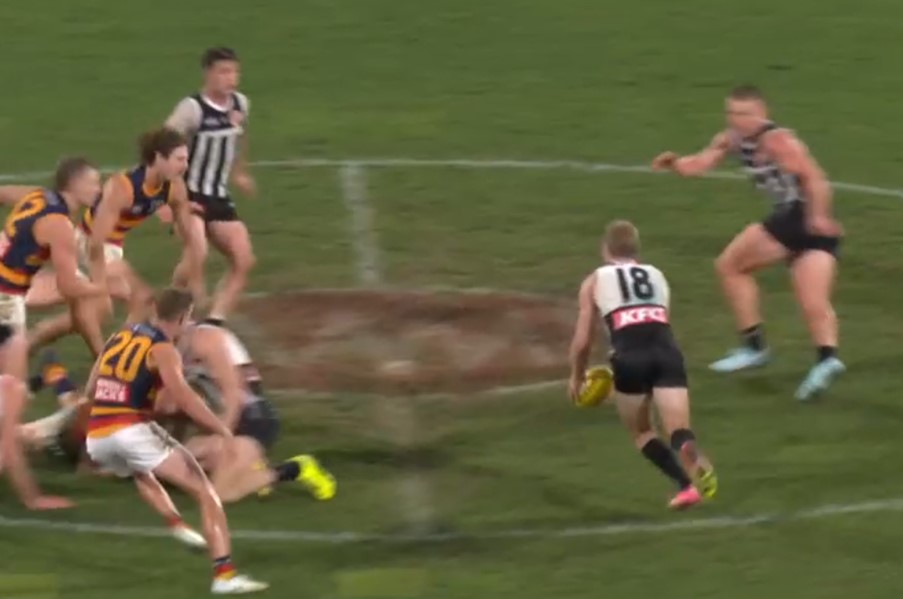
Five games in two years at Collingwood. Five games in his first year at Adelaide. Mark Keane is from County Cork and was skilled at both Gaelic football and hurling— a game featuring amended jousting sticks— with the latter requiring substantial pluck.

He takes six marks tonight, and all attention lands on the last. Maybe moments late in a match acquire falsely enhanced acclaim, but sometimes in life and football, context subverts the text.

Keane’s eyes fixate on the ball with a purity of commitment. He crabs backward and across, almost akin to a country hall line-dancer—I can hear Far Away Eyes chugging along—but the Irishman is more slippery of hip.

His tenure as a backman requires obliviousness to ominous traffic, which can arrive like a freight train—fundamental to the mythic bluesmen so adored by Jagger and Richards.
Up go his periscopic arms and—clunk—the Sherrin’s path is truncated. It might have been an uncontested interception, but the preceding imagination and gallantry offer Keane instant cult status.

With this the remaining 107 seconds unfold in a terse sequence of disposals and turnovers before Sam Berry kicks a behind on the siren.

Did Keane’s grab save the game? Or was it any of a hundred prior events?

*

It was a moment at which to gasp and then smile.

Just like hearing Get Off My Cloud and realising abruptly that while the melody and vocals are frantically urging, and the lyrics are buoyant fun—In the morning the parking tickets were just like flags stuck on my windscreen—Charlie’s drumming was always the deeper, mostly unheralded magic in the song.

Ultimately, whether it’s music or footy, some of the finest artists are those who don’t take centre stage—but make the centre hold.

0

Pub Review: Charlie Watts and the Ramsgate

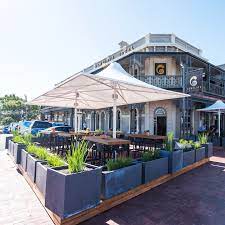
Freshly painted like a Cunard ocean liner, the Ramsgate is a big, majestic seaside pub.

It puts me in mind of similarly white-washed beach-front boozers in Brighton, England and St Kilda in Melbourne. It’s Friday evening and Claire and I are about to dine with Nick and his wife, Chris.

Someone once observed that Glenelg’s Moseley Square is for kids and that you graduate to Henley Square as an adult. I’m not sure the demographics are quite this dichotomous, but it’s a curious thought. I feel lucky that we can enjoy both.

The barkeep speaks my language (a local dialect- Friday Night Thirsty), “We’ve imperial pints for $7.” This was welcome news indeed, but it troubles me that in our tiny colony we differentiate between pints (425ml) and imperial pints (568ml). Surely, a pint is a pint. And I, governor, vote for the big one. It’s like we’ve a South Australian minute that only runs for 45 seconds.

We’re shepherded to our table.

Port and the Bulldogs are playing on multiple screens. A few Januarys’ back Nick and I and some chaps booked lunch in the Ramsgate beer garden to watch the Sydney Test, only to discover that it was showing endless UFC fights. Unable to quickly get some neck tatts we slinked off to the front bar and the gentler magnetisms of cricket.

Nick and I’ve been mates since our Kapunda High days when we bonded over Skyhooks and the Stones’ 1981 album Tattoo You (predating UFC). Later came Midnight Oil and Dylan (for his 21st we gave him a book with the entire collected lyrics of his Bobness) and Nick Cave.

There’s sharing of family histories with ships departing from Hamburg mid-1800’s and Polish Hill and the Victorian goldrush. It’s a compelling privilege to hear the remarkable yarns tracing how you all came to be sitting at the same pub table on an August night. The waiter pays us three patient visits before we’ve decided on our tucker, such is the gusto of our yak. It’s a positive metric.

Claire and Chris finish their bubbles, so Nick asks for a Running with the Bulls Grenache, made in the Barossa. The wine’s Spanish narrative, I’m sure, is designed as a point of difference from the largely German motifs of the valley. Initially, it’s a little sharp but then softens, like a 1950’s hospital matron.

Nick and I have the first of our compulsory conversations about the Rolling Stones and again agree that “Gimme Shelter” is their finest song. I mention reading once of its opening being characterised by “apocalyptic dread” while Nick speaks in awe of Merry Clayton’s backing vocals, probably the most revered in music history.

War, children
It’s just a shot away

Given Charlie Watts’ passing days after our discussion this chat now seems a little haunted.

Claire enjoys her butter chicken while Chris and I each settle upon the lime-infused squid. There’s no audible complaining. Nick’s steak is delayed due to human error, which philosophically, I’d argue, is the only real type of error. Ultimately, he’s pleased with it.

There would seem to be Teal-flavoured human error aplenty on the big screens for at half-time in the footy Port’s only managed a solitary goal. The pub’s front door is shut so we can’t hear the yelping from Alberton.

It’s a prosperous and lively place, this Ramsgate and our night’s replete with conversation, cups and respectable nosh.

Tomorrow night’s a full moon. We stroll up the balmy, windless esplanade for a nightcap.

0

Fun and Feasting at the Beggars Banquet

devil

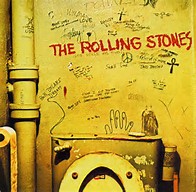
Who forgot the apostrophe? Mick or Keith? Should it be Beggar’s Banquet or Beggars’ Banquet? I prefer the later, imagining a mythical party hosted by the Rolling Stones somewhere like, say, Tangier in Morocco.

Punctuation marks denoting possession aside, this 1968 release is the most fun of their career with sitars, LA’s Watts Street Gospel Choir and a polite devil all prominent. Forgetting the psychedelic swill of Their Satanic Majesties Request, this album’s ambitious but also homage to their American influences.

The music of Satan is not, as many might attest, heavy metal or any of its more ridiculously camp variants. His accompaniment, of course, is something much more seductive. Opening Beggars Banquet is “Sympathy for the Devil” which is narrated by Lucifer himself.

Underpinned by congas the music is a samba: hypnotic, sexual, inescapably charismatic. And there’s the Devil, resplendent in a sharp suit, drawing you in over a cocktail with his allure, but also his invisible menace. Indeed, the opening to this dramatic monologue is a deferential “Please allow me to introduce myself…”

In the days after its release, I imagine God-fearing folk from places like Lynchburg, Virginia quivering at Mick’s vocals, but I reckon it’s now fanciful fun, fetching theatre.

*

In Keith Richards’ autobiography Life my favourite vignette centres upon the young author and his grandfather in Soho, during the austere 1950’s. Upon seeing a poor urchin, the elder asks, “Keith, have you got a shilling?”

“Yes.”

“Good. Now go and give it to that boy. He needs it more than you.” Keith does.

“Well done,” praised granddad, “That’s very kind.” He pressed his fist into Keith’s paw.

Keith opened his hand. In it were two shillings.

*

“Dear Doctor” is the third track and takes us musically and narratively to the American south with the mawkish tale of a doomed boy, trapped to his betrothed.

The melodramatic context is clunky, but it’s one of the record’s fine acoustic songs that could be dismissed as irreverent; making fun of the genre. However, this would misjudge the band’s deep admiration for this music, as they deliver us to their beloved blues and country destinations. Worship, and not cheap parody is driving the pick-up. Such is the authenticity of Mick’s vocal characterisation that the finale is a relief for us all

It read, “Darlin’, I’m sorry to hurt you.

But I have no courage to speak to your face.

But I’m down in Virginia with your cousin Lou

There be no wedding today.

*

In February 1965, my Mum and Dad saw the Rolling Stones at Centennial Hall. It was part of the Showgrounds, but the building is now demolished. A short Par 4 from where I work, and commuting past, I envisage flickering black and white footage and screaming. Shrill, teenaged, screaming.

Roy Orbison took the stage beforehand and with his voice like “the cry of an angel falling backward through an open window” the crowd adored him. But then, Mum and Dad both remember the Stones being booed and jeered. What? They played eight songs with competent energy, but it was too late. Adelaide loved the Big O, and gave the boys from Dartford the Big A.

*

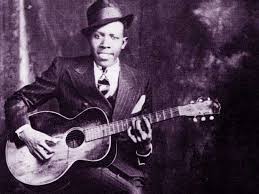
The Rolling Stones are now popularly connected to the electric guitar, but on Beggars Banquet the acoustic songs generate much of the fun. “Prodigal Son” is a country blues, Bible-infused number that on the record’s early pressings was wrongly attributed to Jagger and Richards. It was by the Rev. Robert Wilkins, a Memphis gospel singer and herb medicine specialist whose first recording was “Rolling Stone Blues, Parts I & II.” It dates from 1928.

It’s a reminder that they still loved the blues and regarded themselves as belonging to Memphis as much as London. “Prodigal Son” is a terrific driving song, and the Mississippi swims into widescreen view as Mick’s harmonica eddies and swirls across the speakers.

*

The album is colonized by rich characters and the richest here is the “Factory Girl.” It’s a curious amalgam with violins, South Asian congas or tablas giving it a Hindustani feel and Mick’s mid-Western vowels providing a pilgrimage too. The girl is irrepressible: catching buses, sporting “curlers in her hair” and loving a weekend fight. Even with the “stains all down her dress” she’s attractive. It’s my pet track.

Opening the batting for the band’s astonishing run of form which witnessed consecutive centuries through Beggars Banquet, Let It Bleed, Sticky Fingers and Exile on Main St, it’s a whirling, boisterous set. While it doesn’t gather the acclaim of its successors, it’s their most fun record.

*

And I’m not sure that the title’s absent apostrophe is rock’s greatest grammatical crime. This surely belongs to Paul McCartney’s “Live and Let Die” for its maddeningly redundant preposition, which if you’re not vigilant, sticks in your head like a rusty nail

But if this ever changin’ world

In which we live in.

Ladies and gentlemen, Beggars Banquet!

stones

0

The Sinner of ’69- The Rolling Stones’ Let It Bleed

bleed

It was a hot day in Tanunda and lunch was done. A Sunday, there was energetic engagement with some Carlsberg lagers, and sitting in the garden, Nick and Holmesy1 agreed that these were excellent session beers.2

Of course, there was music. In its desolate, dirty beauty Let It Bleed burst from the outdoor speakers, and I now confess to you, dear reader, that I’d not heard it before. What had gone so wrong for me? My diet had been confined to Get Your Ya-Ya’s Out, Tattoo You 3, and various compilations.

Nick and I saw The Rolling Stones at Football Park in 1995, partly driven by fear of Keith’s mortality. Why did we worry? But I hadn’t properly investigated them as an albums band and was denying myself history’s ultimate run of releases.

Beggars Banquet. Let It Bleed. Sticky Fingers. Exile on Main St.

For me their 1969 record is their best, and while its bookends of “Gimme Shelter” and “You Can’t Always Get What You Want” are correctly celebrated, there are other songs worthy of our attention.

Let It Bleed

This song is so languid; it could be summer in Tallahassee. Each component: guitars, piano, drums and vocals is lazy and loose. The slide guitar and autoharp evoke places remote from the band’s London home while Charlie’s drumming, especially on the outro, is spectacular.

Twenty-year-old Mick Taylor debuted on the album which would be the last for Brian Jones, so incapacitated by drugs and drink that his contributions were minor, and indeed he was soon lost to music, lost to himself. Drowned.

On blossoming display is the genius of Jagger’s singing as his vocals assume an American country twang that could’ve fallen into parody, but here is homage. Over the ensuing decade he’d continue these reverent performances on tracks such as “Dead Flowers” 4 and “Sweet Virginia.”

Damningly, I’ve never heard the song on Australian radio, but its sexual decadence and portraiture would henceforth define the band.

I was dreaming of a steel guitar engagement

When you drunk my health in scented jasmine tea

But you knifed me in my dirty filthy basement

With that jaded, faded, junky nurse oh what pleasant company

 You Got the Silver

For me “Jumping Jack Flash” is caricature. As hard rockers they’re competent, but this is uncomfortable territory; they’re in the wrong church. Nashville and the Mississippi Delta appeal to the band more than Chelsea.5 Blues and country rock are their spiritual habitat.

I’d never appreciated Keith as a singer. But on this song, the first on which he’d take lead vocals, he adopts a character so plausible, in such robust sympathy with his public persona, that it creates a compelling world. Its antagonism was likely inspired by Richards’ then girlfriend Anita Pallenburg, which gives it bemused venom, a telling context.

Hey babe, you got my soul,

you got the silver, you got the gold

A flash of love has made me blind,

I don’t care, no, that’s no big surprise

Both songs reveal The Rolling Stones’ song writing and performing powers, but within a genre not commonly acknowledged. These show imagination, a hunger to grow musically, and remarkable poise- especially as they were not yet thirty.

Our age of downloads and streaming services has made a curio of the album concept, but Let It Bleed is a record of a time and a place that denotes the stratospheric talents of Mick and Keith and their coterie.6

Play it this summer in its ragged, murky entirety. Over a couple Carlsbergs.

Footnotes

  1. Their real names.
  2. Session beers do not include either Coopers Sparkling Ale or Carlsberg’s Elephant beer. Failure to realise this can be catastrophic for all involved.
  3. Tattoo You came out in 1981 and was played on cassette in many HQ Holdens in Kapunda, the town of my youth. “Slave” was an audio calling card for many as we could hear our mates coming around the corner before we saw them, especially for some reason, late on Sundays before we’d go to the Railway Hotel.
  4. A wonderful version of this song by Townes Van Zandt features during the end credits of The Big Lebowski. It captures the laconic nature of the film magnificently and links thematically to The Dude, “possibly the laziest man in Los Angeles County.”
  5. Chelsea, the west London suburb mentioned in “You Can’t Always Get What You Want” the album’s closing song about disillusionment.
  6. Ian Stewart and Nicky Hopkins contribute brilliant piano throughout the album. Merry Clayton’s background vocals on “Gimme Shelter” are rightly recognised as iconic, and in the view of this author are the best of all time.

keef

0

Singapore Darts Masters: “There’s only one word for that – magic darts!”

andy-fordham-throws-in-the-showdown-in-2004-lawrence-lustigpdc_0,,10180-5625416,00

I’m horrified.

The Professional Darts Corporation’s Order of Merit lists a solitary player called Keith. Only one Keith? Like The Rolling Stones?

An AFL equivalent is one culled of every Jaryd, Jarrad, Jared, Jarryd, Jarrod, and Jarred.

With earnings of £1500, number 134 is Dick van Dijk of the Netherlands. Chitty Chitty Bang Bang! One hundred and eighty! When he weighed 31 stone (197 kilograms, 434 lbs.) £1500 was former champion Andy “The Viking” Fordham’s pre-match bar tab.

I’m at The Singapore Darts Masters with a Scot, an Irishman, and another Australian. No, it’s not a joke. It doesn’t finish with, “That’s what she said!” or “I thought you were George Michael!” or “They’re all in the truck and one of them’s honking the horn.”

Ignoring visits to the Docklands, I’ve never laughed so heartily at a sporting event’s price structure:

$501 – First Tier Table Tickets including front row seats, player access, limited edition shirt, bottle of spirit plus mixers, goodie bag, 180 cards, fast food & freeflow beer

$301 – Second Tier Table Tickets including goodie bag, 180 cards, event shirt, fast food & freeflow beer

$180 – Third Tier Tickets including fast food & freeflow beer

$40 – Auditorium Seating, with 25% off for early bird booking (that’s us!)

I rarely play darts. At the pub eight ball and darts are distractions. The pub is the place to go after sport, or to watch sport. But not to play sport.

So, I’m at the arrows for the anthropological insights.

But darts is also a celebration of English pubs. Unlike Antipodean hotels, British boozers are thematic extensions of the living room. Board games, nooks for reading, delightfully dreadful wallpaper. Australian pubs position themselves as being the opposite of home; a place of aggressive escape.

Our local in England was The Goat. Built at the end of the 15th century, it has Chesterfields. There’s water bowls for your dog, and a beer garden with giant Jenga blocks. The landlord wants you in there, enjoying yourself. Collecting your coin is almost an afterthought.

In the Singapore Indoor Stadium’s opening stoush James Wade defeats Peter “Snakebite” Wright. Snakebite sports a technicolour Mohawk and painted skull, while Wade is the one from Finance. “The accountant wins,” I predict. Scottish Andy replies, “They always do. They always do.”

The darts is set in 1982. Like merchant sailors or long-haul truck drivers, some of the players are festooned with ancient tattoos, top of the forearm- no Chinese symbols or wanky Latin maxims here.

The combatants’ shirts are relaxed, except for the girth, where each seems to be smuggling an upturned Sunbeam® Mixmaster® bowl across the Russian border on a dark night.

A cracking soundtrack blasts the arena. The Communards, Style Council, The Church, Stealers Wheel, The Jam. It’s rollicking. The Unicorn darts board is miked up, and each projectile thuds in with a sonically satisfying basso tone like a depth charge in a speeded up submarine movie.

Russ “The Voice” Bray is the score announcer. We’re tickled by his raspy, theatrical style that makes Ray Winstone sound like Barry Gibb. In the UK he lends his larynx to Ladbrokes and Cash Converters. His “One hundred and eighty!” is Tom Waits-tearing-his-hamstring-while-off-the-long-run vocal mania. He and the two official scorers stand with black-shirted backs to us, slump shouldered like Norf London henchmen staring down into Barry’s fresh grave.

Up next is Stoke-on-Trent powerhouse, and former ceramic toilet roll handle maker, Phil Taylor. He and Dave Chisnell exchange 180’s through the middle legs (possibly illegal here).

And Chissy crushes The Power!

“I’m delighted, over the moon,” said Chisnall, fulfilling every British sports-star’s lunar cliché obligation. “I started quite well; my scoring was good at the beginning and I was hitting my finishes well.”

Only twenty-four, Michael van Gerwen is preternaturally talented. On the balcony a cluster of orange-attired girls holler as the Dutch prodigy strides out to The White Stripes’ “Seven Nation Army.”

MVG’s already developing the darts physique, and with his shaven bonce, he’s a hybrid of Gary Ablett Junior and Little Britain’s Matt Lucas. A nine-dart finish is analogous to a hat trick or ten-pin bowling’s 300 game. He first did this on television when he was seventeen.

The boys and I provide our own analysis.

“Loose darts…”

“Tidy darts.”

“Quick darts!”

As our evening evolves we offer more colour.

“Angry darts!!!”

“Pensive darts?”

“Socially enlightened darts.”

“Post-modern darts¿”

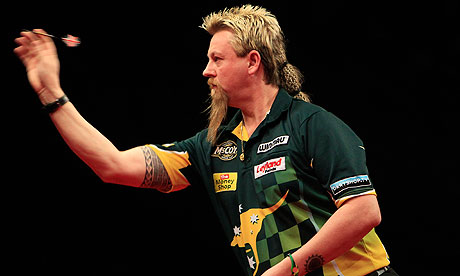
Simon Whitlock’s walk on is “Down Under” by Men At Work. See, 1982! And he does look like Brett Lee. A Brett Lee with a sheet-metal worker goatee, clashing ink, and Willie Nelson ponytail. He strains perilously into the board, but flings like a surgeon. Richie Benaud might’ve observed that, “The slow-motion replay does not really show how fast the dart was travelling.”

Quarter-finals (read in your best BBC voice): Peter Wright 4, James Wade 10; Simon Whitlock 10, Raymond van Barneveld 6; Phil Taylor 6, Dave Chisnall 10; Michael van Gerwen 10, Andy Hamilton 4.

To compensate for the evening’s unspeakable lack of Keiths I listen to Exile On Main St as the MRT hurries under the harbour towards Orchard. And I think of Sid Waddell who once exclaimed, “You couldn’t get more excitement here if Elvis Presley walked in eating a chip sandwich!”

Simon Whitlock

4

Exile on Adelaide Oval: Stone[s] the Crows

HQ

The piano accordion was his passion. For years he performed across the district. A livestock and grain farmer of German descent. So for Christmas his teenaged son, my mate Chris, bought him the New York City drugs and sex soaked Some Girls by The Rolling Stones.

Chris is not alone in offering such gifts. I’ve ordered SK Warne’s autobiography for our youngest, Max. The No-Shane’s-not-named-it-ironically, My Autobiography. It’s perfect for a four year old. Nevertheless, growing up in a dusty town, The Rolling Stones were the band.

Motorists had expectations of me, an adolescent working at a country servo. Smoke and steam, bonnet flung up. Returning from Cadell, the Riverland’s minimum security prison, haunted types’d ask me, “Do you think it’s the head gasket?” I was more familiar with Dollyworld in Pigeon Forge, Tennessee than lumpen V8s. And being a brash undergraduate, I once replied, between swigs of TAB, “Sorry, I can’t help you. I’m a historian.” I was nineteen.

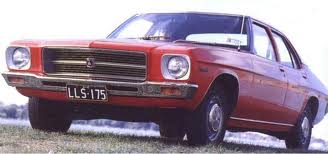
Late every Sunday my cousin Boogly cruised down the hill past Nugget’s Clare Castle Hotel and Trotta’s Hardware to the Esso. Every Sunday I heard Boogly coming, ‘Slave’ from the Stones’ Tattoo You walloping from the speakers in his HQ Holden Kingswood. The music was ridiculous. The music was cool. We loved it.

Do it, do it, do it, do it, do it

Do it, do it, do it, do it, do it

Do it, do it, do it, do it

Don’t wanna be your slave

Don’t wanna be your slave

Don’t wanna be your slave

Genius.

Released in 1981, Tattoo You is their last good record. For their first twenty years The Rolling Stones were VVS Laxman, and for the next thirty they’ve been Jim Higgs, Test batting average: 5.55, but without the menace.

We’d be on the Hill at Adelaide Oval as Viv and Clive and then Viv’s son Richie Richardson went a-clubbing. In the drenching sunshine Nick’d emerge from the bar behind The Duck Pond banner. Juggling trays of West End draught, he’d then recite Mick’s opening to the Stones’ live record Get Your Ya-Ya’s Out, “We’re sorry for the delays. Everybody ready? Let’s really hear it for the next band, The Rolling Stones!”

Tramping into my 21st at the Kapunda Golf Club, Nick was Mick with a Union Jack flag right across his back. In the middle of a pub conversation someone’d channel Jagger, “Charlie’s good tonight.” Or,“ I think I’ve busted a button on my trousers. You don’t want my trousers to fall down, do you?”

Mum and Dad saw them in 1965 at Centennial Hall, but many preferred the support act, Roy Orbison and his operatic baritone. The Stones’ musical and biological mortality threatened, so when the 1995 concert at Footy Park was announced, I had to go. Nick prophesised, “Skeletor (Keith) probably won’t be back in Adelaide. Ever.” Who could disagree?

On an April Tuesday, I pointed my Nissan Exa at Whyalla, eluded the roos, boarded a Piper Navajo Chieftain, and sat on the forward flank as they ran through

Not Fade Away

Tumbling Dice

You Got Me Rocking

Live with Me

Sparks Will Fly

(I Can’t Get No) Satisfaction

Beast of Burden

Far Away Eyes

Just My Imagination (Running Away with Me)

Rock and a Hard Place

I Go Wild

Miss You

Honky Tonk Women

Before They Make Me Run

Slipping Away

Sympathy for the Devil

Monkey Man

Street Fighting Man

Start Me Up

It’s Only Rock ‘n’ Roll (But I Like It)

Brown Sugar

Jumpin’ Jack Flash.

My ultimate Stones set list? Anything from Beggars Banquet, Let It Bleed, Sticky Fingers. The matchless run of form in rock history. Broadly coinciding with Sturt’s SANFL flags in 1966, 1967, 1968, 1969, 1970, 1974 and 1976. Finally, The Beatles, mighty as they’d been, released Let It Be; fatigued and plodding besides some scattered gems.

Ideally, they’d play Exile on Main St in its entirety. In his excellent book on the album Bill Janovich argues

Exile is exactly what rock & roll should sound like: a bunch of musicians playing a bunch of great songs in a room together, playing off of each other, musical communion, sounds bleeding into each other, snare drum rattling away even while not being hit, amps humming, bottles falling, feet shuffling, ghostly voices mumbling on and off-mike, whoops of excitement, shouts of encouragement, performances without a net, masks off, urgency. It is the kind of record that goes beyond the songs themselves to create a monolithic sense of atmosphere. It conveys a sense of time and place and spirit, yet it is timeless. 

When I was nineteen I borrowed the cassette from the State Library, played it lackadaisically in my HQ Holden (everyone in Kapunda drove a HQ) to and from uni, and rejected it. It had country music on it. I was nineteen.

Today side 2, the country side, is my favourite side of any album. Beyond the second side of Abbey Road with its illustrious song medley, or the first side of Belle and Sebastian’s Tigermilk. Exile is muddy and nocturnal. Not only are they the greatest rock ‘n’ roll band. They are the greatest country band too.

The modernised Adelaide Oval hosts The Rolling Stones as Melbourne and St Kilda meet in Round 1 at Docklands. Sympathy for the Bedevilled, or Sympathy for the Devils, who torch a dwarf?

A Showdown then follows. I’ll be in Koh Samui, but will listen to Exile as a tribute. Tex and Paddy are surely Stones men. It would be boorish to say the Power are Beiber types, so I won’t. They’re not even piano accordion fans.

Enjoy the concert. And the footy.

mick