
Let’s imagine a drone hovering over Kapunda.
Gundry’s Hill is the natural place for it to commence with its views across our undulating town. There’s St Roses’ spire, a patchwork of roofs, and the silos standing quietly down near the road to Freeling. The vista is smeared green from the trees lining Clare Road, Mildred Street, and Hill Street which is home to the ancient playground and its old black steam train.
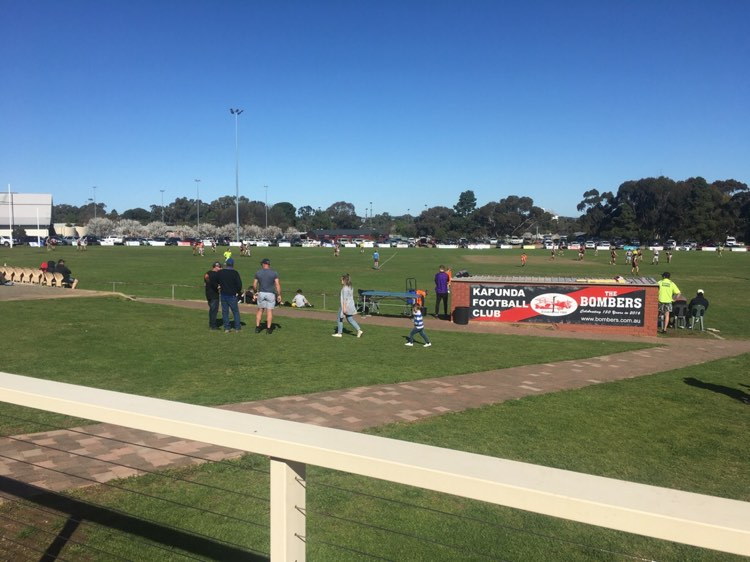
We’re now above Dutton Park and its fetching oval protected by those silent eucalypts. If we listen carefully, we can hear the Mickans chuckling and telling stories. It’s a short flight then to the Duck Pond and if it’s a weekend evening there might be half a dozen cars parked haphazardly on the southern bank, near Dermody Petroleum. There are teenagers draped all across the lawns. My friends. From the tape deck of a car, possibly a Gemini or a Kingswood, you hear this soulful song
Karma, karma, karma, karma, karma chameleon
You come and go
You come and go
Loving would be easy if your colours were like my dreams
Red, gold, and green
Red, gold, and green
We then zip over to the swimming pool. On this hot afternoon we see dotted on the grass untidy groups of kids. Zoom in and they’re munching on Bush Biscuits or a Zooper Dooper before running to the diving board. From this they leap off aiming desperately and adolescently at the canteen, run long-sufferingly by Mrs. Chappell. They try to splash her by doing a storkie, arsey or a coffin. They’re tiresome but determined. The supervisor—an elderly Englishman—yells to the skinny boys, ‘Pack it in!’ They ignore him but he yells again. ‘Pack it in or you’ll have a rest for five minutes!’
A short journey and we pause over the Pizza Bar on the Main Street. Johnny Guzzo is the boss. Again, inside there’s some of the town’s youth and they’re huddled about the Formica tables. Some spill onto the footpath, weighted by black duffle coats and ripple boots. With P plates blutacked to their windows, assorted cars lined up outside. There’s a knot of motorbikes too.
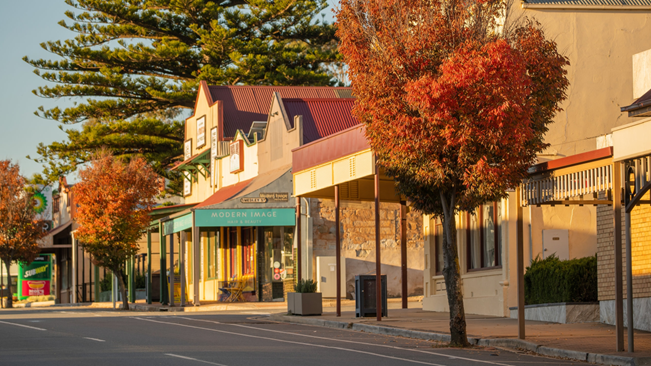
Inside by the windows and next to the pinball machines, a mate’s trying for his best ever score on Frogger. He’s trying to cross the river on logs and—be careful—skip over on the backs of hopefully drowsy crocodiles. But he gets munched and the game’s over. He thumps the glass top of the arcade machine. Johnny’s throwing pizza dough up into ever widening circles and hears the racket. ‘Hey! Do that again and I kicka you out!’
It’s 1983 and for one group of kids, they’re in year 12. Seventeen is an age when much happens but you’re no longer a child and not yet an adult. It’s a fraught, fantastic time. Let’s zoom in and see who they are.
*

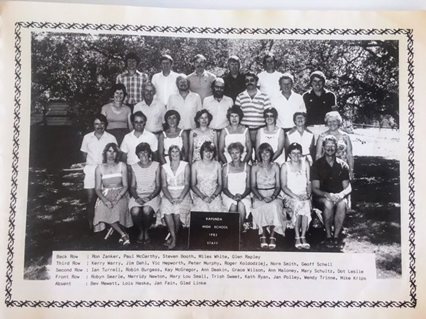
Here’s Kapunda High’s class of 1983. There’s only thirteen of us although this was boosted by the subsequent return of one Paul Masters, and arrival of Eriko, our Japanese exchange student. Then, of course, most of the fifty-odd who began with us in year 8 had left school for a job. Year 12 was matriculation which meant qualifying for university. It an innocent and wonderous time.
This photo was taken on the croquet lawn at the front of the school. I never saw any croquet but sitting on its grass under the autumn sun was calming and peaceable. And it’s such a picturesque setting that a few short decades later it was where the girl fourth from the left and I would be married. No other location presented itself.
There were only fifteen of us, but I thought us an unruly collective. All day long we laughed and yelled and interrupted each other. Thirty years on, talking in the footy club with Macca—our beloved History teacher Paul McCarthy—he told me we were, ‘bright and well-behaved. A really great group.’ In 1983 I sat in a corner next to Chrisso and Davo and we did much together.
Claire and Trish and I had long enjoyed our triangular friendship, and this continued. There were a couple of classmates with whom I barely exchanged words. I didn’t dislike them; we just had little in common and I hope they’re happy and well.
*
Our matric centre was at the front of the school just near the croquet lawn. It was down the cement steps and in Kidman’s bequeathed mansion, Eringa, it had been a servant’s bedroom. A tiny room, it could only fit ten or a dozen of us around the little student tables.
A blackboard hung to the side and an old gas heater sat above the mantle and we’d use it to toast sandwiches until we weren’t permitted. A corridor ran around two of the walls and our individual carrells were lined up there. How lucky that we had our own private desks? Much of our year was spent at these.
In that little classroom we’d conversations which influenced us. Mrs. Schultz, our gentle and wise English teacher, chaperoned us through The Grapes of Wrath with the Joads as they made their emblematic and weighty way from Oklahoma to California through the Mojave Desert.
I recall my terror as she and Trish talked at length about the novel’s symbolism, focusing upon the turtle crossing a highway and how it represented struggle, determination, and hope. Committed to making my own life difficult, I read many Steinbeck novels over the summer and loved them. But, of course, I didn’t finish the compulsory Grapes of Wrath, and generally only saw the turtle as a turtle.
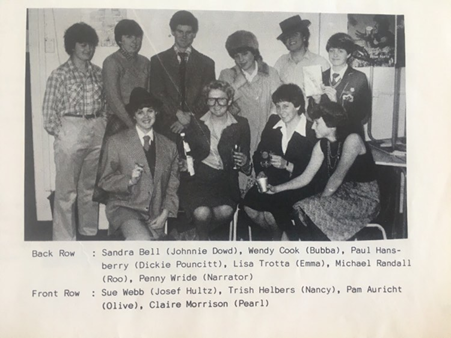
Our Australian History teacher, Mr. Krips, escorted us through a study of our national identity and the apotheosis of the nomad tribe. I’d not encountered the word apotheosis before. It wasn’t used on the cricket, even by Richie Benaud or by Graham Kennedy on Blankety Blanks. It impressed me and I vowed to keep it in my vocabulary as I thought it could have future value. I swiftly forgot it.
Of equal value was the extra-curricular stuff we learnt from our teachers. The girl fourth from the left and Trish always had enthusiasm for curating our experiences and so set up communal diaries in big scrap books. Quickly becoming known as the Crap Books, these enjoyed daily entries, with some contributing more than others. Occasionally Kripsy did too. How great was he? Early in the year he noted the discovery of a musical gem.
Last night I saw Marvin Gaye on TV singing, ‘Sexual Healing’ which was terrific. What a voice! What a performance!
It is a great tune and now when I hear it I instantly think of Kripsy and that tiny, windowless classroom. I hear it with fondness for my classmates and teachers and that fleeting, singular time and place.
Get up, get up, get up, get up
Wake up, wake up, wake up, wake up
Oh, baby now let’s get down tonight!
*
The Coorong is a distance from Kapunda, south of the mouth of the Murray. Until our matric year, school camps had been breezy and amusing affairs. More like holidays than educational experiences. As we had to study both a science and a humanities subject, I found myself in Biology and had to undertake a special personal project. For reasons which over time have only become more bleakly absurd, I was about to immerse myself in the heady, sparkling world of Banksias.
Yes, my teenaged fantasies were all becoming real. I would undertake a vegetation transect. It’s not, however, as glamorous as it sounds.
We stayed in rustic accommodation with Mr. Zanker and Miss Searle. Curiously, I would work with Mr. Zanker decades later at Marryatville High where I taught his daughter in year 12. In 1983, there were about eight of us in Biology and we drove down on Sunday. I recollect none of the journey.
It was cold and grey but one night by a shared metal sink I had a novel experience. One of my classmates, the girl fourth from the left, leant towards me, giggling, and announced, ‘Hey you. Listen to this!’ A brief subterranean rumble followed. We both collapsed into laughter. It was the first time I’d heard a girl fart.
This remains the clear highlight of that camp.
Monday morning was grim and wretched, and it began to rain. I was utterly alone in the middle of a forest of banksias. My task was to measure all sorts of variables like tree height, number of banksia flowers, distance between trees, and other things too hideously dull to itemise for you now.
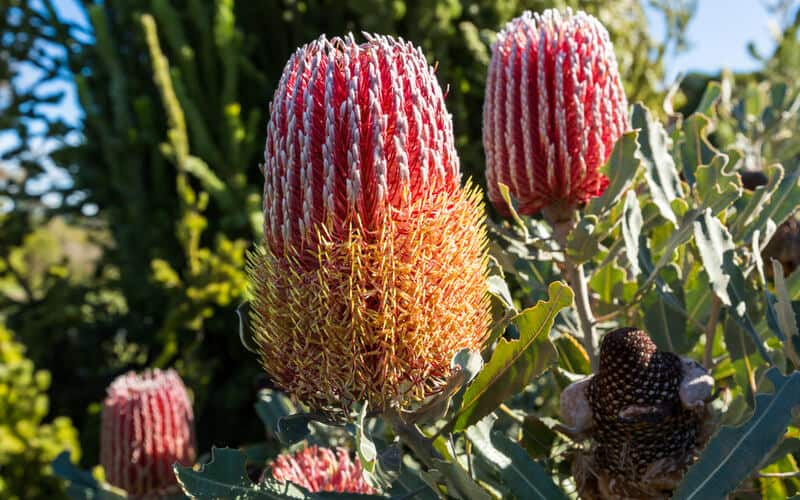
Until then I think I was a kid who just got on with stuff. But this was new for it was an obligation in which I had zero interest. It was a necessity and there was no escape. I sat on the wet ground and my bum became damp. Three more days of this! I reckon it was the first time in my life I was truly bored. Even now I twitch if I see a Banksia. They’re for life, not just the Coorong.
It gave me a glimpse into the dark world of adulthood responsibility. I didn’t like it.
*
The second and final part is coming soon!





 mickeytales