2

Kapunda, Monday: A Drive Through the Quiet

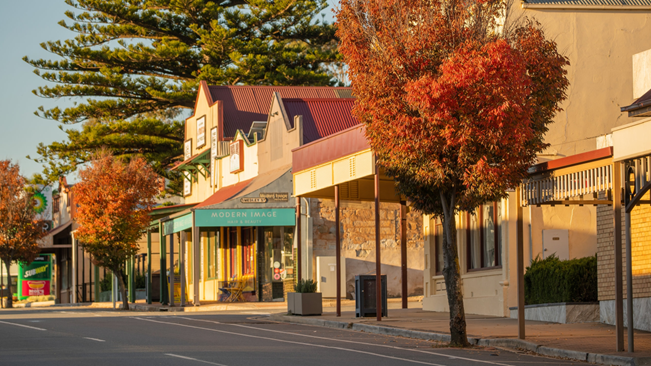
From the top of Gundry’s Hill, Kapunda lies soundlessly below — half-hidden in its jumbled valley.

The topography gifts this view — and encourages a certain kind of reflection. I consider how some of the nearby towns such as Freeling, Nuriootpa, and Tanunda are largely flat — perhaps a little reserved in their landscape. Our steeper hills allowed for a testing upbringing of bike and billycart riding.

Once, the surrounds of Gundry’s Hill were simply paddocks — rolling and empty. Now, a housing estate sprouts, improbably dense. There’s about twenty homes hounded in together — you’d struggle to swing a nine iron between them. However, unlike other locations further north, the population’s climbing.

Driving about I’m gladdened by the early-week industry. People on foot and in vehicles are moving about collecting and depositing stuff, accomplishing transactions, making things happen.

A blue sky presses down on Kapunda, dragged by an icy wind slashing at the trees and roofs. I remember days like these from my childhood. A friend once called it a lazy wind — ‘It doesn’t go around you, just straight through your torso.’ She was right.

I’m curious — profoundly invested — in the high school’s rebuild after the 2022 fire. Eringa now looks familiar and is regaining much of its grandfatherly glory. It’s reclaiming its place as the town’s reassuring heart. The croquet lawn lies beneath a compact row of building site offices and the apron sloping from the grand front steps is crowded with what I hope are temporary structures. The old palm tree stands noble by the basketball court.  

*

Idling through the Dutton Park gates I take a slow lap around the sporting precinct, passing the clubrooms where Claire and I had our wedding reception. I then see the sleek bowls club, tennis and netball courts, and sadly becalmed trotting track — remembering long, dust-kicked laps in the heat of footy’s pre-season. The encircling gum trees bend in the crisp June gusts.

I veer past the old Railway Hotel. Most of it’s intact behind some hopeful orange bunting. I wonder for a moment at what it could become. A motel? Café? Restaurant?  I then shake my head. It’s been decades since the pub fire and nothing’s happened.

Across the road is the Railway Station. It’s now luxury accommodation but I remember Mum taking my sister Jill and I to collect our monthly parcel of State Library books and cassettes. There was always excitement in pulling open the brown paper wrapping to see what’d made the train trip up from North Terrace.

I note mechanics garages all around town. A number have sprung up to service patiently waiting trucks and utes. Diesel motors have feelings, too. A boxing club’s in a shed across from Bald Hill.

The North Kapunda pub is shut although the forlorn loss is yet to drape itself glumly over the veranda and windows. I hope it reopens but Kapunda has probably always been overserviced by pubs. Smiling at the thought of Saturdays in there during the 1980’s — the rowdy white smear of a couple dozen cricketers and I hear, ‘Where are you goin’? You owe me a beer for the Schooner School!’   

In contrast, Puffa’s drive-through has been trading steadily since dawn and just over on Clare Road’s a flashing sign urging punters to drop by for morning coffee and afternoon delights. I love pushing through the front door into its cosy bar but before noon on a Monday’s not really the time. One day soon.

Turning onto Hill Street I spy the sporting mural about which I’ve heard much. I’m carried back to the past and beam at Rocket Ellis, Paul O’Reilly, Davo, and other portraits. Macca — iconic teacher and sportsman — is also there and he once told me, ‘You’ve got it arse about. You hit a cricket ball in the air and a golf ball along the ground!’

I smile at the adjacent mural more broadly acknowledging Kapunda’s story. Much-loved deli owners and revered citizens Eli, Brian, and Reg Rawady are at the rightful centre. I can still hear their distinctive voices, especially Reg’s bellowing baritone. A town that appropriately praises its people and history is surely a healthy place.

At Litl Mo’s bakery, I park outside the former Eudunda Farmers store. Inside’s noisy with older folks concluding their morning tea. As I’m ordering most amble towards the door — leaving behind their coffee cups, chatter, and crumbs. A murmuring din bounces around. ‘See you next week, Bill. Enjoy your golf on Thursday!’ It’s an encouraging hub for the town and a bustling café.
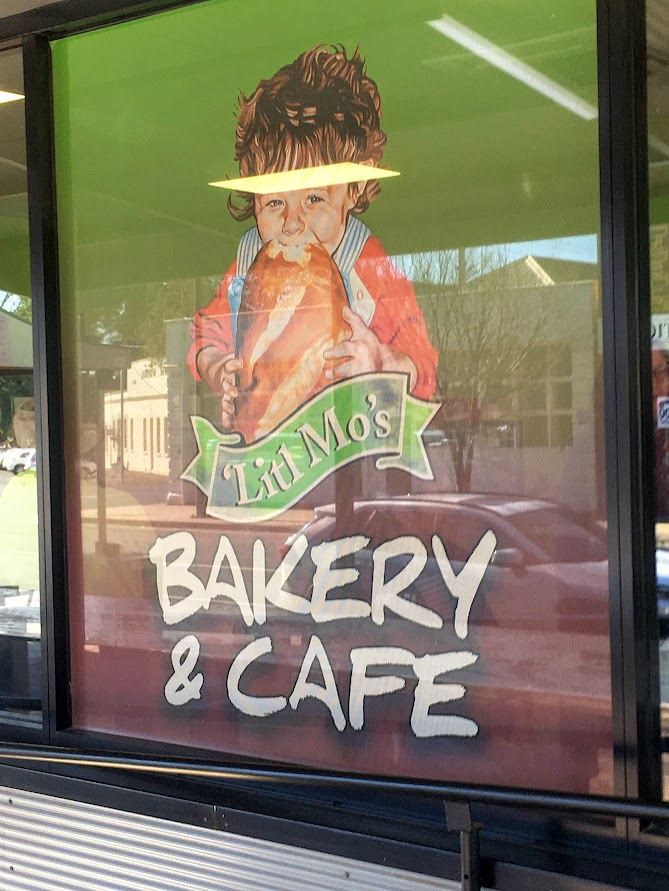
Deciding to eat on the balcony, I spot the dental clinic across the Main Street. It’s new although Dad later tells me it’s been open a while. After too many of Mo’s chocolate donuts, stride across the road to get your teeth fixed.

My sausage roll is excellent. Scrutinising it after a bite or two, I’m thrilled to spot that neglected ingredient: carrot! The taste is delicate and flavoursome. It’s not massive — no need to compensate for tastelessness or oily pastry. It’s a treat.

*

Monday mornings teach you things in a country town. I’ve taken a tranquil drive through memory but have also glimpsed something of Kapunda’s boisterous and bright future. There’s movement beneath the quiet.

2

Kapunda, 1983: Dutton Park to the Duck Pond

Let’s imagine a drone hovering over Kapunda.

Gundry’s Hill is the natural place for it to commence with its views across our undulating town. There’s St Roses’ spire, a patchwork of roofs, and the silos standing quietly down near the road to Freeling. The vista is smeared green from the trees lining Clare Road, Mildred Street, and Hill Street which is home to the ancient playground and its old black steam train.

We’re now above Dutton Park and its fetching oval protected by those silent eucalypts. If we listen carefully, we can hear the Mickans chuckling and telling stories. It’s a short flight then to the Duck Pond and if it’s a weekend evening there might be half a dozen cars parked haphazardly on the southern bank, near Dermody Petroleum. There are teenagers draped all across the lawns. My friends. From the tape deck of a car, possibly a Gemini or a Kingswood, you hear this soulful song

Karma, karma, karma, karma, karma chameleon
You come and go
You come and go
Loving would be easy if your colours were like my dreams
Red, gold, and green

We then zip over to the swimming pool. On this hot afternoon we see dotted on the grass untidy groups of kids. Zoom in and they’re munching on Bush Biscuits or a Zooper Dooper before running to the diving board. From this they leap off aiming desperately and adolescently at the canteen, run long-sufferingly by Mrs. Chappell. They try to splash her by doing a storkie, arsey or a coffin. They’re tiresome but determined. The supervisor—an elderly Englishman—yells to the skinny boys, ‘Pack it in!’ They ignore him but he yells again. ‘Pack it in or you’ll have a rest for five minutes!’

A short journey and we pause over the Pizza Bar on the Main Street. Johnny Guzzo is the boss. Again, inside there’s some of the town’s youth and they’re huddled about the Formica tables. Some spill onto the footpath, weighted by black duffle coats and ripple boots. With P plates blutacked to their windows, assorted cars lined up outside. There’s a knot of motorbikes too.

Inside by the windows and next to the pinball machines, a mate’s trying for his best ever score on Frogger. He’s trying to cross the river on logs and—be careful—skip over on the backs of hopefully drowsy crocodiles. But he gets munched and the game’s over. He thumps the glass top of the arcade machine. Johnny’s throwing pizza dough up into ever widening circles and hears the racket. ‘Hey! Do that again and I kicka you out!’

It’s 1983 and for one group of kids, they’re in year 12. Seventeen is an age when much happens but you’re no longer a child and not yet an adult. It’s a fraught, fantastic time. Let’s zoom in and see who they are.

*

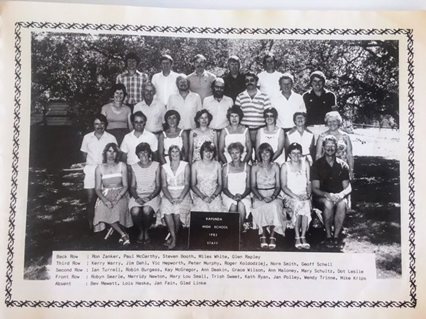
Here’s Kapunda High’s class of 1983. There’s only thirteen of us although this was boosted by the subsequent return of one Paul Masters, and arrival of Eriko, our Japanese exchange student. Then, of course, most of the fifty-odd who began with us in year 8 had left school for a job. Year 12 was matriculation which meant qualifying for university. It an innocent and wonderous time.

This photo was taken on the croquet lawn at the front of the school. I never saw any croquet but sitting on its grass under the autumn sun was calming and peaceable. And it’s such a picturesque setting that a few short decades later it was where the girl fourth from the left and I would be married. No other location presented itself.

There were only fifteen of us, but I thought us an unruly collective. All day long we laughed and yelled and interrupted each other. Thirty years on, talking in the footy club with Macca—our beloved History teacher Paul McCarthy—he told me we were, ‘bright and well-behaved. A really great group.’ In 1983 I sat in a corner next to Chrisso and Davo and we did much together.

Claire and Trish and I had long enjoyed our triangular friendship, and this continued. There were a couple of classmates with whom I barely exchanged words. I didn’t dislike them; we just had little in common and I hope they’re happy and well.

*

Our matric centre was at the front of the school just near the croquet lawn. It was down the cement steps and in Kidman’s bequeathed mansion, Eringa, it had been a servant’s bedroom. A tiny room, it could only fit ten or a dozen of us around the little student tables.

A blackboard hung to the side and an old gas heater sat above the mantle and we’d use it to toast sandwiches until we weren’t permitted. A corridor ran around two of the walls and our individual carrells were lined up there. How lucky that we had our own private desks? Much of our year was spent at these.

In that little classroom we’d conversations which influenced us. Mrs. Schultz, our gentle and wise English teacher, chaperoned us through The Grapes of Wrath with the Joads as they made their emblematic and weighty way from Oklahoma to California through the Mojave Desert.

I recall my terror as she and Trish talked at length about the novel’s symbolism, focusing upon the turtle crossing a highway and how it represented struggle, determination, and hope. Committed to making my own life difficult, I read many Steinbeck novels over the summer and loved them. But, of course, I didn’t finish the compulsory Grapes of Wrath, and generally only saw the turtle as a turtle.

Our Australian History teacher, Mr. Krips, escorted us through a study of our national identity and the apotheosis of the nomad tribe. I’d not encountered the word apotheosis before. It wasn’t used on the cricket, even by Richie Benaud or by Graham Kennedy on Blankety Blanks. It impressed me and I vowed to keep it in my vocabulary as I thought it could have future value. I swiftly forgot it.

Of equal value was the extra-curricular stuff we learnt from our teachers. The girl fourth from the left and Trish always had enthusiasm for curating our experiences and so set up communal diaries in big scrap books. Quickly becoming known as the Crap Books, these enjoyed daily entries, with some contributing more than others. Occasionally Kripsy did too. How great was he? Early in the year he noted the discovery of a musical gem.

Last night I saw Marvin Gaye on TV singing, ‘Sexual Healing’ which was terrific. What a voice! What a performance!

It is a great tune and now when I hear it I instantly think of Kripsy and that tiny, windowless classroom. I hear it with fondness for my classmates and teachers and that fleeting, singular time and place.

Get up, get up, get up, get up
Wake up, wake up, wake up, wake up

Oh, baby now let’s get down tonight!

*

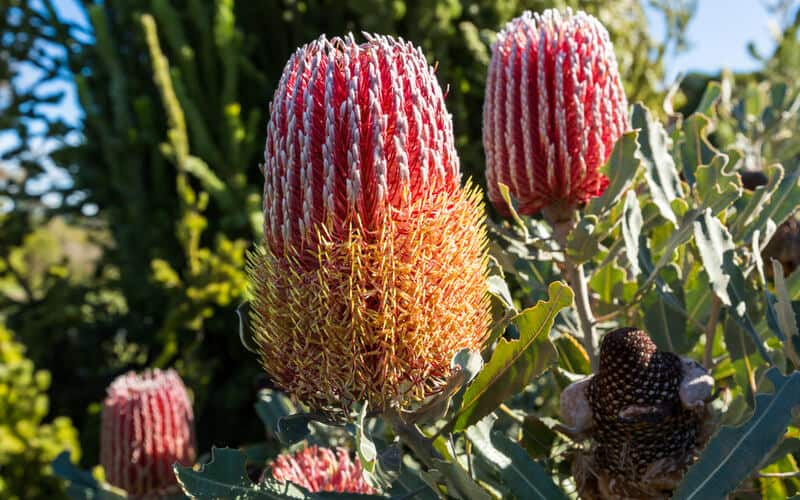
The Coorong is a distance from Kapunda, south of the mouth of the Murray. Until our matric year, school camps had been breezy and amusing affairs. More like holidays than educational experiences. As we had to study both a science and a humanities subject, I found myself in Biology and had to undertake a special personal project. For reasons which over time have only become more bleakly absurd, I was about to immerse myself in the heady, sparkling world of Banksias.

Yes, my teenaged fantasies were all becoming real. I would undertake a vegetation transect. It’s not, however, as glamorous as it sounds.

We stayed in rustic accommodation with Mr. Zanker and Miss Searle. Curiously, I would work with Mr. Zanker decades later at Marryatville High where I taught his daughter in year 12. In 1983, there were about eight of us in Biology and we drove down on Sunday. I recollect none of the journey.

It was cold and grey but one night by a shared metal sink I had a novel experience. One of my classmates, the girl fourth from the left, leant towards me, giggling, and announced, ‘Hey you. Listen to this!’ A brief subterranean rumble followed. We both collapsed into laughter. It was the first time I’d heard a girl fart.

This remains the clear highlight of that camp.

Monday morning was grim and wretched, and it began to rain. I was utterly alone in the middle of a forest of banksias. My task was to measure all sorts of variables like tree height, number of banksia flowers, distance between trees, and other things too hideously dull to itemise for you now.

Until then I think I was a kid who just got on with stuff. But this was new for it was an obligation in which I had zero interest. It was a necessity and there was no escape. I sat on the wet ground and my bum became damp. Three more days of this! I reckon it was the first time in my life I was truly bored. Even now I twitch if I see a Banksia. They’re for life, not just the Coorong.

It gave me a glimpse into the dark world of adulthood responsibility. I didn’t like it.

*

The second and final part is coming soon!

0

Kapunda perspectives: Gundry’s Hill, the Duck Pond, and Dutton Park

We’re doing a lap of Kapunda because it’s probably illegal to come home and not.

So, Lukey and I drive up to Gundry’s Hill. We’ll then swing by the Prince of Wales for a brisk beer before heading to the footy.

We hop out and wander around the grassy knoll. The sky is cloudless, and the rolling hills and crops are a reassuring green.

Glancing about I wonder does everywhere look better from a bird’s eye? Does it always provide a heavenly view? Ascending, do our earthly imperfections vanish?

What happened as we grew up in our town, nestled in that mundane, enchanted valley? Everything and nothing. It was hot and dusty, and cold and muddy. Can you be atop even the smallest hill and not become philosophical? Is private awe guaranteed?

Seeing the whole helps me remember the grainy episodes and to time-travel. I locate the spire of St Roses Catholic Church and it’s midnight mass and I’m an altar boy with lads who, for Father Moore, didn’t always behave like altar boys.

My eye finds the tiny primary school oval. I remember lunchtimes and my classmate Grant Dodman kicking what eleven-year-old me regarded as impossibly prodigious torpedo punts.

What do those from flat towns like Freeling do? How do they access a dreamy perspective?

With this elevated silence on Gundry’s Hill comes warming gratitude. I again gaze out across this modest, little town.

It becomes gentler and postcard-pretty.

*

Between the four pubs of the main street and the oval sits the Duck Pond. Although we knew the family well, nobody I know uses the official name, Davidson Reserve.

This ornamental lake was witness to youthful distraction. As with any locality on a map the geographical value is in the personal narratives.

Undertaking our compulsory tour of our hometown’s landmarks, Lukey and I pause and ponder by the water.

It’s suddenly our teenaged 1980’s.

I remember the cars we owned and can see them clustered conspiratorially by the Duck Pond. There’s Trisha’s Hillman Imp, all English and apologetic. Woodsy’s 180B in which one summer we did two ridiculous laps of Bathurst. My wife Claire’s (sadly our nuptials were a way off) little red and white mini, like an extra from Carnaby Street, London. There’s Lukey’s Alfa Romeo which aside from the then new Chinese restaurant in Nuriootpa, was the most exotic thing I knew.

The Saturday night vista is completed by a crowded used car lot of white HQ Holdens.

If I shut my eyes Stephen Trotta’s green Gemini has all the windows down and the Pioneer stereo volume up. A TDK C-90 cassette is playing. ‘US Forces’ by Midnight Oil blasts across the dark water and then we hear Mondo Rock’s moodily suggestive, ‘Come Said the Boy.’

As Dickens wrote, it was the best of times.

*

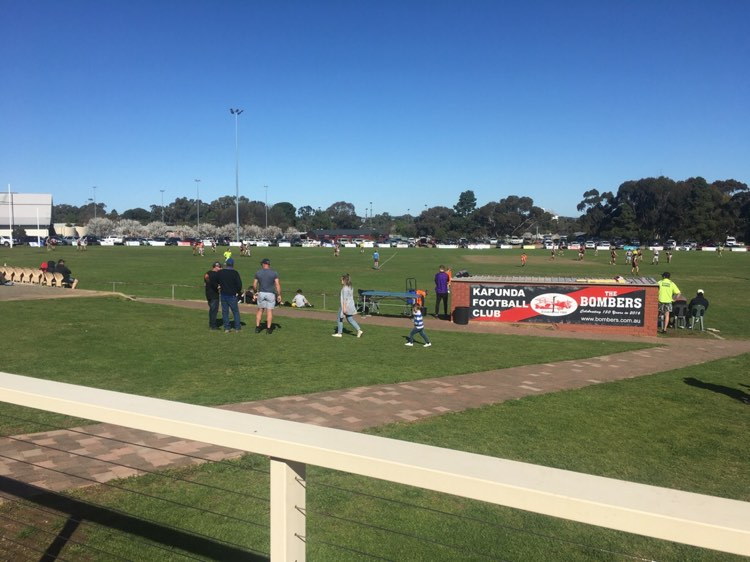
It’s a glorious late-winter’s day beneath the eucalypts at Dutton Park as the B grade footy concludes.

We’re here to see old friends and recount some well-worn tales. Woodsy, Keggy, Hollis, O’s. Fats and Chipper had called into Puffa’s. Whitey’s elsewhere.

Knots of timeworn faces huddle in front of the changerooms on the new wooden deck. Orange bunting separates us from the reunions of the 1973 B grade (Dad’s a member but can’t be here today) and Senior Colts premiers.

There’s something poetic about the equine term ‘colts’ for footy teams that’s much better than the numerical Under 17’s or Under 14’s. Looking over at the often less than sprightly reunionists someone says, ‘That’ll be us soon boys.’

There are folks I’ve not seen for decades like Kelpie Jarman and Peter Masters but the years melt away because we all lived in the same town.

I see three of the Mickan brothers in Goose, Drew, and Richie and have a quick chat with Macca. There’s much handshaking. By the canteen I bump into Fergy. In the morning he’s again off to Arkaroola and we share our experiences. Claire and I went there and to Hawker and Rawnsley Park on our honeymoon.

Early in the A grade Kapunda leads with three goals to two but then by quarter time it’s 13 majors to Angaston and not nearly enough for the Bombers. Nobody seems to mind for the air’s awash with nostalgia.

The first job, as always, when we congregate, is to organise the next event, so arrangements are made to visit Christmas Higgins’ brewery in Greenock. Before Christmas, of course.

I later learn that Morphettville race 9 is won by number 4. A seven-year-old bay gelding, its name is Angaston. And their team salutes too. By 25 goals.

But on the footy club deck it’s all chortles and familiar stories. Homecomings aren’t universally adored so I’m lucky to love these moments.

After the siren I drive south from this modest, little town.

6

Beer Review: Southwark Bitter

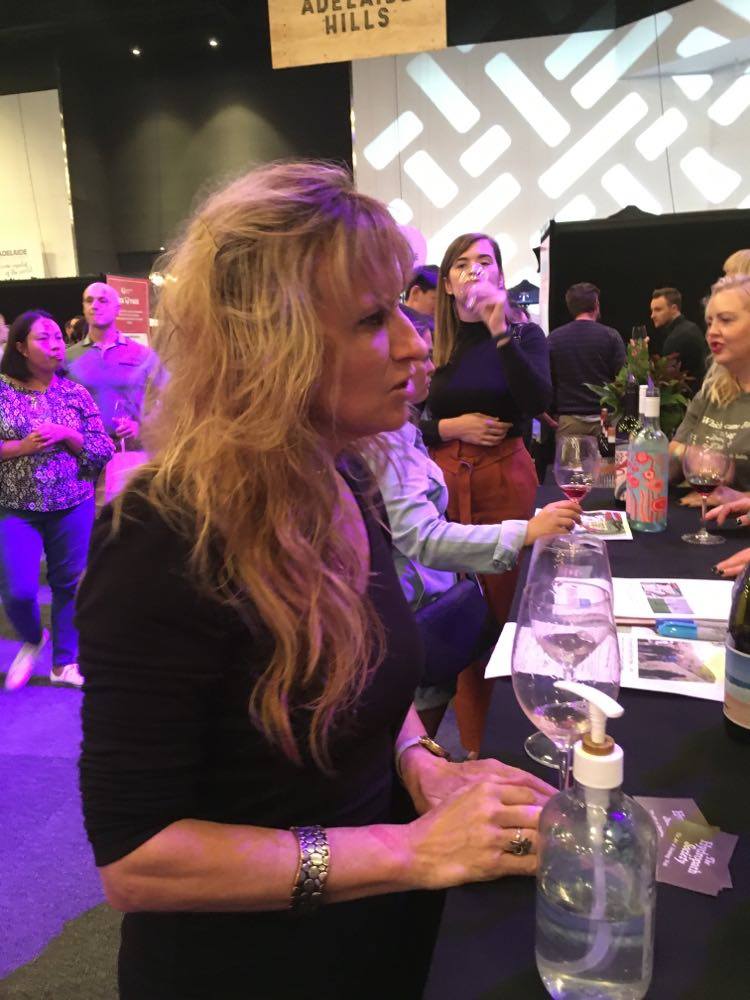
As we ambled along the grey beach this morning and the dogs scampered in the wet sand and we chatted about yesterday’s Cellar Door Fest I thought of many wonderful things for which I’m grateful.

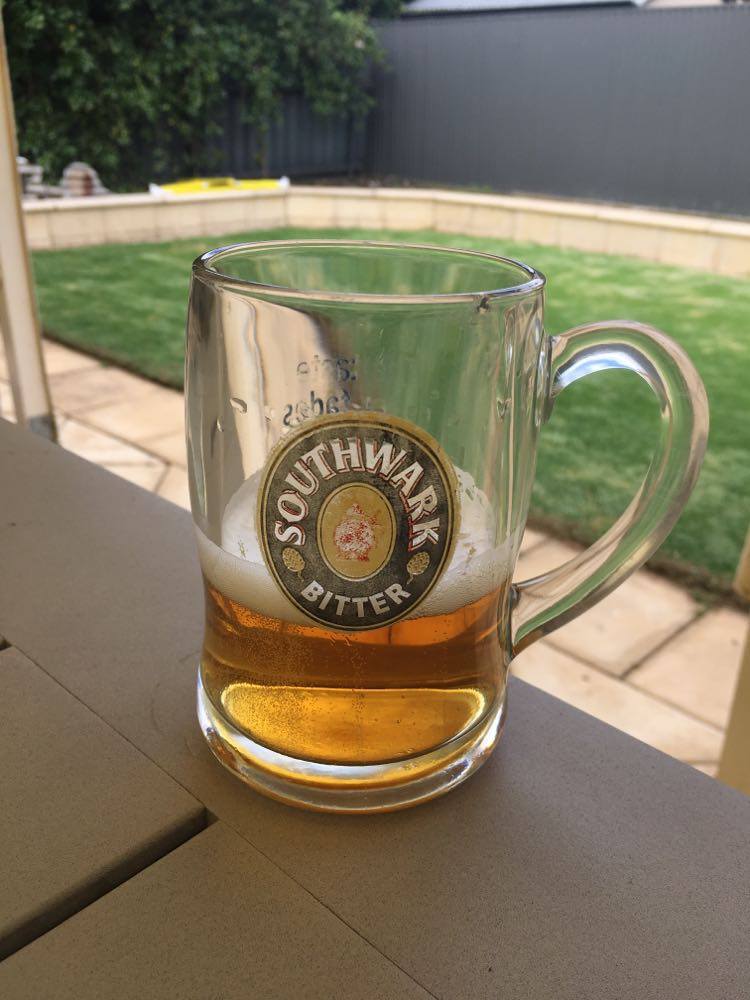
Oddly, Southwark Bitter was absent from this gentle Sunday mindfulness, but now here I am on the patio with a distinctive green can. It’s time to revisit. Excursions into nostalgia should be occasionally inclusive and with the radio on, the lawn freshly mown, and the water feature bubbling along, I flip open the can. I expect it to be combative.

It smells more beery than beer. There’s nothing post-modern or aspirational present. It’s unapologetic, and I know that on Southwark’s playlist there’s just too many songs by The Angels. But, wait, perhaps the aromatics aren’t as boisterous as I remember. There’s a familiar charm, and it’s like the old cricketer who batted at ten, didn’t bowl and had to be hidden in the field. You and your team-mates loved him.

I take a few cautious sips, and personal history makes me expect to be clobbered in the gob. But I’m not. It’s not nearly as angular and cantankerous as my last venture into this beer-themed savannah. It’s smooth and almost subtle. Disbelieving, I check the can. Yep, Southwark. I replaced some lawn this morning and can now feel the effects of shovelling (yes, I used my skimming shovel) and wonder if I’m experiencing some sensory side-effects of this rare Sunday exertion.

A plane takes off from Adelaide airport and with a low scream climbs out across St Vincent’s Gulf. Buddy, the dog moves and Triple J plays a song I don’t know.

I keep two glass Southwark mugs in the freezer and sometimes bring these out on hot days when guests call in. It’s more theatrical than real but the frostiness adds a brief frisson to our shared enterprise. Given that I’ve bought a Southwark for the first time this millennium I decide it would be churlish not to marry beer and ancient mug. So, I do.

This seems to exaggerate the trademark bitterness and now my 2021 experience starts to approach the one I recollect from those dusty Kapunda afternoons after cricket or by the Duck Pond with other misshapen youth or up at Gundry’s Hill with Fats blasting Mondo Rock out of his car boot. The universe settles back onto its known axis. It’s been a curiously rewarding event, and the beer has over-delivered. I’m strangely pleased.

With a determined swallow I finish my mug of beer and sit it down on the table. I wonder when I’ll next have a Southwark.

I look over at the dogs. They don’t seem to know either.