2

Four pubs and a funeral

Yesterday I went to the funeral of my dear mate Bob’s brother Jeff. We all went to Kapunda High. He’d passed away too soon. He left a young wife and two daughters. He was 48.

The service was in Gawler and closed when the casket was draped with a Hawthorn footy club flag and their team song was played on a loop. Training as a junior with Central District he’d idolised Johnny Platten.

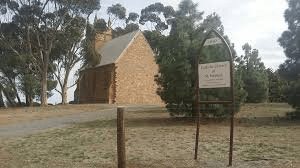
Jeff was laid to rest in the church cemetery where a couple decades’ prior he’d married a local girl. Atop this hill just outside of Saddleworth, the wind roared from the north in that menacing, apocalyptic way, as the temperature screamed into the hundreds. Fahrenheit, as always, seems more appropriate for these timeless occasions.

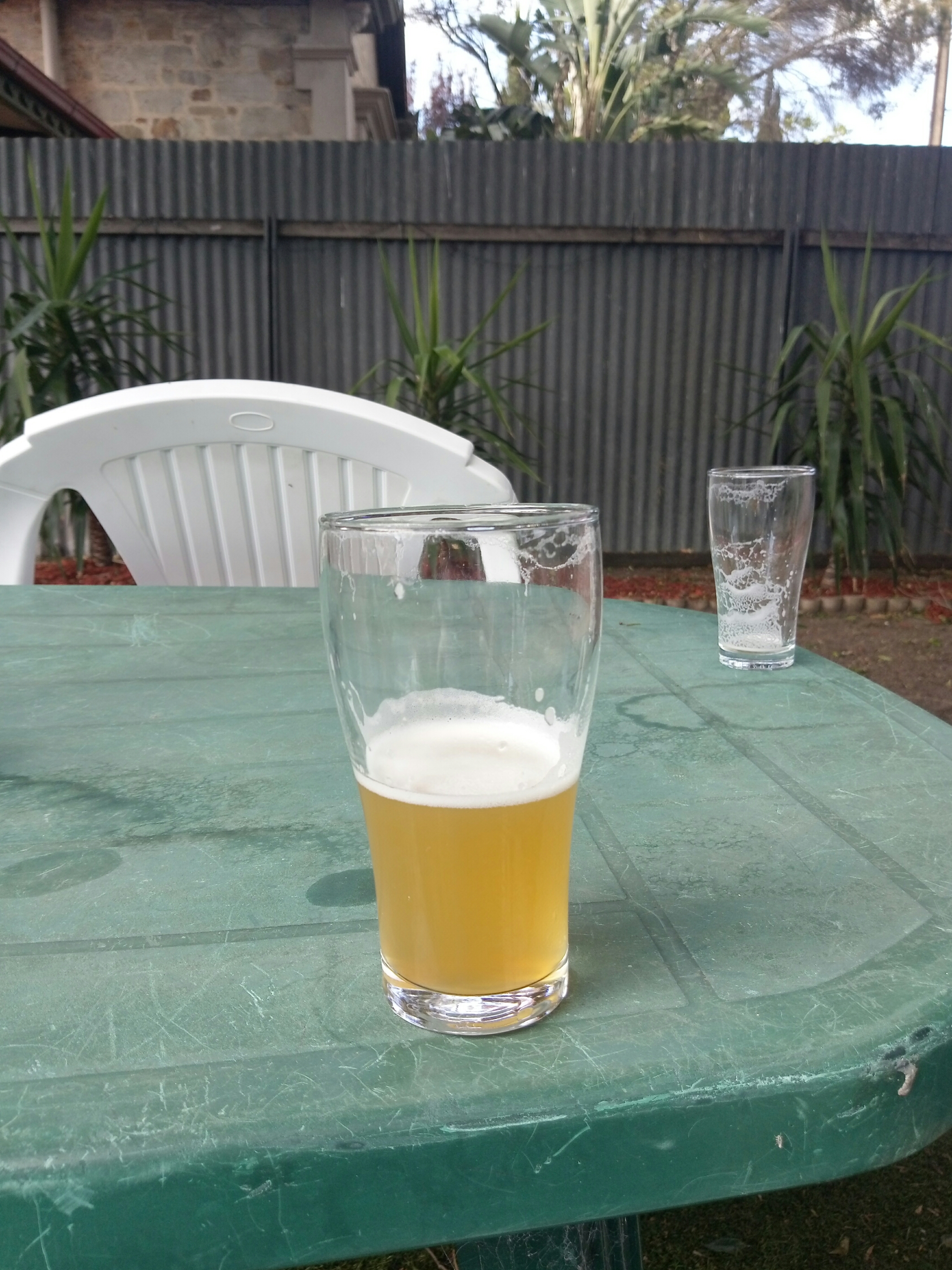
In the interim we called into the Gilbert Valley pub. It’s one of those places that has the take-away drinks fridges in the bar itself. Puggy and I had a quick pint of Session Ale. In a corner below the tele two chaps wearing farming equipment hats were slumped. For some reason the screen was showing an old movie, and not the cricket. They were drinking West End Draught cans.

GV

There was a reception at the bowls club. While the party pies, sausage rolls and scones were all in attendance the sandwiches, of course, were uniformly excellent. For the first time in ten years I saw a girl I went to school with Gert*, and her husband Kempy* against whom I’d played footy and cricket. Again I was reminded of my unbreakable home bonds of school and growing up. On a day of mixed emotions this was a lovely moment.

Saddleworth

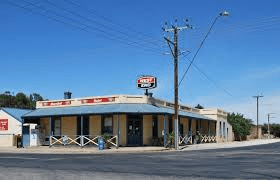
Mid-afternoon our convoy of two conveyances set forth towards Marrabel and its singular pub. I reckon I’d last been inside in 1986, and as near as I could tell all was as I’d left it. Most of us opted for a West End from the keg, largely on account of it being the only draught option.

Marrabel is a town known for its eponymous rodeo, and so we searched the pub wall photos for Kapunda’s champion bull rider and colourful identity, the late Les Cowan. One of the Hayward brothers, Hollis, and I reckon we spotted him clinging to a vertical beast, frozen but waiting for the eight-second horn. However, the memorbilia had no caption so we couldn’t be certain.
Marrabel

Among the flow of cricket stories, both recent and prehistoric, we then paused to toast Jeff, while Chris also hoped that 2019 could be funeral-free.

We then pushed on through Hamilton where there were four churches and a now vacant shop. I wonder how many kids live there today and go to Kapunda High. There was once a dedicated school bus. The earth is desperately brown and scorched.

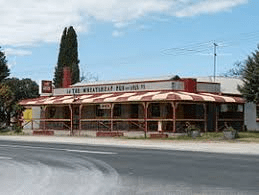
As always it is a treat to call into the Allendale pub. It is cosy, welcoming and inn-like in its charisma. Happily, Greenock Creek ales are on tap. Indeed, two of the four offerings are from our old school mate Chris Higgins and his thriving micro-brewery. A trip home, even amid awful circumstances such as those of today evoke much, both good and bad.
Allendale

It was time to continue our cricket reminisces. Of course we spoke of the Lyndoch Cricket Club which at tea breaks provided the most gentlemanly afternoon tea, all scones and egg sandwiches and pleasant conversation.

First experiencing this as an eighteen year old- the day Wocko took a hat trick- made a mark on my young self. Of course, once this culinary interlude concluded and the locals again stepped across the mythical white line psychopathic hostilities resumed. Both accompanying cousins, Froggy and Puggy understood.

I then dragged out the old chesnut concerning Rodney Hogg and his debut appearance at Mildura’s Willowfest. Handed the ball the recently retired Australian quick heard from the boundary, “Bowler’s name?” The captain answered only to hear, “One ‘g’ or two?”

Finally we adjorned to Kapunda’s Prince of Wales. It was the natural conclusion for our day. Although only six in physical number our party expanded courtesy of the anecdotes. Froggy and Hayward the Elder had a moment of faux disappointment concerning some confusion among the beverage orders.

Prince

Night was gathering when we then heard of the night at the Mickans when Paul E. White, having smoked the brothers in cards, starting counting the cash. One of the brothers Mickan admonished him saying, “You know it’s not etiquette to count your money while still at the table.” His voice rising its customary couple octaves, Whitey retorted, “I’m not counting my money d**khead, I’m counting yours!”

And so homewards.

The good that comes of funerals is community and connection, and the silent vows we take from these to live well, to stride with purpose and to take care of each other.

It is how we can honour the deceased and ourselves.

Vale Jeff.cemetery
3

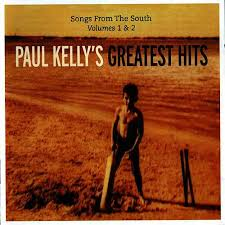
Paul Kelly’s “How to Make Gravy” and me

songs from the south

My favourite Christmas song is twenty-two. But it seems as though it’s been around forever. Like Love Actually, which premiered in 2003, they’re both part of the festive furniture, and signal the season’s arrival.

It’s the 21st of December and our protagonist Joe, freshly imprisoned and hotly anxious, reaches out to his brother. But is “How to Make Gravy” a letter or a phone call? Initially, the form seems spoken- “Hello Dan, it’s Joe here,” but then moves to a written mode- “I hope you’re keeping well.” Which is it? I don’t know.

Over four and a half minutes, this mystery of the medium continues while we meet the brothers; Angus; parents Frank and Dolly; Joe’s wife Rita; his kids; sisters Stella and Mary; Mary’s former boyfriend, the olfactorily-offensive one (just a little too much cologne) and, of course, the almost missable Roger.

Although most are only mentioned once they’re Australia’s first family of Christmas song. We feel like we know them. Despite these skeletal sketches, they’re writ large. Dolly’s the uncrossable matriarch. I can imagine having a beer with Angus, and if he were alive surely Bill Hunter would play Frank in the film version, all gruff wisdom and barbeque tongs.

‘How to Make Gravy’ begins with opening chords similar to Thunderclap Newman’s ‘Something in the Air’ but its guitar riff by the recently-departed Spencer P. Jones almost nods in homage to the British band’s late-sixties hit song. This might be partly why Kelly’s tour de force seems like it’s been around longer than 1996. It’s deep in our musical tectonics.

Across the top and also underneath is that doleful slide guitar, foreshadowing the anguish to come. Exhilarating, it’s suggestive of outback space and tropical heat and melancholic veranda conversations.

The next surge is when Peter “Lucky” Luscombe’s drums kick in with an electrifying jolt at, “I guess the brothers are driving down from Queensland and Stella’s flying in from the coast”.  I was drawn to the song upon its release, and taught it (and Radiohead’s “Karma Police”) to year 10 classes.

I’d only considered it as a stand-alone song until I read this from the singer: “I’m sort of aware where certain songs are written a few years apart from each other – ‘To Her Door,’ then ‘Love Never Runs on Time’ and ‘How to Make Gravy’ – I’ve got a feeling it’s the same guy. He keeps coming back.”

Here Kelly’s created a fictional universe, or at least some intertextuality, especially as the line, “Tell ’em all I’m sorry, I screwed up this time” indicates a wider backstory, an extended narrative, featuring our central character and his wife Rita.

And what of that famous recipe for gravy?

“It’s a real recipe of my first father in law, which he used and which I still use. When I make gravy for my family, that’s the recipe that I use, and now they always make me, make the gravy. It’s my job now (laughs). When I made up the song it wasn’t my job but it is now. Sometimes art influences life or the other way around.”

I love how the song’s acknowledged with today, December 21, declared national Gravy Day. There’s even a hashtag- #GravyDay.

A portrait of timeless Australia, it’s as evocative as the timber pylons of the Port Willunga jetty; a backyard cricket match; the ribbon of road unrolling across the Hay Plains.

As the boys splash about in the twinkling pool on Christmas morning, and I sneak my first piece of ham I anticipate that plaintive strumming and forlorn slide guitar and hearing, yet again, Joe’s confessional.

2

Pub Review: The Cumberland, Glanville

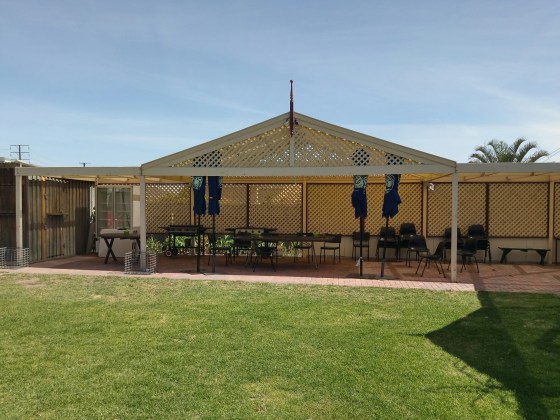
Plenty of room for you and yours in the beer garden

I had one final chance to visit a pub down the Port. I was offered plenty of advice.

“The Largs Pier is a beautiful old building.”

“The British is nicely renovated.”

“The Port Dock Brewery is good fun.”

But, for the moment, no to all of these.

A colleague said, “I reckon you’d find the Cumberland interesting.”

And so last Tuesday afternoon we ventured over the bridge, with Cruickshank’s Beach among the pylons, along Semaphore Road and then towards Glanville Railway Station which eases past the window.

There it was. The Cumberland, or as all such pubs must be known, The Cumby.

Australia is a vast country with many modern and featureless suburbs bigger than European cities. This is why the Port is terrific. Jump in your jalopy and in five minutes you can drive through Port Adelaide, Birkenhead, Semaphore, Exeter and Glanville where the geography is intricate and brutal, welcoming and rich.

Oh dear

Certainly in Britain there’s a whole realm of interest in pubs located by railway stations. Oodles of websites are dedicated to this genre alone.

Sauntering into the front bar the six patrons all ceased their conversations and took us in. If a honky tonk pianist had been banging the ivories he, too, would’ve stopped suddenly.

The publican, Michael Parker, or The Rev as most call him, was friendly and helpful, especially when chaperoning my friend, JB, through the forest of cider choices.

We ventured out the back to the beer garden’s large lawn and sheltered benches, but it was barren, save for a Port Power flag hanging flaccidly in an upstairs window. Sometimes, having too much space to yourselves is unappealing so on we explored.

Next we came across the live music room with its blackened stage. In recent months it has hosted the legendary Kevin Borich Express, and while I must confess to a personal connection, the magnificently-monikered Don Morrison’s Raging Thirst (I’m married to Don’s sister Claire). I reckon Tim Rogers and Tex Perkins would both go well in the Raging Thirst.

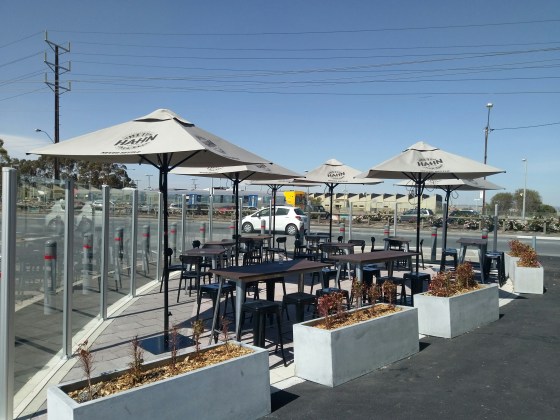
Punters can watch the world go by

Sitting on our stools out the front of the Cumby the mis en scene of sky, battered earth and noiseless trains sliding in and out of the railyard was a compelling palette. It was natural, industrial and human.

The triangular patch had formerly been a carpark for the Holdens, Fords and Valiants. Now in the newish, glass-walled space there was a luckless incident involving a wonky table, JB’s elbow, Bob’s pint and his cream trousers. But in the maritime atmosphere his strides dried quickly. Perhaps they’re from Fletcher Jones.

And as friends for over thirty years we all moved on, although it gave rise to the ancient philosophical question: What’s worse than someone spilling a drink on you? Answer: Someone spilling your own drink on you. This aside, we enjoyed a lively interval in the bright afternoon, and then scarpered.

Such is the dynamic psycho-geography of the Port that last week’s destination, the Lord Exmouth, while technically a compact suburb away, is only 220 metres to the west. But the Cumby’s atmosphere is different, and in our often homogenised world, this diversity is to be celebrated.

So, if you’ve a raging thirst, or you want to hear one, then this pub is right there. And, should you wish, you can catch a train.  

And be there too.

conveniently labelled
0

Pub Review: Lord Exmouth Hotel, Exeter

LE

Among the minor benefits of my brief stint working nearly an hour from home at an architecturally-barren university campus is that my commute takes me through the rich and diverse pub destination of Port Adelaide and surrounds.

The Lord Exmouth is a corner pub just to the south of bustling and charismatic Semaphore Road where it sits on a suburban street. Its crooked front veranda, suggestive of the curious experiences promised within. For inside is a 1970’s museum.

Old mate Bob has a slender window between work and baseball commitments so agrees to meet for a brisk cup. It’s happy hour at this boozer, also known as the Monkey House, so-named as there’s dozens of toy monkeys crammed into the shelves above the bar. Of course it doesn’t matter why these are there, only that they are.

Bob gets a West End Draught and it’s only $3.50. This sets a happily nostalgic tone. My personal bravery has always been in question so I avoid his example and order a Coopers. The front bar is narrow and unlikely to have enjoyed any form of renovation since Gough strolled about Parliament House.

imag06851229094404.jpg

There’s six or eight chaps in there too, and I’m sure this is exactly as they prefer it. They engage in banter about those who are here, and those who aren’t, with the easy familiarity of men who’ve invested many a regular hour, or three, in here.

Graham and Barbara Cox have run the place since the late 1970’s. It’s a family affair and their daughter is a flight attendant but can often be found behind the bar when she’s home. I wonder if she motions elegantly towards the doors, telling new patrons that, “In case of an emergency the exits are located here, and here.” And if she hands a punter a particularly astringent glass of, say, moselle, I also imagine she crisply urges that they, “Brace, brace.”

Our nostalgic theme continues when I mention to Bob that the pub was featured in the films Wolf Creek and Australian Rules. Taking in the interior with its authentic 1970’s decor and vaguely haunting mis en scene I can’t imagine either film’s art director had to do much in the way of preparation.

Graham lets us out the back to the cosy and welcoming beer garden. There’s a rectangle of lawn (dirt) and like Mick Taylor himself, some weathered tables are scattered about. Each table has multiple fliers advertising the pub’s Christmas Eve festivities and I suggest to Bob, “That’s you sorted then.” But he seems uncertain.

bar

Now both helplessly trapped in our 1970’s youth we speak of the Kapunda Cricket Club; currently keen to attract former players to its struggling third team. Our comebacks to this formative outfit are probably more imagined than real, but it’s victimless to dream. West End Draught can do this to unsuspecting men.

Our beers drained we wander back through the bar where Terry is being ribbed in his inexcusable absence and we move out into the Wednesday afternoon. We’ve spent the previous half an hour so deep in the past that I’m surprised there’s not a HQ Holden and a brown Torana awaiting us.

I’m also shocked that I’m not twenty pounds lighter and sporting a mullet.

The Lord Exmouth is another excellent pub discovery, down at the Port.

imag0684-1537551917.jpg