0

Ghosts of the Fairway: Belair Parkrun

As I stop the car in the national park, wistfulness arrives. I’m in the Adelaide Hills for the park run event at the old Belair golf course.

The landscape’s changed. I’ve changed too.

On my previous visit around the change of millennium it was a lush and brilliant sea green and rightly respected as a golfing postcard. That day my leisure buddies were chaps I went to school with from our hometown of Kapunda.

Crackshot. Puggy. Bobby.

I love the pre-run buzz as clusters of runners collect and dissolve, collect and dissolve. Much anticipatory and animated chatter. At the bottom of a brown hill two hundred of us congregate on the parched apron.

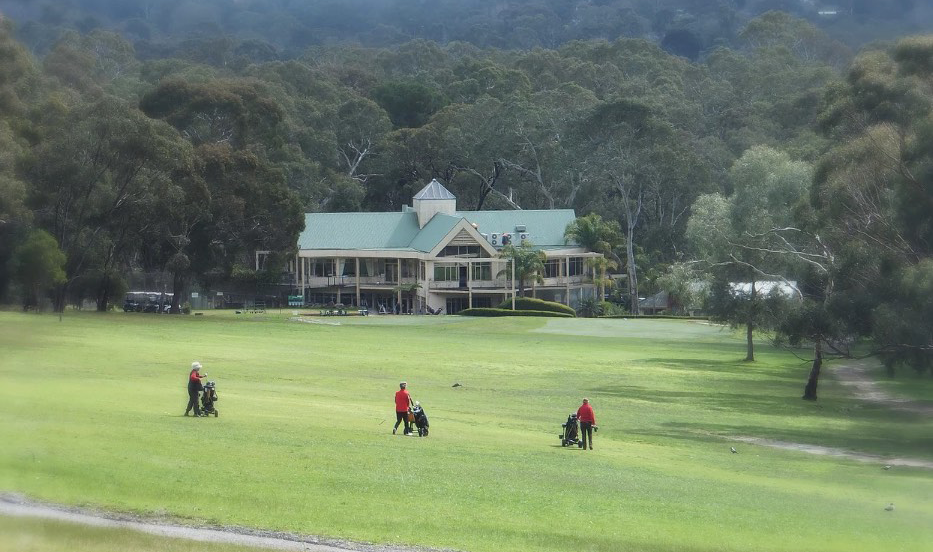
Belair golf course was closed about a decade back. The clubhouse is also gone—replaced by the bumps and swooping curves of a BMX track. I recall post-round beers on its balcony overlooking the final hole and watching other groups approaching the green. We’d admire the parabola of a successful shot but also feel solidarity with those spraying into the foliage. Our conversation might’ve gone thus:

‘That’s a nice shot into the green. Just like yours, Puggy,’

‘Let’s hope he doesn’t three putt as well.’

‘Harsh. How many balls did you hit out of bounds today, Mickey?’

‘Careful. Whose buy?’

‘Crackshot’s.’

I remember playing the Friday after my graduation; a mild winter’s day in 1988. These were good times. My world was necessarily opening up, but the Belair golf course remained a comforting, occasional alcove.

*

Our 5k run begins with an alarmingly steep climb up the 18th. The track’s loose with sandy rubble so I watch my feet. The Run Director had cautioned the throng: ‘It’s a trail and most weeks someone comes to grief.’ Despite this his briefing was generous and encouraged a cuddly sense of togetherness.

We then cut across half a dozen holes and it’s frequently 4WD terrain. Among the inclines and undulating gum forest we’re sheltered from the wind but it’s nonetheless demanding.

At the teardrop turn, we swivel and retrace our steps. As always, there’s a broken stream of elite runners who skate ahead and illuminate the way.

It was nostalgic and my old affection for the course surged. The golf holes remain and some of the greens are now home to frisbee golf buckets and nets. So, it’s still golf Jim, but not as I know it.

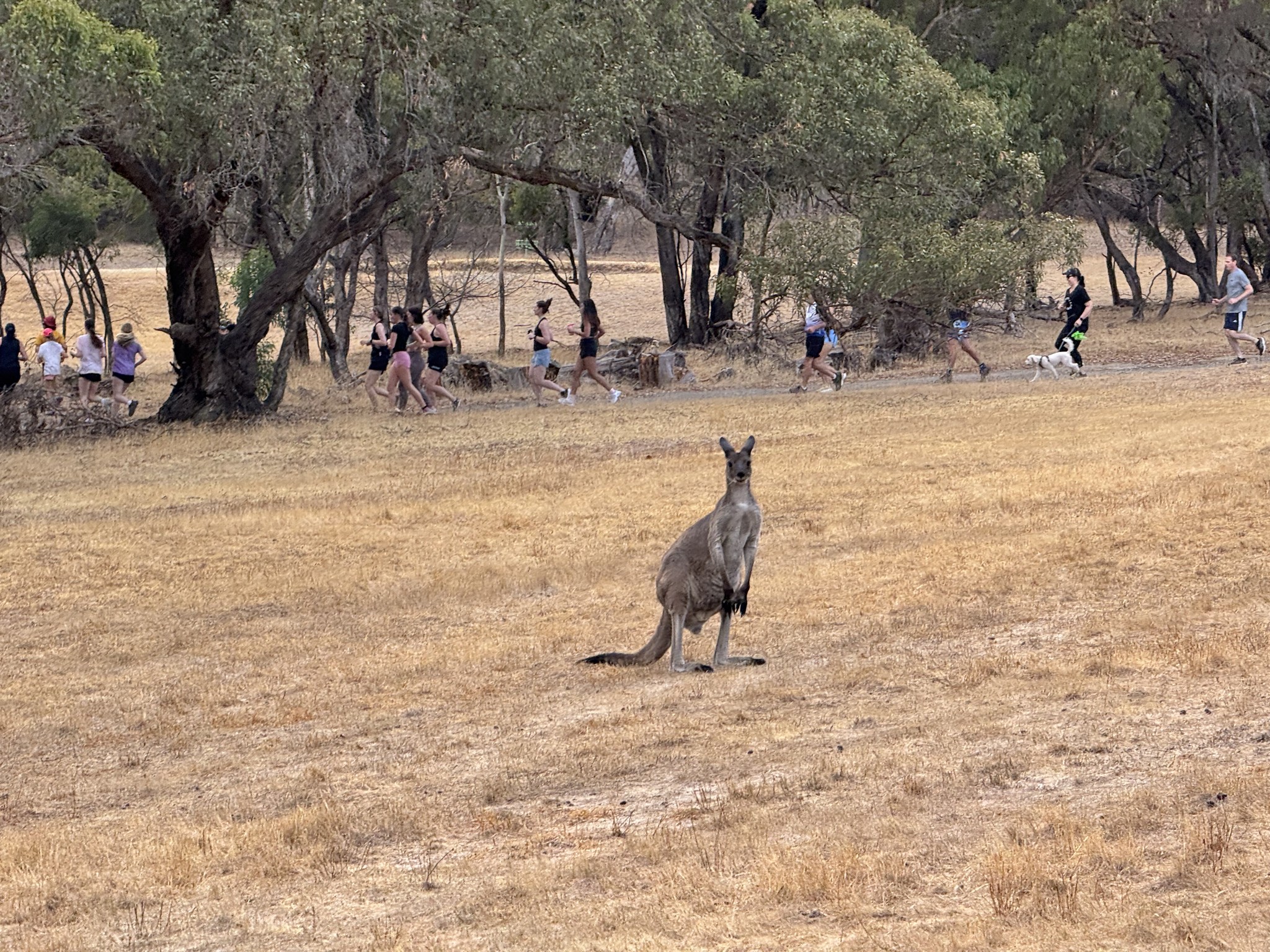
Kangaroos hop here and there or lounge about indifferently like (muscular) bogans in Bali. They still own the place.

Scampering across the ex-fairways, I was teleported back decades and considered The Great Gatsby. I appreciated those, ‘riotous excursions with privileged glimpses into the human heart’ and could almost hear the ghostly rifle crack of an errant Hot Dot clunking onto a gum tree trunk— accompanied by a groan and paddock language.

Pushing along beneath the trees and through the balmy shade, I wondered about the lost world of my youth. Where had it and the verdant fairways gone? Here I was in my new (parkrun) life but was there loss and also emergent reward?

Is the past really a distant, gaseous planet and we’re forever marooned on Earth? TS Eliot once wrote:

Time and the bell have buried the day,
the black cloud carries the sun away.

Perhaps he was right. Or perhaps the past never fully leaves us. No to all that, for my life (now) is radiant, kaleidoscopic, and rich.

I’d enjoyed peering into my youth on this parkrun which had masqueraded as a museum tour. Was I sad the old golf course was gone? Yes, but I was happy for the fun of playing there with childhood friends when a lazy afternoon could be gladly lost on the fairways.

Tumbling back down the final hole, I collapse through the finish gate. Hands on hips, I pull in some air and gaze about Saturday’s temperate, misty morning.

On my way back to the car I hear (I think) a percussive burst of spectral golf club on ball.

Photo credits: Belair National Park parkrun

2

Mystery Pub: Home of the $5 Schnitzel*

Historian (and darts champion) Herodotus once noted, ‘Pubs are markedly different at 5pm on a Sunday compared with after work on Friday.’

The former timeslot is disposed towards anticipation and the later, reflection. Friday pub crowds are singular of purpose whereas those in the Woodville Hotel as Claire and I stroll through late Sunday seem assembled for a variety of intentions.

The Terrace is new to the pub, and its roof, open. This affords the place far more exhilaration than it probably should. Feeling the sun upon your face in a pub is somehow elevated magic and any breeze drifting through a hotel courtyard becomes bewitching and rare.

By a Port Road window there’s a gathering, each woman with an adjacent and empty cocktail glass. A late afternoon malaise has drooped over these patrons. Maybe it was the cocktail they thought they wanted but didn’t actually need or possibly it’s the Sunday night dreads that haunt working folk like prodding ghouls.

A fellow with a prosthetic-leg scurries past and such is the fluency and speed of his gait that if he’d been wearing trousers, we wouldn’t know he’d an artificial limb. Science has done well here—now if we could hurry up with hoverboards.

All clad in basketball singlets, a team of young bucks saunters in from their Sunday fixture. I suspect the match is just a pretext to the post-game pub visit as it’s difficult to tell if they won or lost. I think this is a good approach. They’re all energy and young buzz. A few have moustaches and these have gone beyond irony and are now just fashion.

Earlier, a couple had come in, ordered drinks and wedges, and without difficulty, claimed a table close to the bar. They chat easily and constantly, ranging over topics both personal and global.

The woman detects a plastic sign on a neighbouring table. It says: $5 schnitzels. The man goes over, interrogates it and learns that on Tuesdays folks can dine on schnitzels with the second offered at the advertised price of $5. I can imagine Protagoras being excited by this.

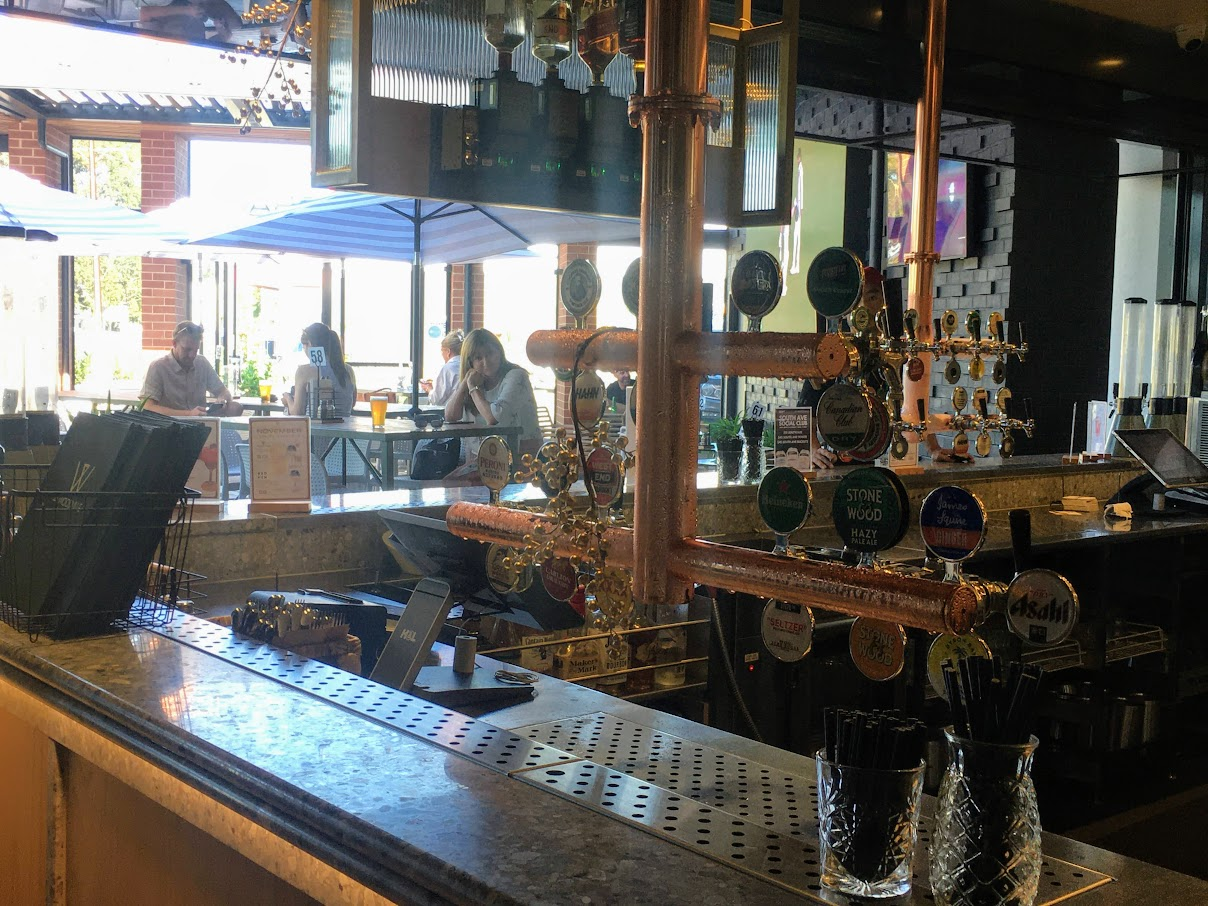
Back up at the bar and in the proliferation of beer taps, the man notes both Coopers Vintage Ale and Sparkling Ale. On this drowsy afternoon he has no use for either but is reassured by their presence. It’s nice to know they’re available. This reminds him of Nick, the narrator of The Great Gatsby, who writes

My own house was an eyesore, but it was a small eyesore, and it had been overlooked, so I had a view of the water, a partial view of my neighbor’s lawn, and the consoling proximity of millionaires—all for eighty dollars a month.

A second drink for the woman is a Frozen Key Lime Pie cocktail. The ingredients include a dehydrated lime wheel— surely not a DLW—which was formerly known to most as a slice of lime. Linguistic dishonesty continues apace, even in the pub.

The bowl of wedges arrives, and this is also exciting beyond comprehension. How on earth did sweet chilli sauce and sour cream come to be the preferred condiments for this? It must’ve been a party accident, likely in a share house of law/arts undergraduates.

And so, this couple—your correspondent and his wife Claire—drove home, pleasantly buoyed by a Socratic hour in the hitherto unvisited Woodville Hotel.

0

Mystery Pub: Shostakovich liked a snort

While Billy Joel approximately sung, ‘It’s five o’clock on a Friday and the regular crowd shuffles in’ this is not so for we have the joint to ourselves apart from the staff or as I once heard someone say of his daily pre-noon hotel visit, ‘The bloke what usually serves me, he’ll be there.’  The Port Admiral, perched on Black Diamond Corner—a quintessentially Port Adelaide location—was vacant.

However, contemporary punk music blasts throughout the barren bar. Formerly, I would’ve enjoyed this but not now as my Triple J days are increasingly done and we listen to Classic FM when driving. It keeps the pulse passive although I find it difficult to pronounce Shostakovich with any confidence. Too much sibilance. Rachmaninov, at least the way Scottish morning announcer Russell Torrance says it, is less knotty. I remember old school mate Davo pronouncing Chopin as choppin’. He was habitually phonetic.

Claire and I explore the pub up and downstairs: broad, inviting balcony, generous dining rooms, and even The Bottle Shop which is a bottle shop but also a snug chamber with every table home to happy folk. Squatting everywhere are bookshelves and I spy Tim Winton’s Cloudstreet; the story of two families sharing a sprawling old house in Perth: the deeply religious Lamb family, and the tempestuous, boozy Pickles clan. Gazing about, I reckon the Port Admiral’s the type of hotel protagonist Sam Pickles would frequent. Sam’s a ‘little truck driving bloke with no schooling’ who makes dreadful decisions but remains earthy and likable.

I love books in pubs and pubs in books.

At the top of the stairs there’s a scattering of games including Yahtzee. Claire confesses, ‘I’ve never played.’ I reply, ‘It’s a game with five dice.’ Claire adds, ‘I don’t like games of chance.’ I whimper, ‘Oh,’ glancing at the Connect Four box, thinking it might be more likely.

Mystery Pub’s singular purpose means I’m content there’s no wide screens showing footy or the Menangle trots or tachyon cricket from India. There’s also no TAB, meat trays or other distractions. Down the Port, there’s plenty of these, elsewhere.

The Port Admiral’s the rarest of pubs: just a pub. 

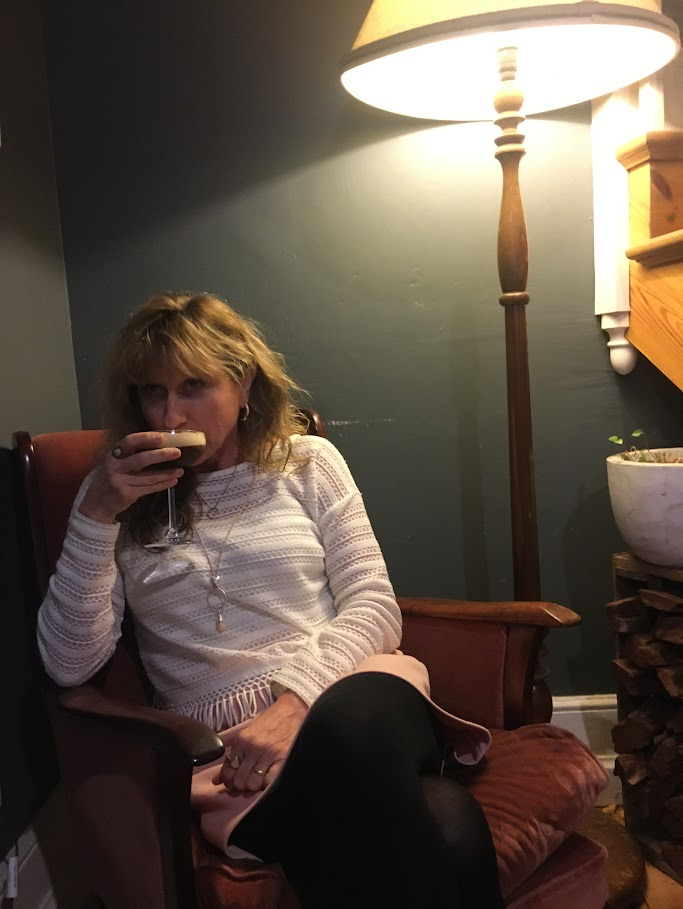
Claire conjures a Martini Espresso to celebrate the week’s wins and I survey the rows of taps before buying an XPA. It looks like Grandma’s pea soup or melted honey or both. However, I think it’s the first beer of the day from this keg and sipping some, it presents like Shaun Tait on a lively deck: problematically. It’s rarely worth being a beer pioneer.

And so, in this massive, sprawling, mostly empty old pub we squirel into a nook by the staircase. It’s cosy and secluded and reminds me of Jordan’s observation in The Great Gatsby, ‘And I like large parties. They’re so intimate.’ Two old chairs are separated by an occasional table. Beneath the stairs is a cram of firewood, which is merely ornamental.  

We speak of our afternoons, our weeks, tonight, and next month… There’s much to investigate. To enhance our empathy, we swap chairs after the first drink. We could be in a period drama set in Oxfordshire save for ridiculous bonnets and forbidden, urgent panting.

I then opt for a Two Bays Pale Ale from Mornington Peninsula while Claire returns with the hitherto unheard of Piquepoul. I learn it’s similar to Riesling and grown in Rhone and Catalonia and the Barossa by Lienerts. Meanwhile the front bar punk explosion continues for an absent demographic. We hear no Billy Joel or Shostakovich.