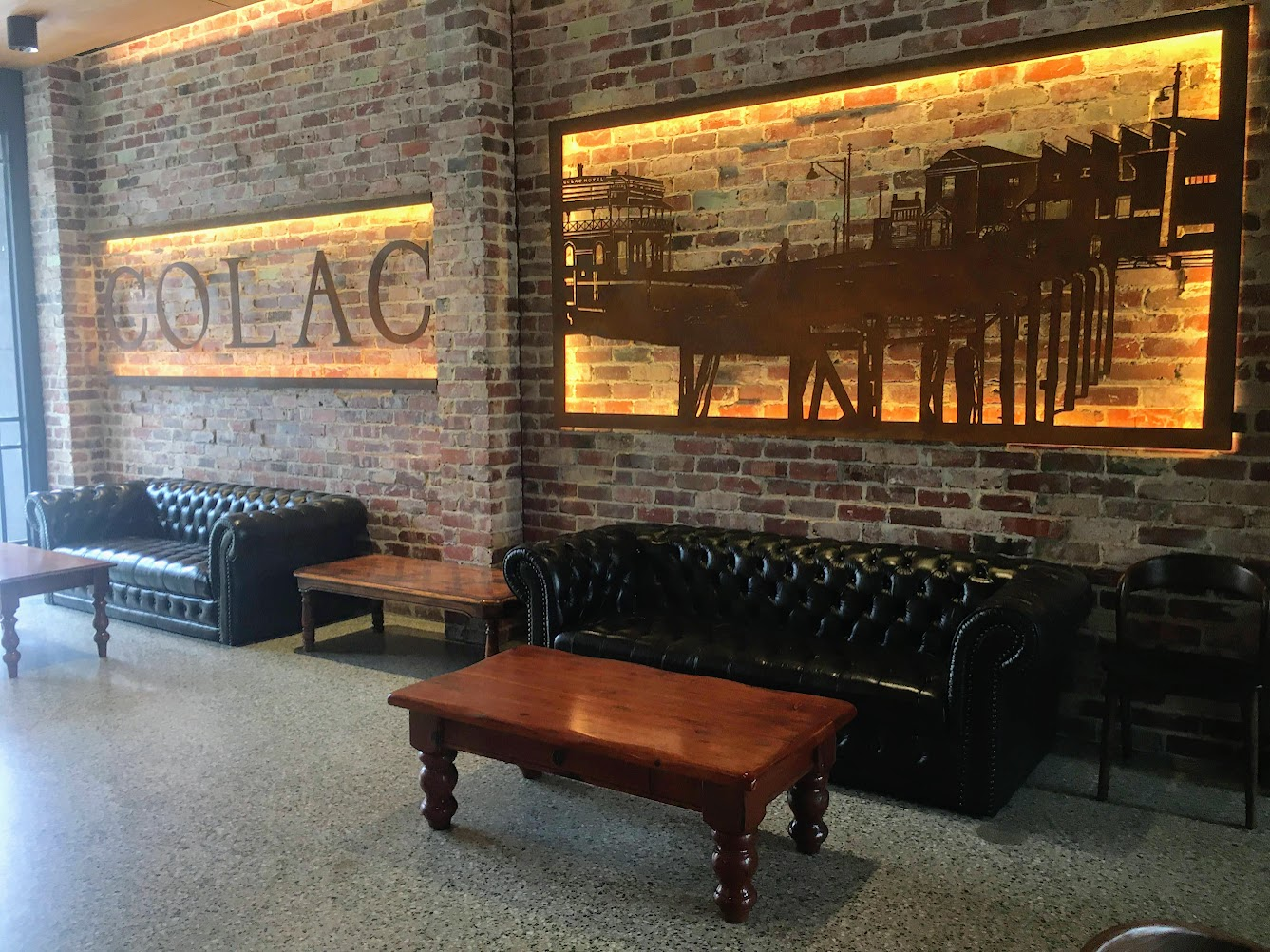
In a suburb stuffed with notorious pubs, The Colac was Port Adelaide’s worst. It was known as The Bloodhouse. It was abandoned for decades. The land around it formerly summoned The Great Gatsby.
This is the valley of ashes—a fantastic farm where ashes grow like wheat into ridges and hills and grotesque gardens
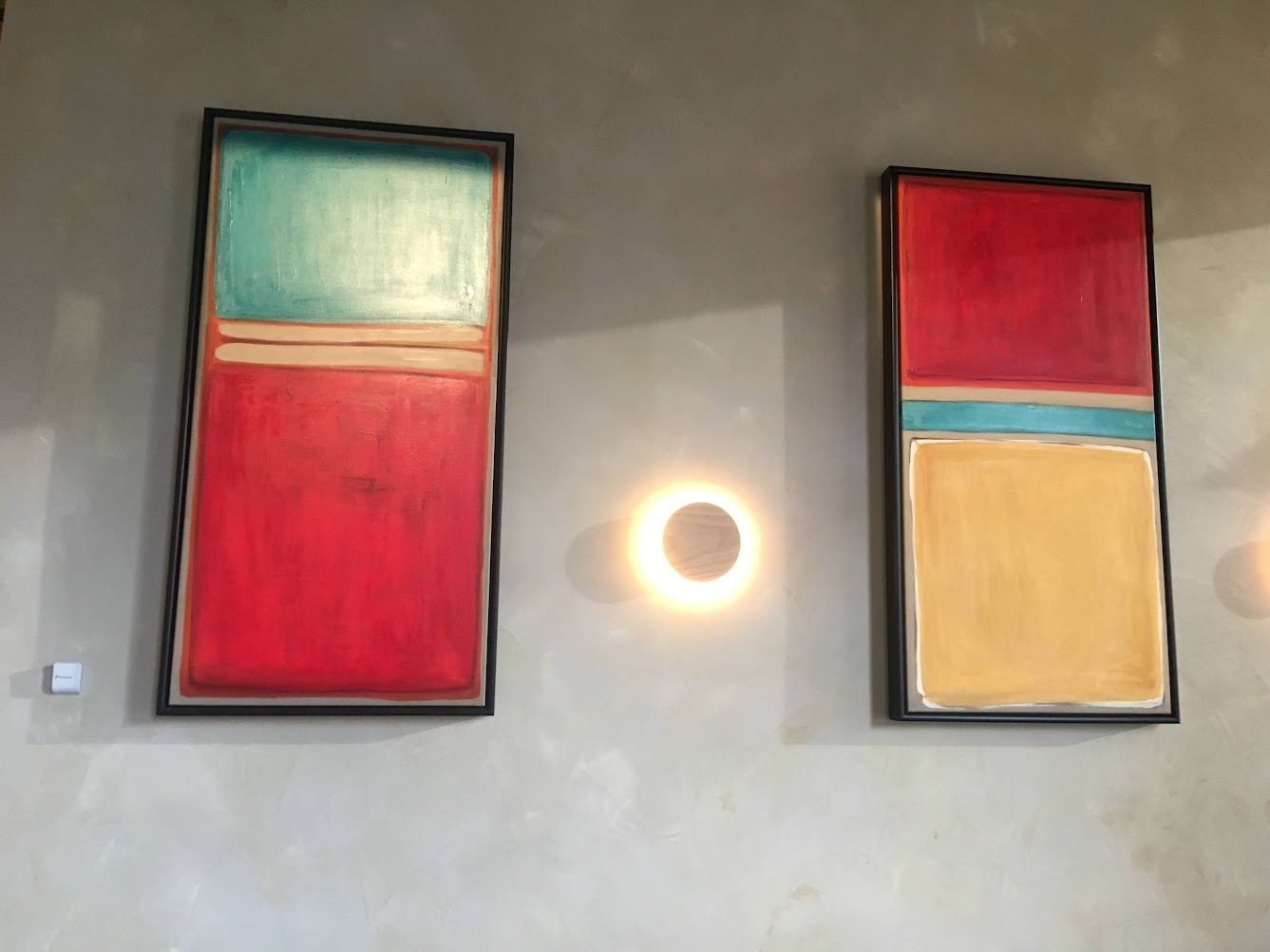
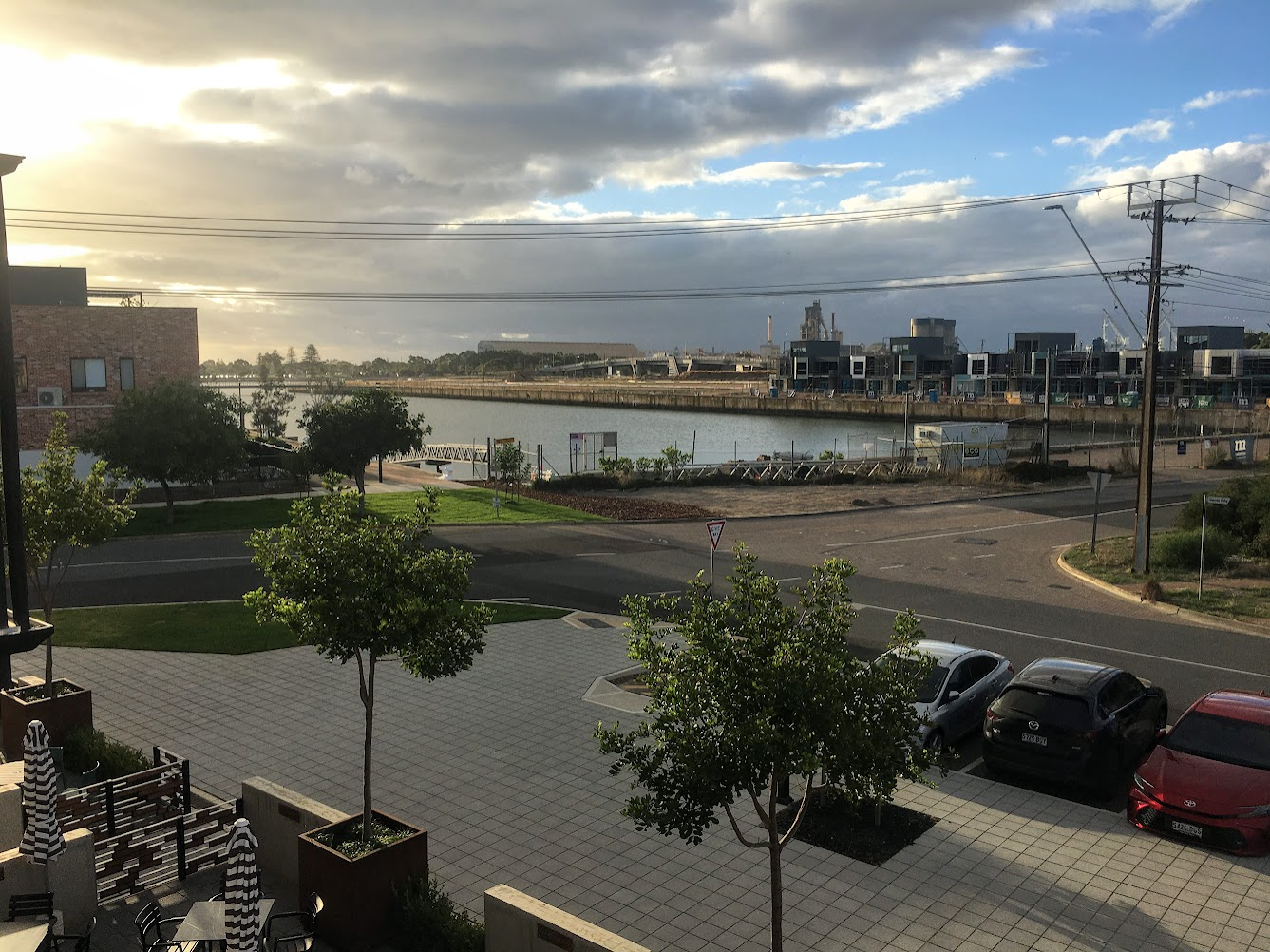
The pub has reopened and is splendidly appointed. Opulent furnishing, sublime art, strangely odourless air. Light drenches the two stories and three distinct spaces, having bent in from the becalmed Port River. Later jazz, a piano ready on the stage. Wagyu and other prized cuts in a cabinet.
The wait staff were welcoming but began yapping at us like terrier pups, having gone from attentive to nutso annoying.
How were the customary hot chips? Sprinkled with fetta, garlic oil, wolfed.
The Colac is now crowded in by eager rows of boxy terrace homes, like an English village. Is the invigoration of the Port finally underway?
*
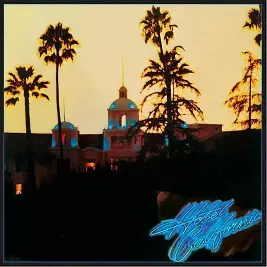
Home, with the dark descending. It’s my favourite hour for a vinyl album so I popped on Hotel California. Shoeless, Claire busied herself cheerfully. I plonked myself in a chair.
I read recently the title track is, among many other things, a reggae song. This genre is difficult to love due to its repetitive boing-boing. For me The Eagles’ tour de force is now tainted. I hope I can reverse this.
Clasping a refreshment, Life in the Fast Lane began with its sunset swagger. As Claire scurried in and out, I contemplated how the guitars are like a Chevy Impala hurtling down Mulholland Drive. The melody and the lyrics marry. When sound mirrors the meaning is this word painting the musical equivalent of onomatopoeia?
The penultimate track is the sun-kissed Try and Love Again, sung by the late Randy Meisner. He’s best known for Take It to the Limit, where his voice soars — arguably their finest. But the nightly demand of it became a private terror. ‘I was always kind of shy… They wanted me to stand in the middle of the stage… but I liked to be out of the spotlight.’ He quit at the zenith of their fame. How cruel to be haunted by your gift?
*
Saturday saw the next in this year’s succession of milestone parties. A 5.30pm start for our dear friend, JB. On the veranda, I wondered aloud to nobody that our social functions now conclude at the hour they once would have begun.
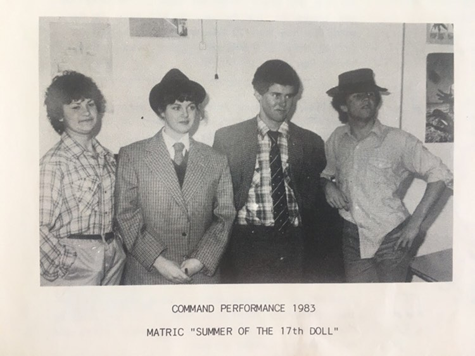
The theme was a reprise of her previous big celebration: come as the person, you’d like to be, so Claire and I both transmogrified to seventeen-year-olds. A school dress (Claire) and Kapunda High blazer (me). Are we misguided in wanting to be younger versions of ourselves?
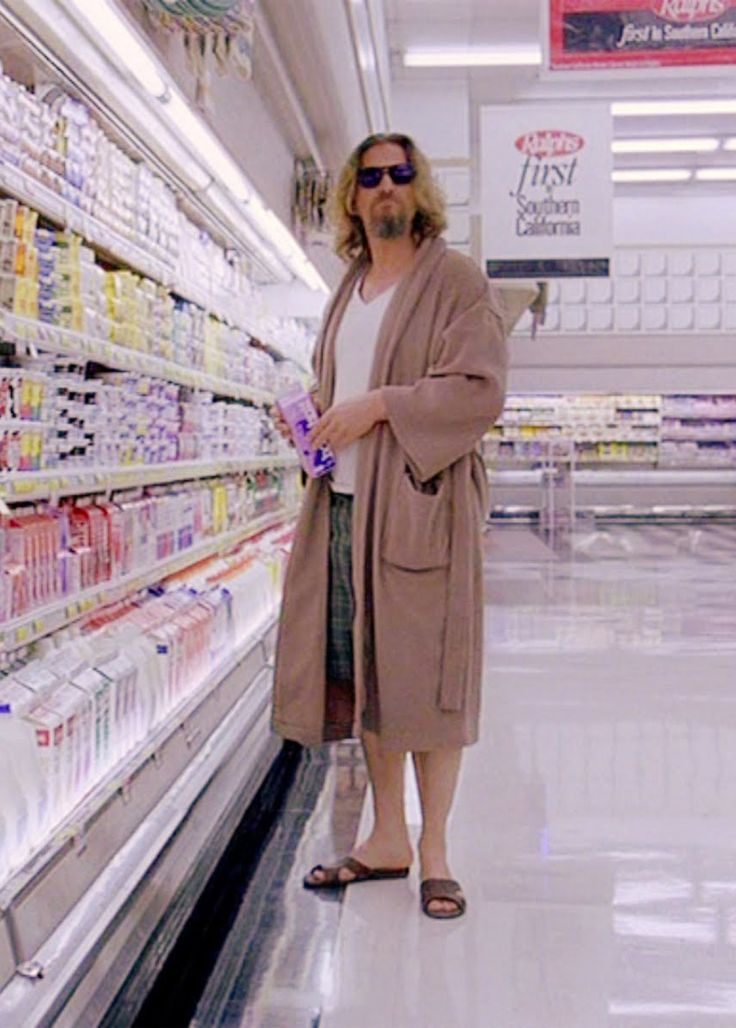
At JB’s 2016 birthday, I’d gone as The Dude from The Big Lebowski. He remains a profound inspiration but now proved too difficult to properly source, sartorially.
Across the backyard, Eagle Rock chugged. With Michelle’s kind kidnapping, I participated — trousers hitched. Later the song Mickey played. Trish performed a cruelly accurate impression of year 12 me doing the Health Hustle.
In the courtyard, they danced on, sweet with summer sweat — some to remember, some to forget.
Well, the South side of Chicago is the baddest part of town And if you go down there, you better just beware Of a man named Leroy Brown Now, Leroy, more than trouble You see, he stands, about, six foot four All the downtown ladies call him ‘Treetop Lover’ All the men just call him ‘Sir’
We were beneficiaries of Kapunda High being a progressive school with teachers who were innovative. When I was in Year 11, vertical homegroups became part of the ongoing reform and this meant students from Years 8, 9 and 10 joined us in the Home Economics Centre under Mrs. Trinne’s watchful and occasionally fierce eye. This arrangement was representative of our bold education.
Mr. Schell was influential in setting up a daily fitness programme. Every day we’d have a different activity and the entire school would rotate through these, including all the staff. Most of this happened on the oval. But one memorable— if haunting session— was scheduled weekly in the former stables.
It’s called the Health Hustle, comprised three or four songs and each tune had a set workout routine. Our class members would claim their space on the rough concrete floor of the Stables and Schelly played the songs on a boombox. For some in our class this was fun and for others like me, it marked the beginning of my descent into dancephobia!
Technically, it’s known as chorophobia and yes, I’ve been attending the Monday meetings for many, many years. No, not really but to describe my dancing as uncoordinated would be a gigantic underrepresentation.
The mere mention today of Health Hustle prompts Claire and Trish to leap up from their otherwise comfy chairs and give a hilarious recreation of me feebly trying to dance in the stables all those years ago. All done with uncontrollable laughter. Look! There they go mimicking me and my tangle of disobedient, droopy limbs. Arrythmia not of the heart but of the body. Still, our friendship, if not my choreography, flourished.
Catching the opening notes of ‘Mickey’ or ‘Teach Your Children’ nowadays I’m sure many of the class of ‘83 also have a Pavlovian response that causes them to break into those deeply embedded routines. But I somehow retain affection for the Chicago gangster jaunt of ‘Bad, Bad Leroy Brown.’ The marriage of the Scorsese lyrics and the wide-eyed piano stomp is terrific.
He got a custom Continental He got an El Dorado too He got a 32 gun in his pocket full a fun He got a razor in his shoe
*
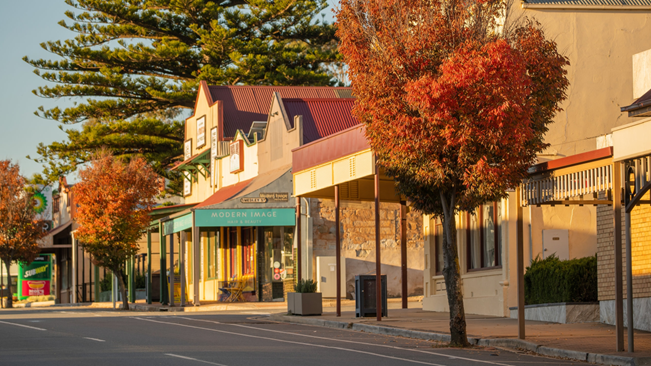
Resuming our drone flight over Kapunda, we’re now on the Main Street and peer under the veranda of Rawady’s Deli. Pausing at the front window we see sporting team sheets sticky-taped to the glass. Handwritten names on a paper footy oval or for cricket, a list of eleven boys along with details of when and where. If it was a summer’s Saturday morning, there’d be a white huddle on the veranda, ready to head to Eudunda or Angaston or maybe Truro.
Gazing further into the shop we witness a constant flurry of activity behind and in front of the long counter. Reg is moving about, helping people with his baritone that always seemed too large for his tiny frame while out the back Brian’s endlessly cooking chips in the deep fryer. Rawady’s Deli was the town’s heartbeat and epicentre for much communal good.
On any given day, my Mum or sister, Jill could be working or it might be Claire making me a post-cricket milkshake. If I was in there with Greggy Higgins getting mixed lollies before Thursday afternoon RE with Mrs. Schultz at the former convent then we’d see this transaction-
‘Yes, thanks. Can I have ten cobbers?’
‘Sure.’ Ten cobbers would then be shoved into the white paper bag by someone like Eli. ‘Okay. What’s next?’
‘How about some of those red ones?’
‘Which ones?’ This question would emerge from deep in the lolly cabinet. A headless voice.
Greggy would sometimes say, ‘See where your hand is? Not there. Over to your left.’ We’d then both giggle.
‘Okay. These?’ An impatient finger would point at a box of bananas or teeth or red snakes.
‘No. Not my left. Your left.’
We then fly down the street to the outskirts of town and the Esso service station. A man of relentless motion like the Rawady brothers, the owner, Rex Draper was also a Musical Society devotee. Like Rawady’s Deli many locals worked there. The girl fourth from the left (here too), Damian Trotta (still there) Nevvy Ellis, Grantley Dodman— who called himself a petroleum transfer engineer—and for about six years, me.
Most Sundays around six my cousin Paul ‘Boogly’ Ryan would drive in, piloting his HQ Holden Kingswood. Hearing him before I saw his car, he’d cruise past Trotta’s Hardware and swing up the volume on his Kenwood stereo and it blasted across the dusty, otherwise tranquil townscape. This ritual always made me laugh.
We were massive fans of the Rolling Stones and knew how cool they were. From their last great album, Tattoo You, ‘Slave’ was a blues jam and part of our shared vernacular. It was always greeted with nodding heads and wry smiles.
Do it, do it, do it, do it, do it Do it, do it, do it, do it
Don’t wanna be your slave Don’t wanna be your slave Don’t wanna be your slave
Let’s zoom in now as a sinister black motorbike has rumbled onto the forecourt of Rex’s servo and shuddered noisily to a stop. In 1983 full driveway service was expected. Fill her up, check the oil and tyres, clean the windshield. I recall my utter terror when a bikie—always fat and gruff and menacing—would scowl before murmuring instructions to me. This was scarier. Their lifeless eyes always hidden by impenetrably black sunglasses.
He’d order, ‘Fill it up.’ I’d gulp, knowing what was next. My hands shaking as I eased the now unwittingly weaponised nozzle into the tank of the Harley. Brain surgery would’ve been less intimidating. They’d often be returning from a day trip to Cadell Prison. He’d then whisper in a barely disguised death-threat. ‘Don’t spill any on the tank. I’ve just had it repainted.’
Of course. These feckers had always just repainted their tank. They lived only for their Harleys. They didn’t have lives or hobbies or volunteer to goal umpire the junior colts. Just repainting the fecking tank on their fecking murder machines.
*
Late in 1983 we had our final school social. These were terrific fun and the last dance was always ‘Hotel California.’ With the duelling guitar solo still ringing out as the lights came up in the Parish Hall, Davo, Chrisso, and I pointed my sky-blue HR Holden towards our friend Stephen’s unit in Plympton where we spent the night.
The next day was Friday and our last at Kapunda High. Some like Chrisso didn’t appear fussed and Paul Hansberry was already working at the silos for the summer. I remembered my first day in year 8 when I was scared at what high school would hold. Now, on our concluding day I was scared at what life beyond school might hold as the world opened up in vast and uncertain ways.
I’m quite sure I didn’t thank my teachers—Mrs. Schultz, Miss Searle, Ali Bogle (she was young so didn’t have an honorific, sorry), Mr Krips and Mr. McCarthy. Macca—who would speak at the footy club wedding reception Claire and I would have many years into the future. So, I thank them now.
Trish and Claire and Belly and Lisa and Davo and Penny and Chrisso and Crackshot and I would’ve said things like this to each other-
‘Well, we’re done. See you round.’
‘Bye, you.’ Accompanied by a friendly punch and a grin.
‘I’ll see you soon, probably before Christmas.’
And that was it.
I didn’t realise it then but Kapunda High—indeed the entire town—had prepared me well. They had accomplished that most miraculous feat, the very thing that every day drives our teachers, parents and coaches. Despite our frequent resistance, they persevered. They had helped create our lives.
1983 was soon replaced and off we all went. Uni, the air force, nursing, work. The world was waiting. Kapunda High had been great.
Gundry’s Hill is the natural place for it to commence with its views across our undulating town. There’s St Roses’ spire, a patchwork of roofs, and the silos standing quietly down near the road to Freeling. The vista is smeared green from the trees lining Clare Road, Mildred Street, and Hill Street which is home to the ancient playground and its old black steam train.
We’re now above Dutton Park and its fetching oval protected by those silent eucalypts. If we listen carefully, we can hear the Mickans chuckling and telling stories. It’s a short flight then to the Duck Pond and if it’s a weekend evening there might be half a dozen cars parked haphazardly on the southern bank, near Dermody Petroleum. There are teenagers draped all across the lawns. My friends. From the tape deck of a car, possibly a Gemini or a Kingswood, you hear this soulful song
Karma, karma, karma, karma, karma chameleon You come and go You come and go Loving would be easy if your colours were like my dreams Red, gold, and green Red, gold, and green
We then zip over to the swimming pool. On this hot afternoon we see dotted on the grass untidy groups of kids. Zoom in and they’re munching on Bush Biscuits or a Zooper Dooper before running to the diving board. From this they leap off aiming desperately and adolescently at the canteen, run long-sufferingly by Mrs. Chappell. They try to splash her by doing a storkie, arsey or a coffin. They’re tiresome but determined. The supervisor—an elderly Englishman—yells to the skinny boys, ‘Pack it in!’ They ignore him but he yells again. ‘Pack it in or you’ll have a rest for five minutes!’
A short journey and we pause over the Pizza Bar on the Main Street. Johnny Guzzo is the boss. Again, inside there’s some of the town’s youth and they’re huddled about the Formica tables. Some spill onto the footpath, weighted by black duffle coats and ripple boots. With P plates blutacked to their windows, assorted cars lined up outside. There’s a knot of motorbikes too.
Inside by the windows and next to the pinball machines, a mate’s trying for his best ever score on Frogger. He’s trying to cross the river on logs and—be careful—skip over on the backs of hopefully drowsy crocodiles. But he gets munched and the game’s over. He thumps the glass top of the arcade machine. Johnny’s throwing pizza dough up into ever widening circles and hears the racket. ‘Hey! Do that again and I kicka you out!’
It’s 1983 and for one group of kids, they’re in year 12. Seventeen is an age when much happens but you’re no longer a child and not yet an adult. It’s a fraught, fantastic time. Let’s zoom in and see who they are.
*
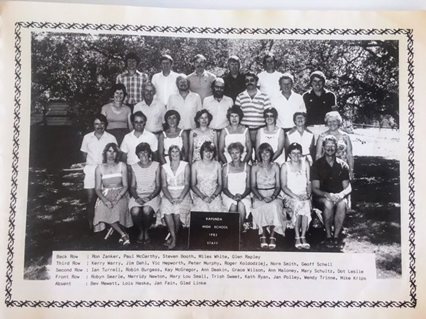
Here’s Kapunda High’s class of 1983. There’s only thirteen of us although this was boosted by the subsequent return of one Paul Masters, and arrival of Eriko, our Japanese exchange student. Then, of course, most of the fifty-odd who began with us in year 8 had left school for a job. Year 12 was matriculation which meant qualifying for university. It an innocent and wonderous time.
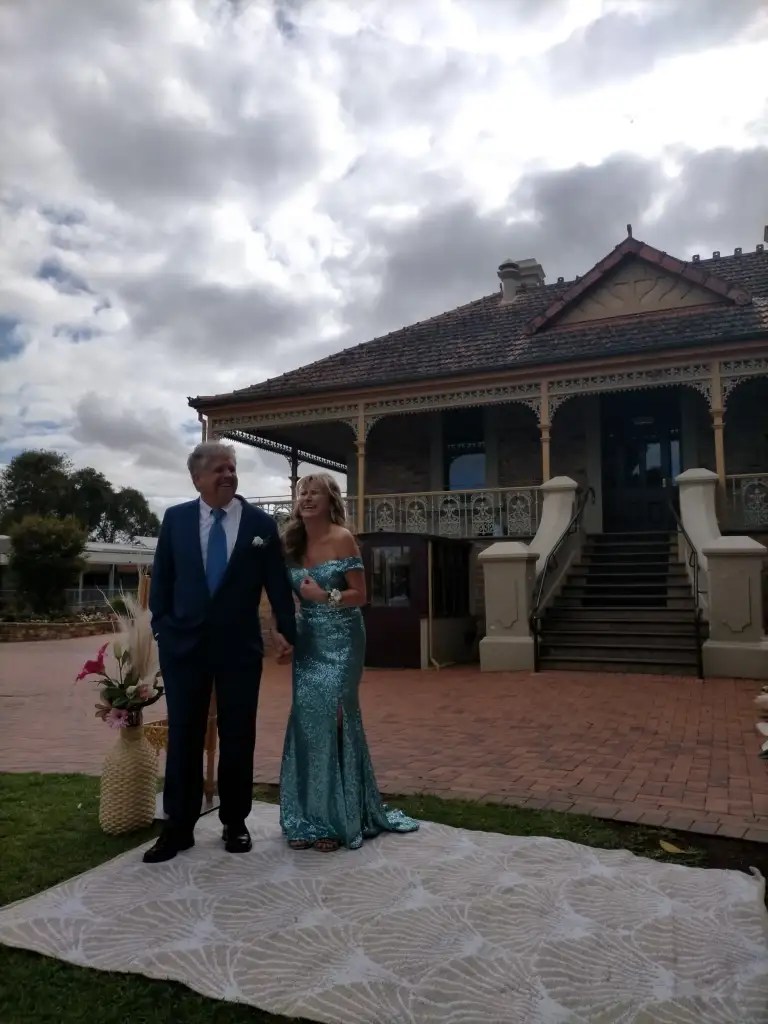
This photo was taken on the croquet lawn at the front of the school. I never saw any croquet but sitting on its grass under the autumn sun was calming and peaceable. And it’s such a picturesque setting that a few short decades later it was where the girl fourth from the left and I would be married. No other location presented itself.
There were only fifteen of us, but I thought us an unruly collective. All day long we laughed and yelled and interrupted each other. Thirty years on, talking in the footy club with Macca—our beloved History teacher Paul McCarthy—he told me we were, ‘bright and well-behaved. A really great group.’ In 1983 I sat in a corner next to Chrisso and Davo and we did much together.
Claire and Trish and I had long enjoyed our triangular friendship, and this continued. There were a couple of classmates with whom I barely exchanged words. I didn’t dislike them; we just had little in common and I hope they’re happy and well.
*
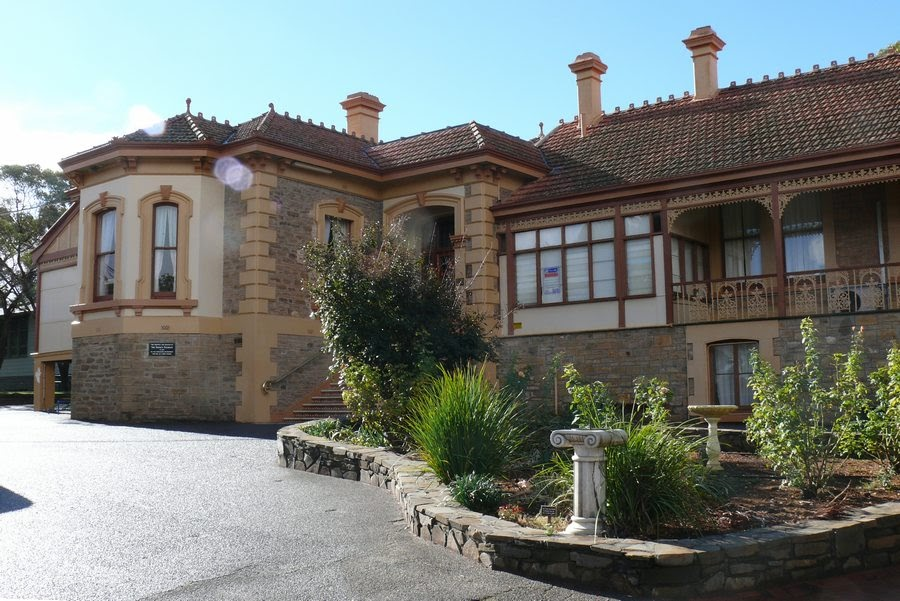
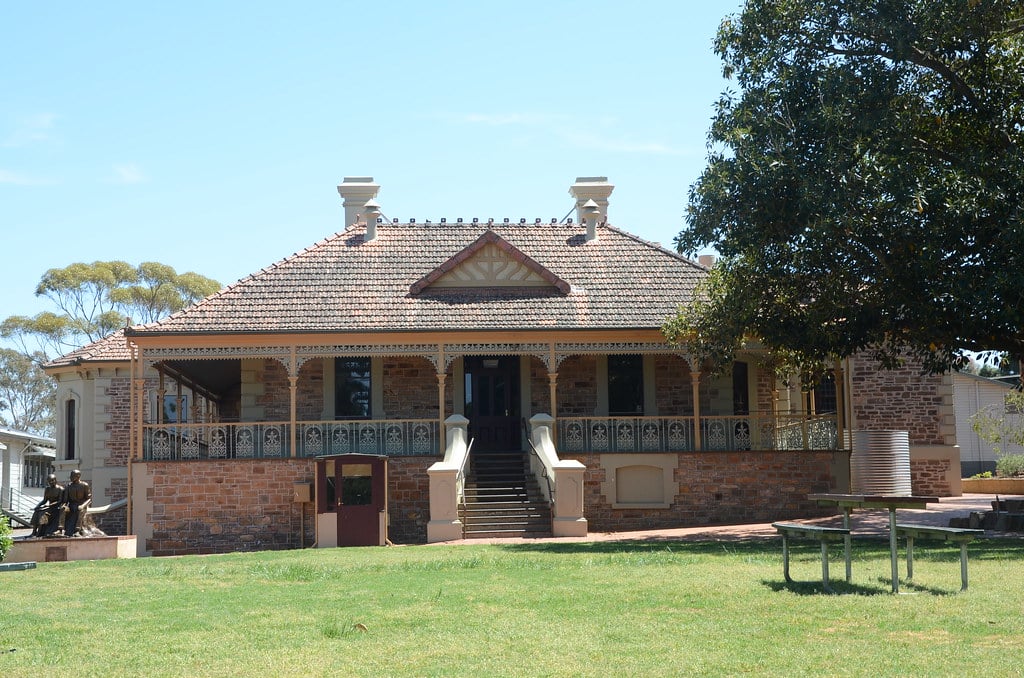
Our matric centre was at the front of the school just near the croquet lawn. It was down the cement steps and in Kidman’s bequeathed mansion, Eringa, it had been a servant’s bedroom. A tiny room, it could only fit ten or a dozen of us around the little student tables.
A blackboard hung to the side and an old gas heater sat above the mantle and we’d use it to toast sandwiches until we weren’t permitted. A corridor ran around two of the walls and our individual carrells were lined up there. How lucky that we had our own private desks? Much of our year was spent at these.
In that little classroom we’d conversations which influenced us. Mrs. Schultz, our gentle and wise English teacher, chaperoned us through The Grapes of Wrath with the Joads as they made their emblematic and weighty way from Oklahoma to California through the Mojave Desert.
I recall my terror as she and Trish talked at length about the novel’s symbolism, focusing upon the turtle crossing a highway and how it represented struggle, determination, and hope. Committed to making my own life difficult, I read many Steinbeck novels over the summer and loved them. But, of course, I didn’t finish the compulsory Grapes of Wrath, and generally only saw the turtle as a turtle.
Our Australian History teacher, Mr. Krips, escorted us through a study of our national identity and the apotheosis of the nomad tribe. I’d not encountered the word apotheosis before. It wasn’t used on the cricket, even by Richie Benaud or by Graham Kennedy on Blankety Blanks. It impressed me and I vowed to keep it in my vocabulary as I thought it could have future value. I swiftly forgot it.
Of equal value was the extra-curricular stuff we learnt from our teachers. The girl fourth from the left and Trish always had enthusiasm for curating our experiences and so set up communal diaries in big scrap books. Quickly becoming known as the Crap Books, these enjoyed daily entries, with some contributing more than others. Occasionally Kripsy did too. How great was he? Early in the year he noted the discovery of a musical gem.
Last night I saw Marvin Gaye on TV singing, ‘Sexual Healing’ which was terrific. What a voice! What a performance!
It is a great tune and now when I hear it I instantly think of Kripsy and that tiny, windowless classroom. I hear it with fondness for my classmates and teachers and that fleeting, singular time and place.
Get up, get up, get up, get up Wake up, wake up, wake up, wake up
Oh, baby now let’s get down tonight!
*
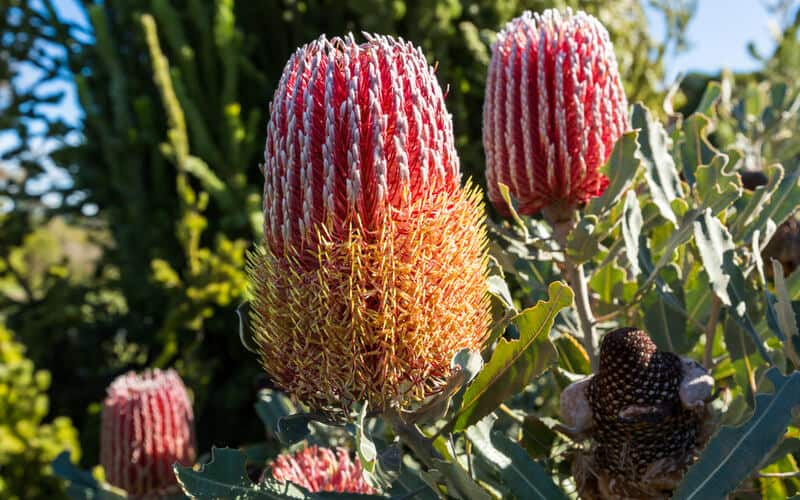
The Coorong is a distance from Kapunda, south of the mouth of the Murray. Until our matric year, school camps had been breezy and amusing affairs. More like holidays than educational experiences. As we had to study both a science and a humanities subject, I found myself in Biology and had to undertake a special personal project. For reasons which over time have only become more bleakly absurd, I was about to immerse myself in the heady, sparkling world of Banksias.
Yes, my teenaged fantasies were all becoming real. I would undertake a vegetation transect. It’s not, however, as glamorous as it sounds.
We stayed in rustic accommodation with Mr. Zanker and Miss Searle. Curiously, I would work with Mr. Zanker decades later at Marryatville High where I taught his daughter in year 12. In 1983, there were about eight of us in Biology and we drove down on Sunday. I recollect none of the journey.
It was cold and grey but one night by a shared metal sink I had a novel experience. One of my classmates, the girl fourth from the left, leant towards me, giggling, and announced, ‘Hey you. Listen to this!’ A brief subterranean rumble followed. We both collapsed into laughter. It was the first time I’d heard a girl fart.
This remains the clear highlight of that camp.
Monday morning was grim and wretched, and it began to rain. I was utterly alone in the middle of a forest of banksias. My task was to measure all sorts of variables like tree height, number of banksia flowers, distance between trees, and other things too hideously dull to itemise for you now.
Until then I think I was a kid who just got on with stuff. But this was new for it was an obligation in which I had zero interest. It was a necessity and there was no escape. I sat on the wet ground and my bum became damp. Three more days of this! I reckon it was the first time in my life I was truly bored. Even now I twitch if I see a Banksia. They’re for life, not just the Coorong.
It gave me a glimpse into the dark world of adulthood responsibility. I didn’t like it.
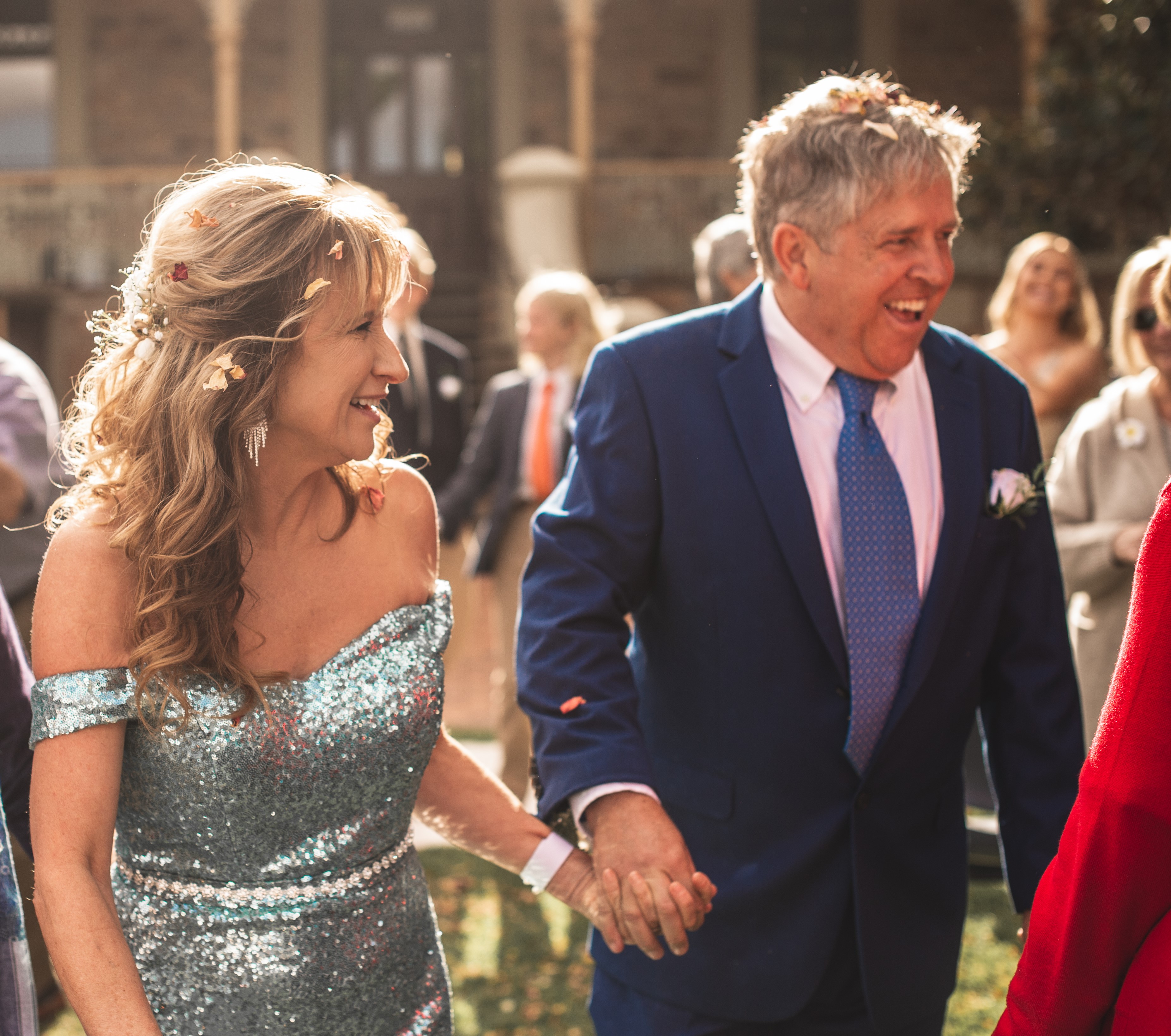
After the insistent, whipping squalls and sullen clouds, our fretful phone calls and the unending wiping down of the rows of plastic chairs, we’re submerged in sunlight. It streams through our hair as we amble back down the aisle beneath the soft serenity.
I love how we’re laughing at someone off-stage. It’s a mystery starring an unseen, comedic protagonist. Is Lukey saying something brash? Or is JB making a quirky quip? Can you remember? Will we ever know?
I’m in the middle of a guffaw and you’re on the edge of chuckling. It’s an affirmation, the reassurance of our world’s axis spinning as it should, a sunny instant in an impeccable day.
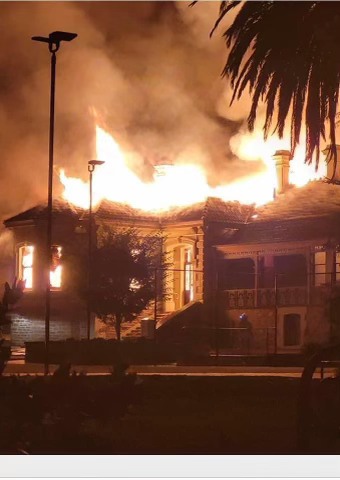
Kapunda High, our joyous, kindly school, is in the background watching approvingly, nodding in wise appreciation having stood witness to our teenage lives and then from both near and afar, our adulthood. A mere twelve months after this special occasion the beloved building, Eringa, was devoured by those diabolical flames and we impatiently await its reconstruction.
See the fluttering flower petals caught delicately in your curled, tumbling hair, as it cascades onto your dress: impossibly pretty, bold and deeply considered, the turquoise an exquisite, arresting hue.
With hands clasped, we’re hitched triumphantly, at ease and brightly expectant, stepping into our afternoon.
Word quickly escaped that a fire had ravaged our beloved Kapunda High on a Tuesday night in late March. It was awful and yet bought many together. As published in the local paper here’s my story.
*
On Wednesday there was a pilgrimage to Kapunda High School, and its centrepiece, the mansion known as Eringa. People stared and shook their heads and became teary at the sight of the burned ruins.
One former student said to me that, ‘it was like someone has died.’ Indeed, the stunning structure around which the school has grown is like a much-loved old friend and main character in the town’s story. We embrace it dearly.
In our Kapunda group-chat my cousin Froggy praised the school saying, ‘Its aura and rich history have played a big part in many people’s lives.’ We all agreed.
When I began Year 8 it had less than a couple hundred students but was always at the town’s heart. It seemed snug. Even as gawky teenagers I think we realised it was special and would shape our lives for the best.
It still does.
Not purpose-built as a school, it was the residence of Sir Sidney Kidman, his wife, and children, and just like a family home, remains a source of deep pride for Kapunda. We had classes in what were servants’ quarters, high-ceiling bedrooms, and grand reception rooms with stained glass windows. It was wonderfully unique.
Every year, the prefects ran a week of lunchtime fundraising activities. A key attraction was a ghost experience in the tunnels running under the mansion. Can you imagine this happening now? Nobody was spooked but there was mischief and laughter in the darkness, and we’d emerge caked in thick dust and blinking at the sun, ready for more mayhem with Bunsen burners or hockey sticks.
My wife and I met in Year 8 and were only ever going to be married at our beloved school. The affection we hold for it, and the teachers and students with whom we shared the beautiful building and grounds meant we had to return to where it all began for us.
Our choice of wedding venue surprised some city guests who’d not ever visited Kapunda but then saw it’s no drab school. It’s a welcoming estate flanked by Moreton Bay Figs, rose gardens and a fetching sweep of lawn.
On our day last April, the setting was moving and picturesque, and this made Tuesday’s fire more devastating.
For those like me who moved away, a trip home always meant a slow lap of the town. You’d ease past the duck pond, Dutton Park (home of the Bombers), the Prince of Wales pub (there might be a car you recognise out the front) and Gundry’s Hill.
But you’d also drive to the high school, pause by the fence and smile at the view. I’m not sure other towns can make this claim. Even for those who went there our school is a tourist attraction.
Driving up late Wednesday afternoon, we wanted not to merely witness the awful smouldering ruins, but to see friends and to grieve. This was never only about the building.
At the school we saw our treasured history teacher Paul McCarthy and his wife Kerry. There were handshakes and hugs. These were precisely the people we needed to see.
Later in the pub local icon Tolly remarked that it was, ‘like a wake.’ How terrible that Eringa, the showpiece of not only the school, but Kapunda itself, has suffered this? But those who’d come and congregated weren’t really at a wake. There’s already a rugged resolve that this dreadful event not be a final chapter. Following the equally devastating fire of 1902, Sidney and Isabel Kidman rebuilt their home.
For the thousands touched by Kapunda High, we’re hopeful that this happier side of history can be repeated.



 mickeytales