Happy birthday! I thought it a fine moment to pause and raise a glass (West End if available) to a few tremendous memories from the vault…
Let’s begin with the ongoing tradition of our SANFL Grand Final texts in the case of Sturt or Glenelg winning. You had the upper hand in 2016 and 2017; I had a turn in 2019, then received a text in 2023 and 2024. Surely one of us gets a message this year. Watch out!
*
I still think back to those Adelaide Oval Test matches of our youth. We loved the cricket, of course, but also the economy of the cheap kid’s ticket. More cash for beers. I can see us now at the Victor Richardson Gates — me first, just 17, sliding through. Then Davo. Taller. He’s waved in too. Chrisso, taller again, gets the nod after a suspicious squint from the bloke on the gate. But then comes you, all six-foot-five of you, last in the queue. The old guy takes your ticket, peers up, irritated, and says, ‘Are you sure you’re all under sixteen?’ Davo doesn’t miss a beat: ‘Yeah, we’re from the country. Breed ’em big out there.’
We all then galloped straight to the hill and set up shop just in front of the Duck Pond. We heard the whistling of stems being pulled from empty kegs. Shortly after one of us came back with a plastic cup holder bursting with beers, slopping West End Draught onto the sloping lawns.
*
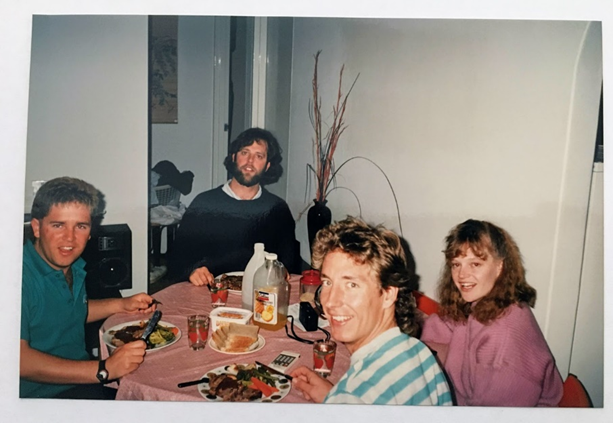
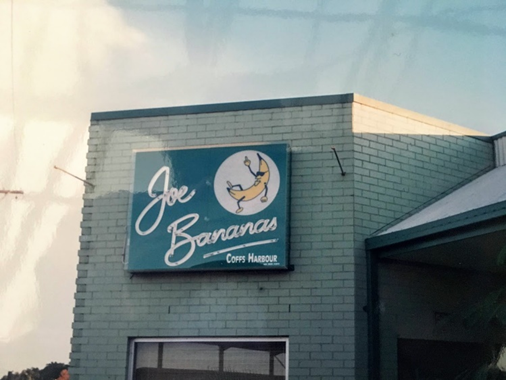
A highlight was most certainly the trip Chrisso, and I made to Coffs Harbour in July of 1990 to visit you and Michelle. We had a great week. I recall Mutton Bird Island, Par 3 golf in Coffs, the cocktail party with your footy club friends, going to the Sawtell RSL and Joe Bananas for dinner, lots of fun along the way and — of course — the triumphant meat tray at a local pub.
Good people, good weather, and that ancient stubby holder still tells the tale!
*
A less successful expedition was the 1982 Lutheran Youth trip to Naracoorte with Stephen in the Gem. Ending up in a ditch and travelling home by train! Found sanctuary on the Fanks farm. In between was a theological and beery blur. But we survived — just.
*
Then there was Melbourne in 2017 — you, me, the Hayward brothers, Lukey and Nick. Listening to Phil Carmen at the North Fitzroy Arms. He was truly compelling. It was a great event and as people say, you know it’s a big day when you get to the pub at noon and next thing, you’re ordering dinner there too before zipping into Young and Jackson’s for a midnight nightcap. Collingwood and Port the next day! Free bird seed. A funny weekend.
*
It was also terrific to be part of two Senior Colts cricket premierships. Fergy our coach. Tanunda and Angaston Ovals. I had a stint at silly mid-on when you charged in. No helmets in those days — and no shortage of courage. Both the Tanunda batsman and I in danger of fouling our whites. Especially when he defended one of your short balls using only his (four-cornered) head. I was sure it’d come straight off his double scoop Gray Nicolls.
*
But it wasn’t all bouncers and meat raffles. That you and Michelle asked Chrisso and I to act as ushers at your wedding ceremony in Hamilton remains an utter honour. The Yalumba reception was also excellent!
Thanks for all this, Rod — the cricket, the laughs, the travel, the stories we can now retell like old blokes at a reunion. Hang on! Enjoy your extended birthday celebrations. Well played!
You wear an elegant, off-the-shoulder sequined dress—sparkling, even in monochrome. In your left hand is a small bouquet of white roses. Your right hand rests gently on mine.
We are gazing at each other with affection, both smiling softly—it’s a candid and heartfelt demonstration of connection.
The setting is outdoors, beside Kapunda’s duck pond. In the background gum trees contemplate while the island’s soft, weeping branches add to the serene, almost dreamlike atmosphere. Late afternoon light filtering through bathes everything in tranquil reverence.
As kids, how many times had you and I walked, rode or driven here? It was always evocative but I dared not imagine it as a setting for such a photograph.
You exude warmth, elegance, and joy. Even in the black-and-white image, you are catching the autumnal light. Your hair is styled in soft waves, loosely pinned back with a natural, graceful finish that frames your face with an artful, effortless beauty. As you look up at me, beside you, you have a luminous smile and your expression is one of affection and contentment. Your face, as well-known to me as my own thoughts, is wholly familiar but somehow brand-new.
With this, my world is remade.
Your posture—relaxed, leaning slightly into our embrace—conveys ease and deep correlation to this instant. The sparkle of the dress, paired with the tenderness in your eyes, contributes an almost cinematic glow. There’s an attractive balance of glamour and surrender in your appearance, making the scene striking.
We had a timeless and profound minute—the photo’s composition accentuates love and natural beauty.
Your face is turned slightly toward me, and you’re looking with a warm, affectionate smile. There’s a calm confidence in your gaze—you look truly content and immersed. You are muse and memory, myth and moment.
For this moment, my life had been a faltering, often uncertain rehearsal.
On this day of orchestration and meticulous planning and staging it is an improvised tableau. A reverential moment at a childhood location. Late afternoon you and I drove past and were drawn to this poignant place. An intermezzo between the ceremony and the reception. It is a place that catches the magical narrative of our wedding.
And here, in this quiet place, is where the light found us.
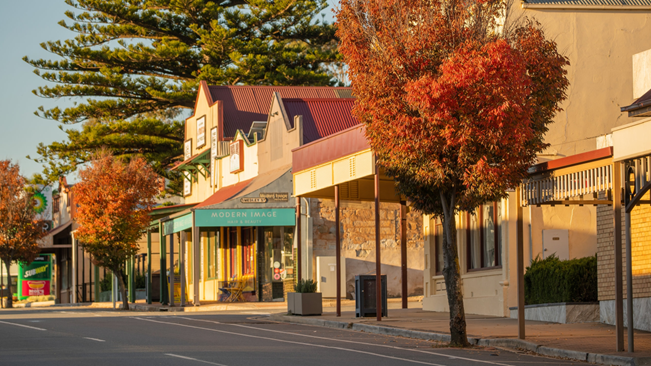
Gundry’s Hill is the natural place for it to commence with its views across our undulating town. There’s St Roses’ spire, a patchwork of roofs, and the silos standing quietly down near the road to Freeling. The vista is smeared green from the trees lining Clare Road, Mildred Street, and Hill Street which is home to the ancient playground and its old black steam train.
We’re now above Dutton Park and its fetching oval protected by those silent eucalypts. If we listen carefully, we can hear the Mickans chuckling and telling stories. It’s a short flight then to the Duck Pond and if it’s a weekend evening there might be half a dozen cars parked haphazardly on the southern bank, near Dermody Petroleum. There are teenagers draped all across the lawns. My friends. From the tape deck of a car, possibly a Gemini or a Kingswood, you hear this soulful song
Karma, karma, karma, karma, karma chameleon You come and go You come and go Loving would be easy if your colours were like my dreams Red, gold, and green Red, gold, and green
We then zip over to the swimming pool. On this hot afternoon we see dotted on the grass untidy groups of kids. Zoom in and they’re munching on Bush Biscuits or a Zooper Dooper before running to the diving board. From this they leap off aiming desperately and adolescently at the canteen, run long-sufferingly by Mrs. Chappell. They try to splash her by doing a storkie, arsey or a coffin. They’re tiresome but determined. The supervisor—an elderly Englishman—yells to the skinny boys, ‘Pack it in!’ They ignore him but he yells again. ‘Pack it in or you’ll have a rest for five minutes!’
A short journey and we pause over the Pizza Bar on the Main Street. Johnny Guzzo is the boss. Again, inside there’s some of the town’s youth and they’re huddled about the Formica tables. Some spill onto the footpath, weighted by black duffle coats and ripple boots. With P plates blutacked to their windows, assorted cars lined up outside. There’s a knot of motorbikes too.
Inside by the windows and next to the pinball machines, a mate’s trying for his best ever score on Frogger. He’s trying to cross the river on logs and—be careful—skip over on the backs of hopefully drowsy crocodiles. But he gets munched and the game’s over. He thumps the glass top of the arcade machine. Johnny’s throwing pizza dough up into ever widening circles and hears the racket. ‘Hey! Do that again and I kicka you out!’
It’s 1983 and for one group of kids, they’re in year 12. Seventeen is an age when much happens but you’re no longer a child and not yet an adult. It’s a fraught, fantastic time. Let’s zoom in and see who they are.
*
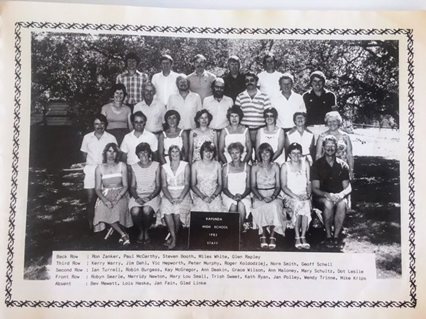
Here’s Kapunda High’s class of 1983. There’s only thirteen of us although this was boosted by the subsequent return of one Paul Masters, and arrival of Eriko, our Japanese exchange student. Then, of course, most of the fifty-odd who began with us in year 8 had left school for a job. Year 12 was matriculation which meant qualifying for university. It an innocent and wonderous time.
This photo was taken on the croquet lawn at the front of the school. I never saw any croquet but sitting on its grass under the autumn sun was calming and peaceable. And it’s such a picturesque setting that a few short decades later it was where the girl fourth from the left and I would be married. No other location presented itself.
There were only fifteen of us, but I thought us an unruly collective. All day long we laughed and yelled and interrupted each other. Thirty years on, talking in the footy club with Macca—our beloved History teacher Paul McCarthy—he told me we were, ‘bright and well-behaved. A really great group.’ In 1983 I sat in a corner next to Chrisso and Davo and we did much together.
Claire and Trish and I had long enjoyed our triangular friendship, and this continued. There were a couple of classmates with whom I barely exchanged words. I didn’t dislike them; we just had little in common and I hope they’re happy and well.
*
Our matric centre was at the front of the school just near the croquet lawn. It was down the cement steps and in Kidman’s bequeathed mansion, Eringa, it had been a servant’s bedroom. A tiny room, it could only fit ten or a dozen of us around the little student tables.
A blackboard hung to the side and an old gas heater sat above the mantle and we’d use it to toast sandwiches until we weren’t permitted. A corridor ran around two of the walls and our individual carrells were lined up there. How lucky that we had our own private desks? Much of our year was spent at these.
In that little classroom we’d conversations which influenced us. Mrs. Schultz, our gentle and wise English teacher, chaperoned us through The Grapes of Wrath with the Joads as they made their emblematic and weighty way from Oklahoma to California through the Mojave Desert.
I recall my terror as she and Trish talked at length about the novel’s symbolism, focusing upon the turtle crossing a highway and how it represented struggle, determination, and hope. Committed to making my own life difficult, I read many Steinbeck novels over the summer and loved them. But, of course, I didn’t finish the compulsory Grapes of Wrath, and generally only saw the turtle as a turtle.
Our Australian History teacher, Mr. Krips, escorted us through a study of our national identity and the apotheosis of the nomad tribe. I’d not encountered the word apotheosis before. It wasn’t used on the cricket, even by Richie Benaud or by Graham Kennedy on Blankety Blanks. It impressed me and I vowed to keep it in my vocabulary as I thought it could have future value. I swiftly forgot it.
Of equal value was the extra-curricular stuff we learnt from our teachers. The girl fourth from the left and Trish always had enthusiasm for curating our experiences and so set up communal diaries in big scrap books. Quickly becoming known as the Crap Books, these enjoyed daily entries, with some contributing more than others. Occasionally Kripsy did too. How great was he? Early in the year he noted the discovery of a musical gem.
Last night I saw Marvin Gaye on TV singing, ‘Sexual Healing’ which was terrific. What a voice! What a performance!
It is a great tune and now when I hear it I instantly think of Kripsy and that tiny, windowless classroom. I hear it with fondness for my classmates and teachers and that fleeting, singular time and place.
Get up, get up, get up, get up Wake up, wake up, wake up, wake up
Oh, baby now let’s get down tonight!
*
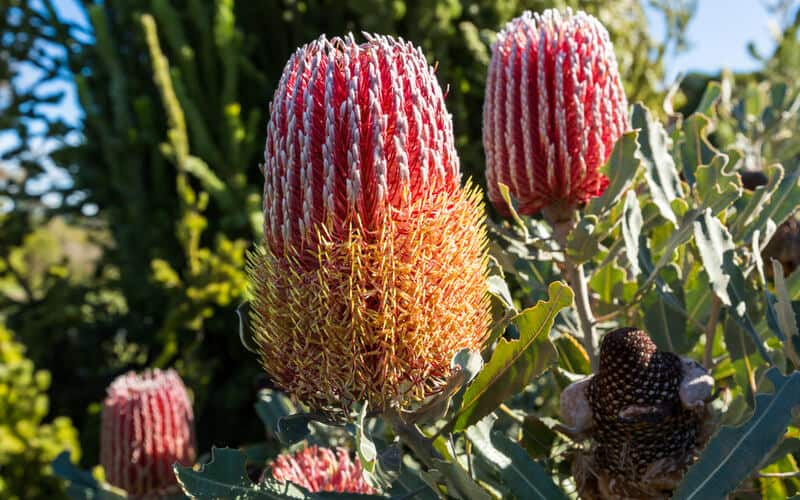
The Coorong is a distance from Kapunda, south of the mouth of the Murray. Until our matric year, school camps had been breezy and amusing affairs. More like holidays than educational experiences. As we had to study both a science and a humanities subject, I found myself in Biology and had to undertake a special personal project. For reasons which over time have only become more bleakly absurd, I was about to immerse myself in the heady, sparkling world of Banksias.
Yes, my teenaged fantasies were all becoming real. I would undertake a vegetation transect. It’s not, however, as glamorous as it sounds.
We stayed in rustic accommodation with Mr. Zanker and Miss Searle. Curiously, I would work with Mr. Zanker decades later at Marryatville High where I taught his daughter in year 12. In 1983, there were about eight of us in Biology and we drove down on Sunday. I recollect none of the journey.
It was cold and grey but one night by a shared metal sink I had a novel experience. One of my classmates, the girl fourth from the left, leant towards me, giggling, and announced, ‘Hey you. Listen to this!’ A brief subterranean rumble followed. We both collapsed into laughter. It was the first time I’d heard a girl fart.
This remains the clear highlight of that camp.
Monday morning was grim and wretched, and it began to rain. I was utterly alone in the middle of a forest of banksias. My task was to measure all sorts of variables like tree height, number of banksia flowers, distance between trees, and other things too hideously dull to itemise for you now.
Until then I think I was a kid who just got on with stuff. But this was new for it was an obligation in which I had zero interest. It was a necessity and there was no escape. I sat on the wet ground and my bum became damp. Three more days of this! I reckon it was the first time in my life I was truly bored. Even now I twitch if I see a Banksia. They’re for life, not just the Coorong.
It gave me a glimpse into the dark world of adulthood responsibility. I didn’t like it.
We’re doing a lap of Kapunda because it’s probably illegal to come home and not.
So, Lukey and I drive up to Gundry’s Hill. We’ll then swing by the Prince of Wales for a brisk beer before heading to the footy.
We hop out and wander around the grassy knoll. The sky is cloudless, and the rolling hills and crops are a reassuring green.
Glancing about I wonder does everywhere look better from a bird’s eye? Does it always provide a heavenly view? Ascending, do our earthly imperfections vanish?
What happened as we grew up in our town, nestled in that mundane, enchanted valley? Everything and nothing. It was hot and dusty, and cold and muddy. Can you be atop even the smallest hill and not become philosophical? Is private awe guaranteed?
Seeing the whole helps me remember the grainy episodes and to time-travel. I locate the spire of St Roses Catholic Church and it’s midnight mass and I’m an altar boy with lads who, for Father Moore, didn’t always behave like altar boys.
My eye finds the tiny primary school oval. I remember lunchtimes and my classmate Grant Dodman kicking what eleven-year-old me regarded as impossibly prodigious torpedo punts.
What do those from flat towns like Freeling do? How do they access a dreamy perspective?
With this elevated silence on Gundry’s Hill comes warming gratitude. I again gaze out across this modest, little town.
It becomes gentler and postcard-pretty.
*
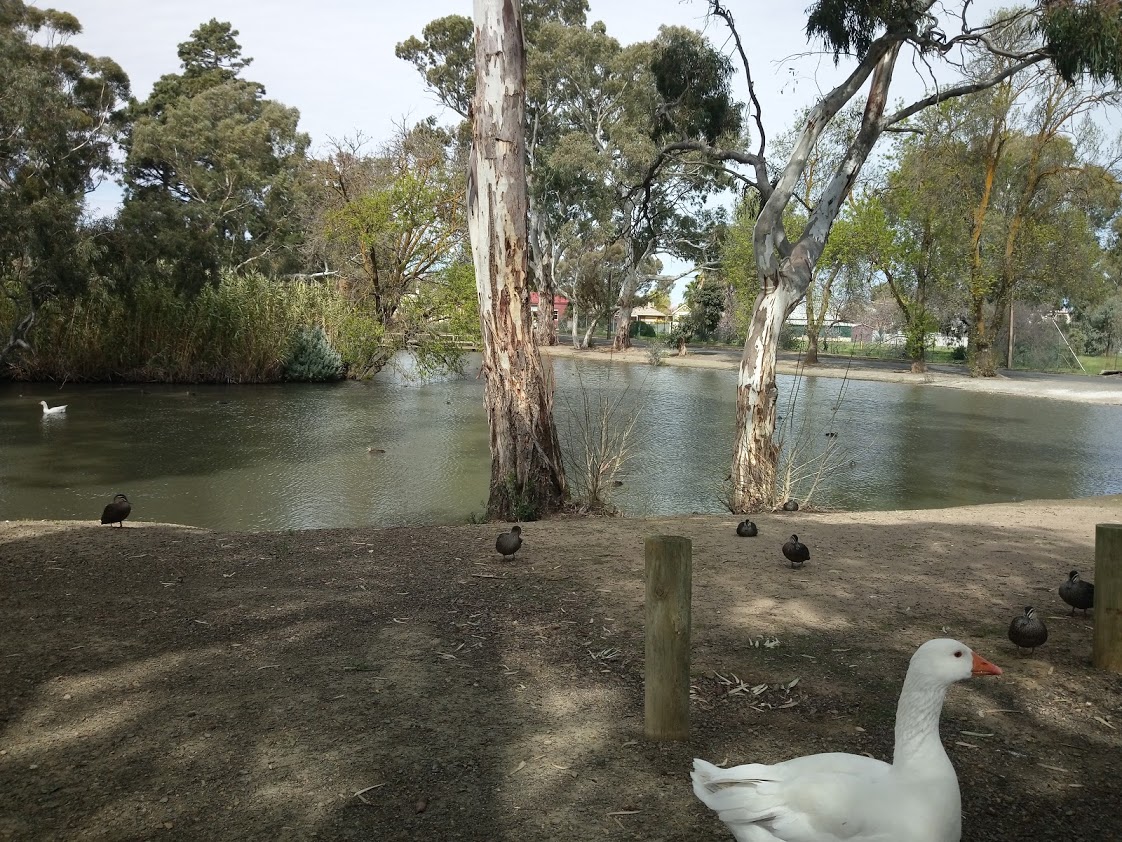
Between the four pubs of the main street and the oval sits the Duck Pond. Although we knew the family well, nobody I know uses the official name, Davidson Reserve.
This ornamental lake was witness to youthful distraction. As with any locality on a map the geographical value is in the personal narratives.
Undertaking our compulsory tour of our hometown’s landmarks, Lukey and I pause and ponder by the water.
It’s suddenly our teenaged 1980’s.
I remember the cars we owned and can see them clustered conspiratorially by the Duck Pond. There’s Trisha’s Hillman Imp, all English and apologetic. Woodsy’s 180B in which one summer we did two ridiculous laps of Bathurst. My wife Claire’s (sadly our nuptials were a way off) little red and white mini, like an extra from Carnaby Street, London. There’s Lukey’s Alfa Romeo which aside from the then new Chinese restaurant in Nuriootpa, was the most exotic thing I knew.
The Saturday night vista is completed by a crowded used car lot of white HQ Holdens.
If I shut my eyes Stephen Trotta’s green Gemini has all the windows down and the Pioneer stereo volume up. A TDK C-90 cassette is playing. ‘US Forces’ by Midnight Oil blasts across the dark water and then we hear Mondo Rock’s moodily suggestive, ‘Come Said the Boy.’
As Dickens wrote, it was the best of times.
*
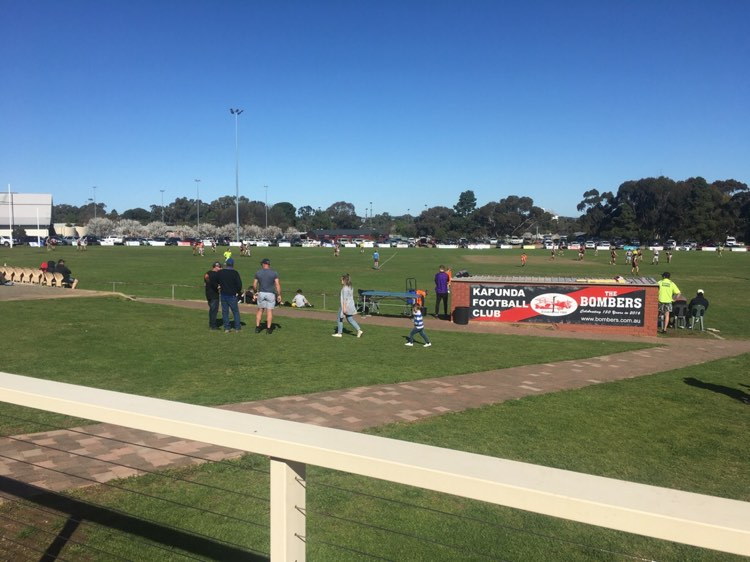
It’s a glorious late-winter’s day beneath the eucalypts at Dutton Park as the B grade footy concludes.
We’re here to see old friends and recount some well-worn tales. Woodsy, Keggy, Hollis, O’s. Fats and Chipper had called into Puffa’s. Whitey’s elsewhere.
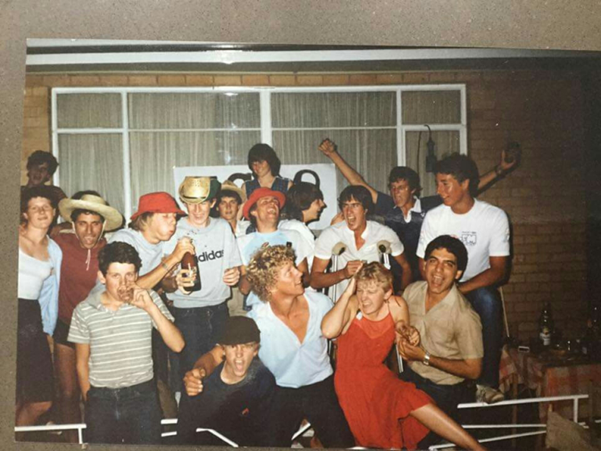
Knots of timeworn faces huddle in front of the changerooms on the new wooden deck. Orange bunting separates us from the reunions of the 1973 B grade (Dad’s a member but can’t be here today) and Senior Colts premiers.
There’s something poetic about the equine term ‘colts’ for footy teams that’s much better than the numerical Under 17’s or Under 14’s. Looking over at the often less than sprightly reunionists someone says, ‘That’ll be us soon boys.’
There are folks I’ve not seen for decades like Kelpie Jarman and Peter Masters but the years melt away because we all lived in the same town.
I see three of the Mickan brothers in Goose, Drew, and Richie and have a quick chat with Macca. There’s much handshaking. By the canteen I bump into Fergy. In the morning he’s again off to Arkaroola and we share our experiences. Claire and I went there and to Hawker and Rawnsley Park on our honeymoon.
Early in the A grade Kapunda leads with three goals to two but then by quarter time it’s 13 majors to Angaston and not nearly enough for the Bombers. Nobody seems to mind for the air’s awash with nostalgia.
The first job, as always, when we congregate, is to organise the next event, so arrangements are made to visit Christmas Higgins’ brewery in Greenock. Before Christmas, of course.
I later learn that Morphettville race 9 is won by number 4. A seven-year-old bay gelding, its name is Angaston. And their team salutes too. By 25 goals.
But on the footy club deck it’s all chortles and familiar stories. Homecomings aren’t universally adored so I’m lucky to love these moments.
After the siren I drive south from this modest, little town.
Sleeping, dusty streets. Saturday afternoon like a still creek.
Kapunda.
Memories, rushed and gentle on every corner. Footy, cricket. Bikes.
A pasty each up by the high school lawns. Awash with grey Midford shirts. Roman sandals. Unfinished essays. The poetry of Gerard Manly Hopkins. Year 12 Biology and a vegetation transect on Banksias.
A cricket match shout from the oval. Share a beer and chat in the pub later with my cousin, Froggy. The captain. Rolled for bugger-all.
Visit our history teacher, Macca and his wife, Kerry. Discuss 1983 and everywhere since. Feel seventeen again.
Dinner around a big kitchen table with old friends, Woodsy and Sue. Happy collision of past, present and future. Not enough time to see others. Next time.
Sunday morning. Out to scan the golf club. Admire the lush fairways and nod at the greens which replaced the scrapes of my youth. Recall the handful of 21sts. White HQ Holdens lined up like butchers of West End. Hoodoo Gurus blasting into the cold night.
Drive back across the River Light bridge towards the city.
Back soon.
The footy club is a vast ark of memory. Always nice to see RW Randall on the board too.No visit to the Duck Pond is complete without seeing (but not eating) a local duck.Kapunda High School has a croquet lawn although some would prefer a croquette.In 1980 we slept at The Pines on a bush-walking camp. Today, for the first time we returned, together.Some call this a Pump House, but, of course, it’s The Turncock House. Don’t ask.As law-abiding citizens we know a visit to the Prince of Wales pub is compulsory.
Stephen’s harlequin green Gemini took us to Adelaide Oval one-day matches starring the Bruces (Laird and Yardley) and on other days to Kapunda’s Duck Pond lawn and memorably across the roo-infested plains preceding Blanchetown so we could rollick and crash at Crackshot’s family shack by the river.
It was a significant car. There was continuous music for we were teenagers with our windows down and the volume up.
We often played Donald Fagan’s The Nightfly.
The Gemini’s cassette player had a fast-forward feature that miraculously read the gaps in the tape and moved to the next song! If, say, a mixed tape was on, one moment we’d have track 3- perhaps a lesser tune from McCartney’s Tug of War, and then suddenly, track 4- probably “Smoke on the Water”- boomed from the Pioneer speakers (woofer, midrange and tweeter). I found it astonishing. How amazing would the future be?
My gateway to original music was Brendan. He’d moved to Kapunda from the Barossa and although the same age as us he was somehow older and viewed the tiresome planet through world-weary eyes.
In his darkened loungeroom I first heard Van Morrison’s Astral Weeks and Midnight Oil’s 10,9,8. In 1983 it was a centre of cool. He also introduced me to The Smiths, U2, and one evening to Donald Fagan, who I learned was half of Steely Dan.
Brendan had a Flock of Seagulls haircut before Flock of Seagulls existed.
“IGY (What A Beautiful World)” is The Nightfly’s opening song and first single, and my favourite ever tune referencing the International Geophysical Year (actually eighteen months in duration, going from July 1957 to December 1958) but it was “New Frontier” which grabbed me.
I’d like to declare that back then I was drawn to Fagen’s nostalgic depiction of young love in suburban America; that this energetic Bildungsroman or coming of age account spoke to me intensely; that the interplay between wide-eyed youth and our cynical selves was enticing.
But no, it was the cowbell.
When K-Tel ultimately releases 20 Cracking Cowbell Classics! with “Honky Tonk Woman” and “Drive My Car” among other percussive pearls I trust “New Frontier” will occupy a prominent (vinyl) place.
Concluding with a suitably slick, LA cool, instrumental guitar break, and with the Gemini hurtling down a country road I’d accompany the song on my own invisible cowbell (air cowbell remains my chief musical talent) and aim to stop wacking my invisible drumstick on my invisible idiophone hand percussion instrument when it suddenly yet predictably ceased on the cassette.
This synchronisation was tough but if I timed it right there’d be a nod from one of my fellow passengers like Chrisso or Claire or Trish. But not Stephen for he was driving. It’s still the pinnacle of my (invisible) musical career.
I can now see that I’m wistful about the lyrics which convey a wistfulness of their own. I guess scholars call this meta-wistfulness. It’s a song of innocence. It’s about being on the magical cusp of your future, when your world is opening up, and this is curious given that, for the geeky semi-autobiographical narrator the action- real and anticipated- takes place one weekend in the family’s nuclear bomb shelter.
Yes we’re gonna have a wingding
A summer smoker underground
It’s just a dugout that my dad built
In case the reds decide to push the button down
We’ve got provisions and lots of beer
The key word is survival on the new frontier
My last high school summer was punctuated by New Year’s Eve. It was the first time I stayed up all night. We were at Stephen’s in his absent parents’ loungeroom. Around 4am, with my hometown sinking to sleep and the music muted, a couple of us decided to aim for the dawn. It was a new frontier.
Beyond seeing that year’s first light, there was no other incentive. Standing on the concreted driveway we peered out over the chaff mills towards the unremarkable hills and I recall my exhilaration as the sun’s easterly rays filtered down to dusty, slumbering Kapunda.
Shortly after I fell asleep on the floor. Later, Boogly and Bongo and the others woke and soon music began – probably Australian Crawl’s Boys Light Up- from the imposing boom-box. Someone then made a cup of pineapple cordial.
Over my next twelve months there was footy and cricket; weekend work at the Esso service station; Year 12’s unforgettable anguish and ecstasy.
1983 was here, and The Nightfly would become part of the soundtrack.














 mickeytales