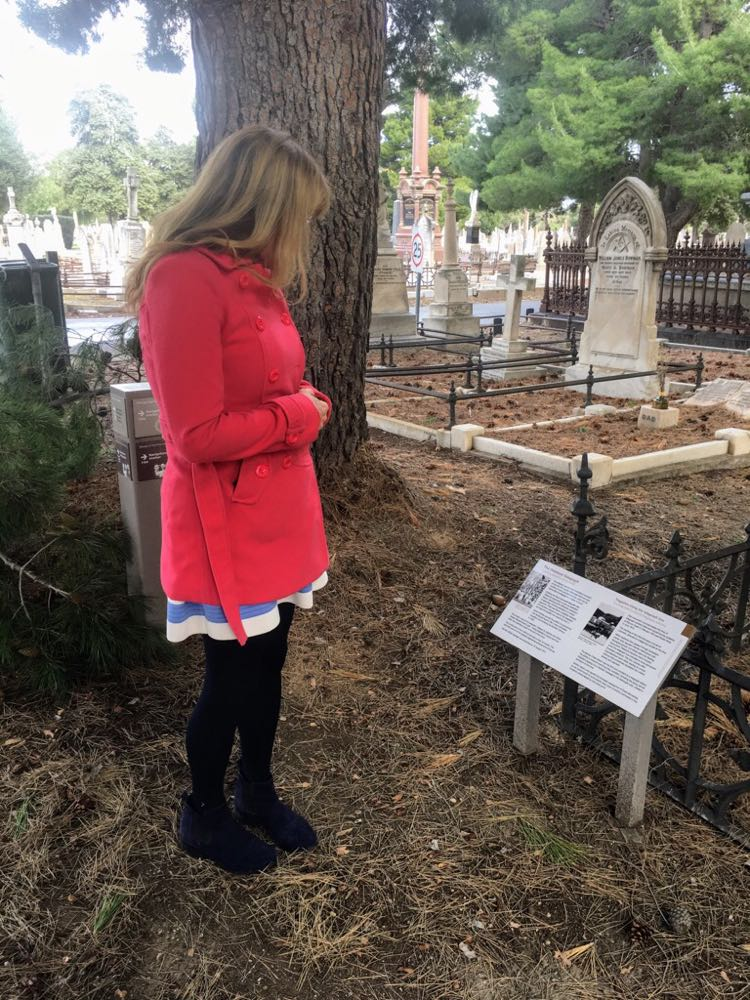
In her eternally breezy way Claire says, ‘The cemetery’s such an interesting place to go.’
She doesn’t know what’s about to happen and I feel a pocket-sized spasm of panic.
I veer into the left lane so we can go to the first destination of our Mystery Day. Feeling happy with my insightful planning, I’m taking us to the West Terrace cemetery, and Mystery Day works best when there’s an intact sense of mystery, which of course, is now entirely vanished given my wife’s casual, prophetic remark about her continuing curiosity surrounding graveyards.
I’ve never been to this cemetery and knowing Claire’s interest in the stories of everyday people we select a self-guided walking tour that points us toward headstones offering tragic and triumphant narratives.
I open the website on my phone and off we stroll.
How many of us are at our very best on Saturdays, just before lunch? Our afternoon stretches out with the enthralling promise of carefree hours as we make our way through the city and punctuate the day with conversations that leap joyously between our past, present, and future.
The cemetery sprawls in every direction so it truly is a necropolis. Pleasingly, we’re alone. A bustling memorial park serves nobody well.
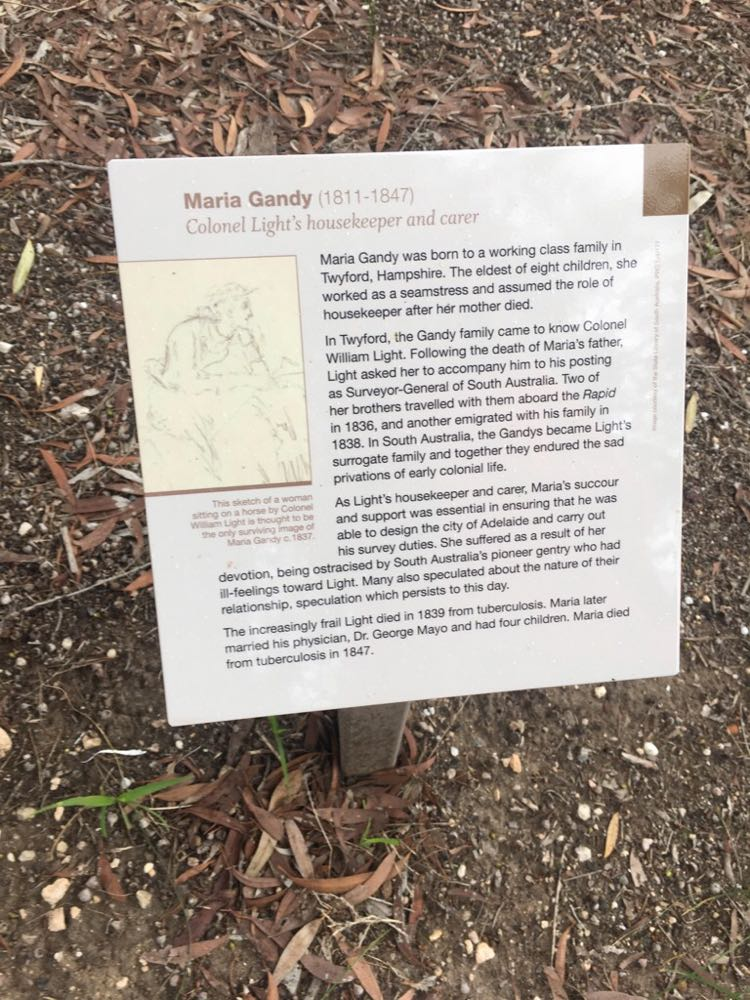
The digital map directs us to Road 2 Path 10 Site 26 West. It’s a modest grave for Maria Gandy. The plaque is informative. Born in Hampshire she became known to Colonel William Light. Claire and I then recall Year 12 Australian History at Kapunda High.
I’ve a vague notion. ‘Didn’t he spend time in prison? Remember Mr. Krips telling us about him?’
Claire nods as the rain begins. Has there ever been a film scene in a cemetery or a funeral and it doesn’t rain? ‘No, it wasn’t Colonel Light. It was someone else. Light surveyed the city. You’re thinking of the guy who had the idea for the colony of South Australia.’
This is why Claire achieved a perfect 100 in matric Australian History, and I didn’t.
I now have a belated flash. ‘That’s right. Wakefield. Edward Gibbon Wakefield.’
Maria Gandy accompanied Colonel Light to Adelaide, became his housekeeper and carer and, according to the day’s idle talk, much more than this. After Light’s death she married his physician George Mayo and had four children with him before tuberculosis claimed her. She was thirty-six.
There we were beneath the swirling July rain nattering about South Australia’s colonial past and our high school days right in the heart of our warm and incasing present. Cemeteries also quietly guide our gratitude and sharpen our sense of the fragile now. There were narratives all around, but mostly I thought of ours.
I’ve nearly finished reading Be Mine, the final release in my favourite series, the Frank Bascombe novels by Richard Ford. The storyteller takes his dying son on a sad, harrowing, and strangely humorous road trip to Mt. Rushmore and mindful of life’s delicacy, more than once mentions how, ‘there is no was, there is only is.’
*
Scurrying back through the drizzle to the car Claire suddenly announces, ‘Look.’ She then gives a happy sigh. We stop.
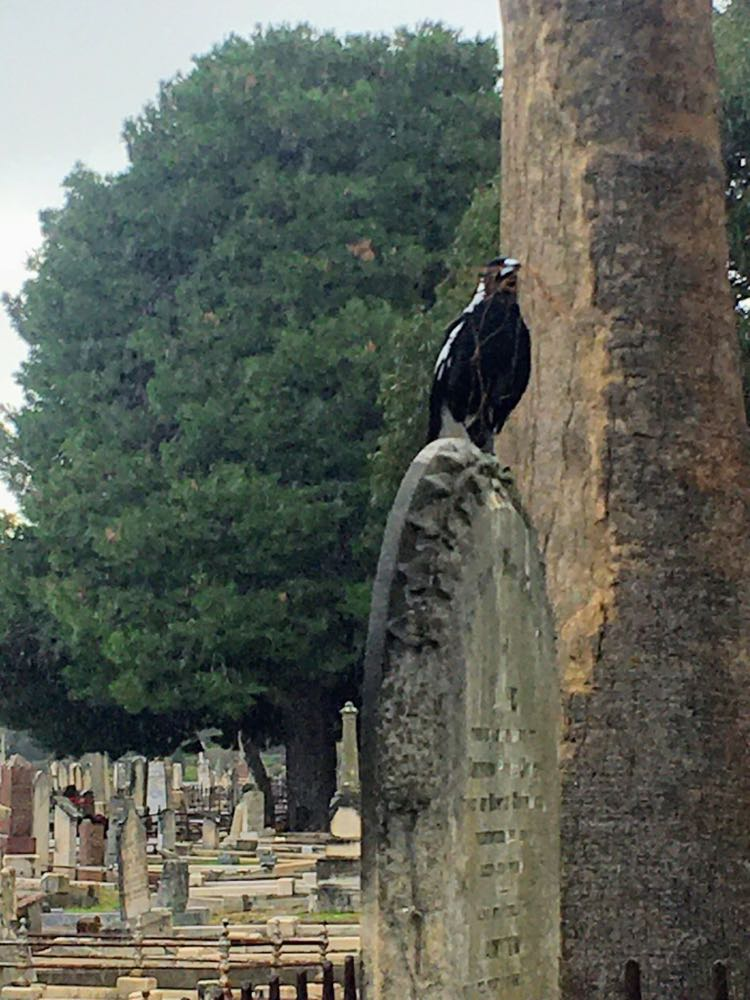
On top of a grey headstone is Claire’s favourite bird, a magpie. From its mouth hangs a clump of twiggy, leafy matter. He’s proud to show us his familial efforts. He’s building a nest.
And so, in this vast acreage dedicated to the city’s dead we see a sign of eager, irrepressible life and nature’s renewal. Holding hands, we walk on, and the rain slows.


 mickeytales